
Turning youth into island stewards
Teacher Ervie Ann C. Conte was honored at the 4th Philippine Resilience Awards for promoting environmental conservation, literacy, nutrition and sustainable livelihood in Siargao’s last-mile island communities.
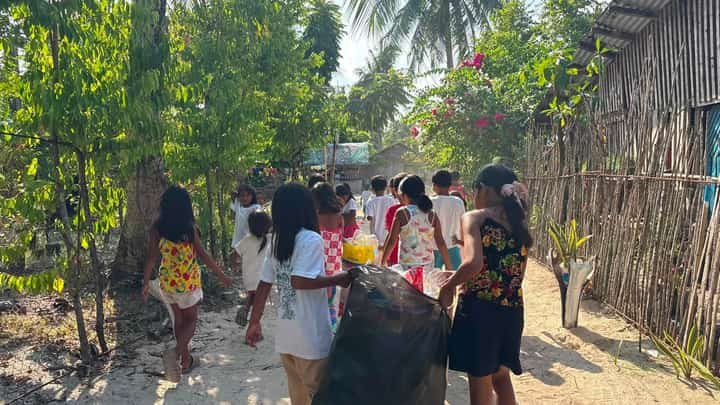
The small island of Anajawan lies just over an hour by boat from Siargao’s main island and is part of General Luna, Surigao del Norte. It is a quiet, sea-bound village of roughly 477 to 600 residents, known for clear waters and squid fishing. There are no cars or motorbikes. Households relied on generators or solar power rather than a continuous electricity supply.
Local teacher Ervie Ann C. Conte started a youth-led initiative called Project Paglajag that teaches children to take care of the island. An initial activity was the weekly shoreline cleanup to tackle plastic pollution, coastal erosion and environmental degradation.
She also conducted storytelling, workshops on recycling and art, and leadership training. Discarded plastics were turned into reusable materials, giving young people a tangible way to see waste become a resource.
Conte gradually expanded the project to address limited electricity, malnutrition and uneven access to quality education. Anajawan became part of the Solar Community-Based Island Tourism and Livelihood Energizer Platform (SMILE), a project led by WWF-Philippines with support from the European Union. SMILE aimed to provide 24-hour renewable-energy access to four remote island communities, including Anajawan, while creating livelihood and eco-tourism opportunities.
Before the project, electricity on the islands was constrained by fossil-fuel generators, often limited to a few hours daily. SMILE’s solar electrification was designed to replace the noise, smoke, and expense of diesel generators with cleaner, more reliable power for around 500 households across the participating communities. It also helped her make learning, environmental work, and youth activities more sustainable on an island that had long been off-grid.
Resilience award
Paglajag’s most important achievement may be its people. Former young participants have gone on to become instructors, local entrepreneurs, and role models for the next generation in northern Siargao.
On 29 October, Conte and Paglajag were honored at the 4th Philippine Resilience Awards (PRA) for promoting environmental conservation, literacy, nutrition and sustainable livelihood in Siargao’s last-mile island communities. For Conte, the lesson is simple: when young islanders are trusted to protect their home, they do not merely inherit their community’s future — they help build it.
Aside from Conte, the 4th PRA 2026 awarded other women and youth climate leaders for their exceptional work in strengthening community climate resilience.
James Nathaniel Refugio, founder of Bicolano Young Leaders Initiatives, was recognized for the Bicolano Young Leaders Program, which equips young people with leadership skills and practical tools for climate action, environmental protection and disaster resilience.
Deborah C. Dacanay, head of the Quezon City Persons with Disability Affairs Office, was recognized for advancing disability-inclusive disaster preparedness and climate resilience through inclusive planning and sustainable livelihood initiatives.
Dr. Angelina P. Galang of Green Convergence for Safe Food, Healthy Environment and Sustainable Economy was honored for Ako ang Bukas, an initiative that promotes ecological sustainability and climate awareness.
Marife M. Mustacisa of Samar State University was recognized for LETs CARE–AGHAM, which strengthens climate-resilient agriculture, fisheries, food security, and livelihoods in vulnerable coastal communities.
Rebecca A. Ynares, former governor of Rizal, was honored for the YES Program, a provincial initiative that integrates environmental management, waste reduction, greening, and disaster risk reduction.
Mylene A. Rivera of the Department of Human Settlements and Urban Development was recognized for the PLANADO Program, which advances risk-informed land use planning and climate-resilient settlements through digital tools and improved local governance.
“The Philippine Resilience Awards matters because it recognizes people who make resilience practical in their communities. Our role as convenors is to listen, learn, and build stronger ways to connect their experiences with the support their communities need,” CCC vce chairperson and executive director Robert E.A. Borje said.
The resilience champions, CCC Commissioner Rachel Anne S. Herrera said, are “people who chose to confront the challenges before them and build solutions.”
“In a world rapidly being reshaped by climate change, these are the stories we need to remember,” she said.
Initiated by Senator Loren Legarda, the PRA is a multi-stakeholder program of the CCC in collaboration with the Philippine Commission on Women, National Resilience Council, SM Prime, Women’s International Network on Disaster Risk Reduction and ARISE Philippines. All awardees will receive continued support to expand and strengthen their resilience initiatives nationwide.