
Quezon City increases total solar capacity by 73% in less than two years - ICSC
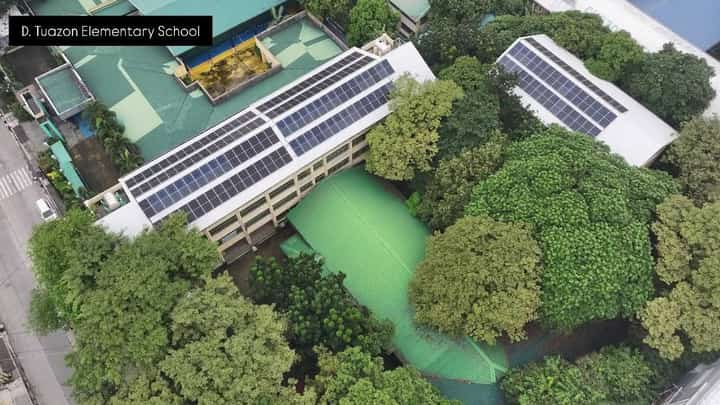
Solar-powered D. Tuazon Elementary School in Quezon City. The city government has expanded its solarization program in schools, with 21 public schools equipped with solar power as of 25 July 2026.
Photo Courtesy of QC Mayor Joy Belmonte
A 73-percent increase has been recorded in the estimated total solar capacity in Quezon City in less than two years, a Philippine-based non-governmental organization focused on climate and energy said Thursday.
The Institute for Climate and Sustainable Cities (ICSC) cited updated data from its Solar Power Estimation of Capacities and Tracking Using Machine Learning (SPECTRUM) platform, revealing a nearly twofold increase in the estimated total capacity of detected solar installations in Quezon City.
From approximately 33.85 megawatts (MW) based on 2023–2024 data, the city's estimated total solar capacity reached 58.55 MW in 2026, representing a 73-percent increase in less than two years.
“More than 95% of the present total capacity emanates from roof-mounted solar systems at 55.88 MW. These installations could generate more than 78 gigawatt-hours (GWh) of electricity annually, equivalent to at least 1.35% of the city's total electricity consumption in 2025," the ICSC said.
The NGO said the increase in solar capacity may be attributed, in part, to Quezon City's expanded solarization program and parallel initiatives by the private sector.
The ICSC noted that the city government initially installed solar panels on several buildings within its compound before expanding the program to public schools and city-owned hospitals.
“Solar installations in major commercial establishments, including SM, Ayala, and Robinson malls, have also contributed to the city's increased solar capacity,” it stated.
The ICSC said the city's expanding rooftop solar adoption amid a strong El Niño and continuing concerns on electricity underscores the potential of urban areas to generate own electricity and opportunity to extend its benefits to more households and communities.
Installed rooftop solar capacity by panel class
The ICSC said Quezon City has also institutionalized renewable energy and energy efficiency measures through its 2025 Green Building Code, which sets green building requirements for buildings and infrastructure, including those undergoing construction or renovation.
However, the NGO said rooftop solar adoption remains below 1% despite the 73-percent increase in estimated solar capacity.
“This points to the need to expand access, particularly among households, socialized housing communities, micro, small, and medium-sized enterprises (MSMEs), and other institutional and public establishments,” the ICSC pointed out.
Quezon City has a maximum rooftop solar potential of 4,916 MW, according to estimates from the ICSC's SPECTRUM platform, indicating substantial room for expanding installations across residential, commercial, and institutional sectors.
ICSC Senior Advisor on Energy Literacy and Energy Democracy Monalisa Dimalanta said the growing solar capacity in Quezon City demonstrates the “game-changing” role of rooftop solar in meeting the electricity needs of urban communities.
“While adoption accelerates, the challenge now is to ensure that this growth is enjoyed by a wider base of consumers, particularly households and small businesses that cannot easily shoulder the upfront cost of installation,” she said.
Dimalanta noted the need to expand access to affordable financing and streamline permitting processes to extend the benefits of rooftop solar to more households and businesses.