
Northern Luzon advocates push stronger civic role in human rights protection
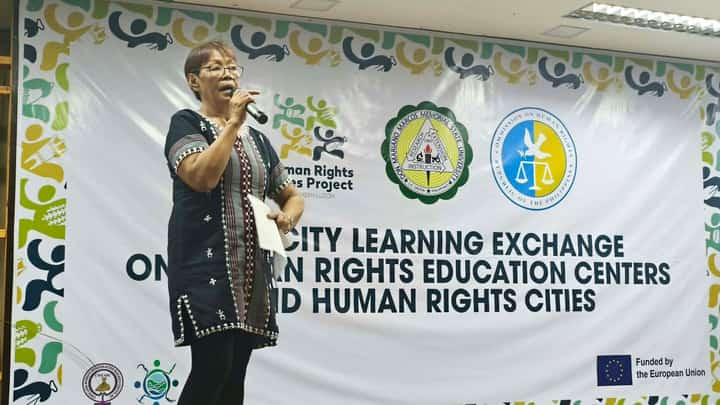
BACNOTAN, La Union — Stronger community participation, civil society engagement and accountable local governance are needed to establish Human Rights Cities in Northern Luzon, advocates said Thursday.
Rhoda Dalang, project manager of the Human Rights Cities Project Northern Luzon, said passing local ordinances alone would not guarantee meaningful human rights protection without sustained public involvement.
Dalang presented the findings of nearly two years of project implementation in Baguio, Tabuk, Santiago and San Fernando during the second day of the Second Inter-City Learning Exchange at the Don Mariano Marcos Memorial State University (DMMMSU) International Convention Center on 12 November 2026.
She identified persistent challenges, including distrust between government authorities and human rights advocates, limited capacity among civil society organizations (CSOs) to influence policy and public misconceptions associating human rights advocacy exclusively with leftist groups.
Harassment, intimidation, fabricated charges and red-tagging also continue to discourage public participation, she said.
In Baguio City, Dalang cited the passage of City Ordinance No. 78-2024, or the Human Rights Defenders Ordinance, in late 2024 and its implementation in January 2025 as a significant development.
She said red-tagging on official social media pages of the Philippine National Police and local government offices had stopped following the ordinance's implementation, although anonymous accounts continued such activities.
Baguio also allocated P600,000 for human rights activities in 2026 and P5 million through the Department of Education for the development of learning modules.
Progress has been uneven in other participating cities.
In Tabuk City, Kalinga, a proposed ordinance establishing the Kalinga Human Rights Action Center passed the legislative council but had yet to secure executive approval.
Dalang said the situation underscored the importance of engaging both the legislative and executive branches of local government.
In Santiago City, Isabela, fear among community organizations continued to hamper civic participation.
Meanwhile, in San Fernando City, La Union, government and civil society initiatives have largely operated independently, although cooperation between the Commission on Human Rights and the Office of the United Nations High Commissioner for Human Rights has produced encouraging results.
Fisherfolk from 14 coastal barangays have also organized to assert their municipal fishing rights against commercial fishing vessels following a recent Supreme Court ruling.
Educational institutions have joined the effort, with DMMMSU expanding its role as a Center for Human Rights Education and Union Christian College establishing a human rights library section.
Dalang urged CSOs to strengthen their research, documentation and coalition-building capabilities to participate more effectively in local policymaking.
She also called on educational institutions to incorporate universal human rights standards into their curricula.
Local governments, she said, must recognize residents as rights-holders rather than passive recipients of government assistance and ensure that policies translate into concrete protection and meaningful public participation.
The Second Inter-City Learning Exchange brings together local officials, educators, students and advocates to promote rights-based governance across Northern Luzon.
The gathering is part of a three-year project funded by the European Union and implemented by the Cordillera Women's Education Action and Research Center, Katinnulong Daguiti Umili ti Amianan Inc. and the Cordilleran Youth Center.