
Great Wall of the Philippines
There is nothing shameful about acknowledging that millions of Filipinos still struggle to afford decent housing or earn a sustainable living.
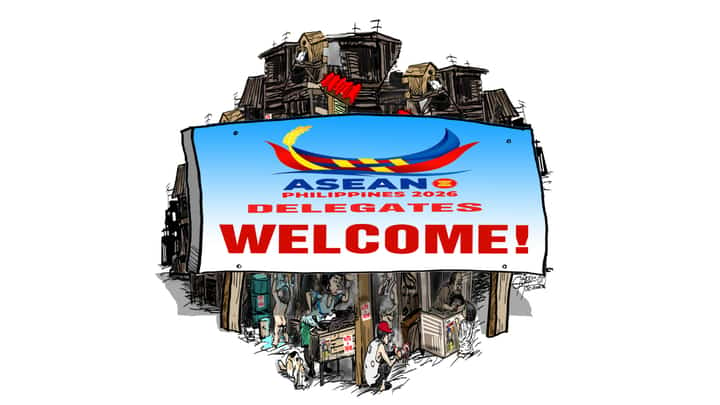
Just days before the Philippines welcomes world leaders, the government is scrambling to hide a reality it has yet to address.
Apparently, the easiest way to deal with poverty is to build a wall around it.
Ahead of the 49th ASEAN Summit, temporary barriers have been erected in parts of Metro Manila apparently to conceal urban poor communities from the visiting dignitaries.
Street vendors are being cleared out. Houses along waterways are being hidden from view. The everyday lives of ordinary Filipinos are being treated as something the world should not see.
Why hide it?
Why not let the foreign leaders see how ordinary Filipinos live? Let them see the small businesses that keep local economies moving, the vendors who earn just enough to get through the day, the communities that have endured years of inadequate housing and government neglect.
Instead of hiding the houses along the waterways, leave them out in plain sight.
These are not merely unpleasant sights along a motorcade route; they are the consequences of problems that have persisted in Philippine society for decades.
President Ferdinand Marcos Jr. has described hosting the ASEAN Summit as a great honor and an opportunity to showcase the beauty of the Philippines and the excellence of its people to Southeast Asia and the rest of the world.
Then show them the Philippines. Not just the polished roads, freshly painted sidewalks and carefully curated routes reserved for foreign delegates.
Yes, wash the streets. Clear the roads. Remove the obstructions. Security and public order are necessary, especially when hosting an international gathering.
But there is a difference between cleaning up a city and concealing its communities. The problem is not that these communities are visible. The problem is that their living conditions have remained largely unaddressed.
According to the Philippine Statistics Authority, 11.08 million Filipinos lived below the national poverty threshold in 2025, representing 9.7 percent of the population. That is a reality no temporary wall can erase.
These problems are not unique to the Philippines. Overpopulation, inadequate housing, urban congestion, poverty and the lack of decent livelihoods are challenges faced by countries across Southeast Asia.
Instead of treating these conditions as an embarrassment, why not bring them into the conversation? The ASEAN Summit is supposed to be a platform for cooperation. What better opportunity to discuss shared problems and craft shared solutions?
The Philippines could present itself as a country that recognizes its shortcomings and is willing to work with its neighbors to address them.
There is nothing shameful about acknowledging that millions of Filipinos still struggle to afford decent housing or earn a sustainable living. What is shameful is allowing those problems to persist while investing effort to keep them out of sight.
How the country is presented to the world ultimately depends on the government and the President. Will poverty be treated as an inconvenience to be concealed or as a national concern that deserves regional attention?
Marcos has appealed for public patience over temporary disruptions caused by the summit, assuring Filipinos that the benefits of regional agreements, economic opportunities and job creation would outweigh the inconvenience.
Then make sure those benefits are felt by everyone. Not just the business leaders signing agreements, the investors attending conferences and the officials posing for photographs.
The success of an international summit cannot be measured solely by how presentable the host country looks or how quickly a delegate can travel from point A to point B on traffic-free roads.
It must also be measured by whether the agreements reached will improve the lives of the people who call that country home.
The Philippines has beautiful destinations, a rich culture and countless reasons to be proud. None of those qualities disappear simply because poverty exists.
The Philippines does not need walls to impress the world. It needs a government willing to confront what lies behind them.
Love the Philippines. All of it.