
Ship flounders
Growth has largely slowed since the start of the Marcos Jr. administration, with five consecutive quarters of slowdown since late 2025, marking the most sustained and largest decline so far.
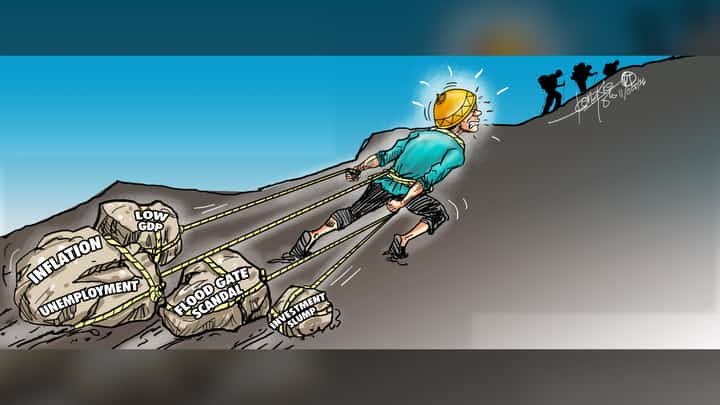
Economic indicators came in like a barrage of torpedoes, striking an economy already under siege from the country’s political turmoil and further battered by the unresolved conflict in the Middle East.
First came inflation, which accelerated to 7.8 percent in October from 7.2 percent in September, marking its fastest pace in more than three years. Higher transport, electricity and housing costs drove the surge.
The jobs figures followed, showing that 2.86 million Filipinos were unemployed in September. The unemployment rate rose to 5.4 percent from 5.3 percent in August 2026 and 3.8 percent in September 2025.
Then came the coup de grace: a laggard 2.1-percent Gross Domestic Product (GDP) expansion in the third quarter, down from 2.3 percent in the previous three months and 2.8 percent in the first quarter. Outside of the pandemic years, this represents the country’s weakest quarterly growth since late 2009.
The indicators reflect mounting economic pressure as the weak expansion coincides with accelerating consumer prices and a growing jobless population.
All the figures were among the poorest in the region and point to stagflation that is taking the economy to the brink of a recession, the first since the late President Ferdinand Marcos Sr.’s term.
The country is now back to being the doormat of the region. Research group IBON Foundation said the Philippines is now Southeast Asia’s economic laggard.
The situation stems largely from the mayhem of the Marcos administration and its failure to boost spending to increase agricultural production, support small enterprises and raise household purchasing power.
Neglect worsened joblessness, eroded incomes and drove up the cost of living for millions of Filipinos.
Growth has largely slowed since the start of the Marcos Jr. administration, with five consecutive quarters of slowdown since late 2025, marking the most sustained and largest decline so far.
In the first three quarters, GDP expansion skidded to 2.5 percent from 4.9 percent in the same period in 2025, putting the government’s 3.5 percent to 4.5 percent full-year target out of reach.
Based on the latest available data, the Philippines has one of the lowest GDP growth rates in the region at 2.1 percent, compared to Malaysia (5.3 percent), Singapore (5.4 percent), Indonesia (5.5 percent) and Vietnam (10 percent).
It was better than Brunei’s 0.02 percent and Thailand’s 1.9 percent, however.
The Philippines has the highest unemployment rate compared to Indonesia (4.8 percent), Malaysia (2.9 percent), Vietnam (2.2 percent), Singapore (2 percent) and Thailand (0.9 percent), and the fastest inflation rate compared to Lao PDR (7.7 percent), Cambodia (5.3 percent), Vietnam (5.1 percent), Thailand (3.9 percent), Indonesia (3.2 percent), Singapore (2.2 percent) and Malaysia (1.8 percent).
The Marcos regime’s failure to strengthen the Filipino middle class led to declining overall output, since the economy is consumption-driven and services-heavy.
Then there’s the political head-bashing, which weighed down the confidence of both consumers and businesses.
The floodgate scandal was the clearest cause for the downturn as public spending was frozen.
Infrastructure spending contracted 26.2 percent in the third quarter of 2025, and its effects are showing in slower GDP growth. Socioeconomic Planning Secretary Arsenio Balisacan said the sharp fall in public construction shaved 1.1 percentage points off the GDP.
The Marcos-Duterte feud also dampened investor sentiment. Stocks slumped in February 2026 after an impeachment complaint was filed against Vice President Sara Duterte, amid fears the political distraction would divert lawmakers’ attention from governance and fiscal reforms.
Investment analysts said the political turmoil was making investors increasingly cautious. They noted that an impeachment trial could further weigh on market sentiment, particularly if a conviction triggered prolonged political unrest.
The outlook points to a possible escalation as political tensions mount and political players increasingly turn their attention to the 2028 elections.