
Push for food warning labels aims to protect Filipino children
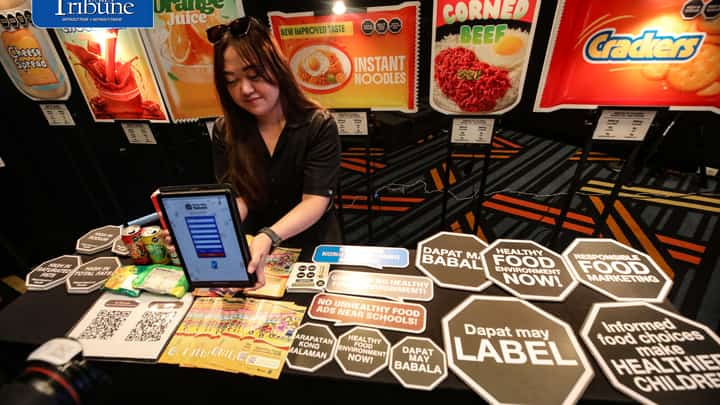
Health advocates launched “Dapat May Babala” mass media campaign in Quezon City on Monday, 9 November, to push for mandatory Front-of-Pack Food Warning Labels (FOPWL) on packaged foods high in sugar, sodium, and unhealthy fats to protect children's health.
Photographed by Analy Labor for the Daily Tribune
Health advocates, patient groups and government representatives gathered at a mass media campaign launch on Monday to demand the implementation of front-of-pack warning labels (FOPWL) on packaged foods to protect Filipino children from foods with high sugar, sodium and unhealthy fat contents.
Imagine Law, Health Justice and the Department of Health (DOH) led the Dapat May Babala: Protecting Filipino Families through Front-of-Pack Warning Labels campaign in recognition of National Children’s Month, calling on lawmakers to mandate warning labels that would help consumers identify high levels of sodium, sugar and fat in ultra-processed foods (UPF).
“Right now, our current food labeling system is failing Filipino families. Fine-print nutrition facts are at the back of the [food] packages. Those [nutrition facts] on packages are not enough and are rarely looked at,” former DOH Secretary Jaime Galvez Tan said.
“We believe a policy for mandatory food warning labels can help build healthy behavior change,” he added.
The front-of-pack warning labels (FOPWL) on packaged foods are designed around clear, black octagonal warning labels indicating whether products are high in sugar, sodium, total fat and saturated fat.
Tan stressed that a mandatory food warning label policy could influence consumers, parents and children to choose healthier alternatives, noting that FOPWL is one of many interventions that would help families protect children from lifelong diseases, including diabetes, heart and kidney diseases, and hypertension.
“Mandatory food labels are not about restricting choice, it is expanding the choices,” he said.
Meanwhile, DOH Assistant Secretary Lester Tan said the campaign comes amid the growing burden of diet-related noncommunicable diseases (NCDs) in the Philippines, which accounted for 73.3 percent of all deaths in 2023, while obesity prevalence among adults aged 20 to 59 reached 44.5% in 2025, according to the country’s latest National Nutrition Survey.
For the Dialysis PH Support Group, FOPWL translates confusing nutrition charts into information that Filipinos can easily understand within seconds, helping protect future generations from chronic kidney disease (CKD) and other noncommunicable diseases.
Warning labels only for high content
FOPWL on packaged foods would only apply to products with high sugar, sodium and unhealthy fat contents, as the policy aims to help Filipinos avoid foods that could negatively affect their health.
“The evidence is very clear in many countries that ran a randomized control trial that the signal that tells them that it is high in sodium is helping to decide not to buy it,” Imagine Law Executive Director Sophia San Luis responded to DAILY TRIBUNE.
“[For] low and medium [warning label], they [other countries] do not need to fight low and medium label because it would not help in their decision and purchasing behavior,” she pointed out.
The lawyer and health advocate said that chronic kidney disease (CKD) patients, for instance, want to know which foods they should avoid because of their high sodium content, noting that warning labels must be clear and easy to understand to help consumers make informed decisions.
Legislation for healthy food environment
Several proposed bills in the House of Representatives seek to establish a healthy food environment by mandating front-of-package warning labels for foods high in fat, sugar, sodium and calories.
“All pre-packaged food with warning labels will also be prohibited from marketing to children in child-centered settings or from using child-directed tactics like cartoons, giveaways in toys and other tactics,” San Luis said.
Key lawmakers championing a healthy food environment and FOPWL include House Committee on Health Chairperson and Fourth District Representative Giselle Maceda, principal author of House Bill No. 6166, and House Committee on Welfare of Children Chairperson and Nanay Party-list Representative Florabel Yatco, co-author of House Bill No. 2660.
“We have the support of 101 legislators that are championing the bill either as author or co-authors, which demonstrates growing recognition that Filipinos deserve stronger protection from misleading and aggressive marketing of unhealthy food and an enabling environment where healthy food choices can be made through warning labels,” the Imagine Law executive director said.
“We are hopeful that the Senate will follow this trend. This is the trend that they should support,” she added.
San Luis urged lawmakers to take advantage of the “unique opportunity” in advancing front-of-pack warning labels, with committee discussions on the proposed measure expected to continue in November and December.