
Cavite City heat index reaches 40°C
Extreme caution persists as Cavite and Quezon face elevated heat index levels through 10 November
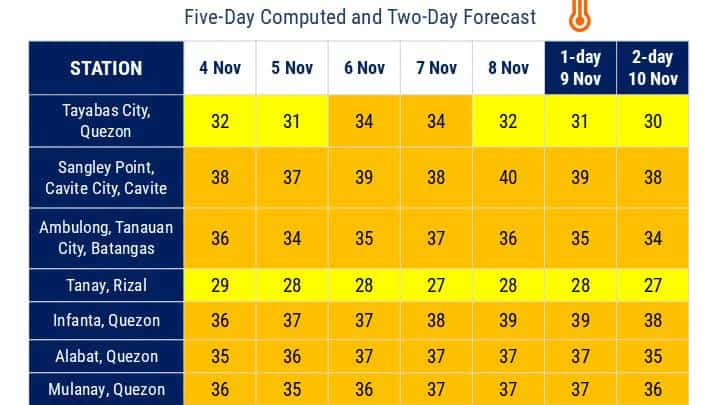
HEAT INDEX ALERT — Sangley Point in Cavite City recorded a heat index of 40°C on 8 November 2026, the highest among nine CALABARZON monitoring stations in the RDRRMC's latest bulletin. Elevated heat index levels are forecast in parts of Cavite and Quezon through 10 November. (Photo courtesy of RDRRMC CALABARZON/DOST-PAGASA)
CALABARZON DOST PAG ASA
CAVITE CITY — The heat index at Sangley Point in Cavite City reached 40 degrees Celsius on Sunday, 8 November, the highest among nine monitoring stations covered by the Regional Disaster Risk Reduction and Management Council (RDRRMC) CALABARZON's latest heat index report.
The bulletin, issued at 6 p.m. Sunday using data from the Philippine Atmospheric, Geophysical and Astronomical Services Administration (PAGASA), placed the reading under the extreme caution category, where prolonged heat exposure and physical activity may cause heat cramps and heat exhaustion.
Infanta, Quezon registered the second-highest reading at 39°C, followed by Alabat and Mulanay in Quezon at 37°C each.
Ambulong in Tanauan City, Batangas, and the NAS-UPLB station in Los Baños, Laguna both recorded 36°C, while CvSU Indang in Cavite registered 33°C.
Tayabas City, Quezon posted 32°C, while Tanay, Rizal recorded the lowest heat index among the nine stations at 28°C.
For Monday, 9 November, the RDRRMC forecast heat index levels of 39°C at Sangley Point and Infanta, followed by 37°C in Alabat and Mulanay.
On Tuesday, 10 November, Sangley Point and Infanta are both expected to register 38°C, remaining within the extreme caution category.
PAGASA classifies heat index readings from 33°C to 41°C as extreme caution, during which heat cramps and heat exhaustion are possible. Continued exposure and physical activity could lead to heat stroke.
The heat index measures how hot conditions feel to the human body by combining air temperature and relative humidity.
Residents, particularly outdoor workers, children, older persons and individuals with existing health conditions, are advised to limit prolonged sun exposure, drink sufficient water and take regular breaks in shaded or well-ventilated areas.
The public may monitor updated heat index information through PAGASA's official website.