
Where is judicial wisdom?
Dela Rosa is still here, still within reach of our courts, and the Supreme Court can still decide the matter before anyone is surrendered.
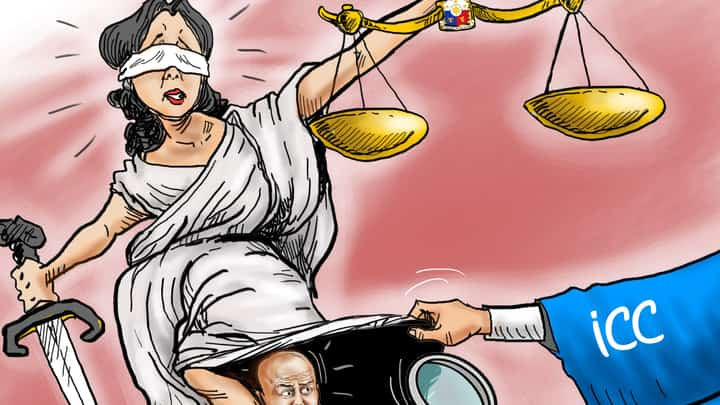
The Supreme Court’s failure to expeditiously address the pending petitions regarding the International Criminal Court (ICC) is taking its toll on Philippine justice, as seen in the vigilante-like actions against Senator Ronald “Bato” dela Rosa, who has a bounty on his head despite there being no domestic charges against him.
Whether the ICC retains jurisdiction over the Philippines remains unsettled at the Supreme Court (SC). The government should keep this in mind before surrendering another Filipino to The Hague, especially since the SC has yet to clarify what the Constitution requires.
The Court still has petitions pending on this very question and must resolve them without further delay. A man’s liberty is at stake, and the SC cannot afford to leave the matter hanging indefinitely.
Michael Karnavas, an American-trained lawyer and a known expert in international criminal defense, said the ICC itself believes the matter is closed. Its Appeals Chamber has ruled on the challenge raised by former President Rodrigo Duterte and, as far as the ICC is concerned, the arrest warrant against Dela Rosa is valid.
But Karnavas said that is only half the story. What matters more, at least for Dela Rosa, is whether the question is still open under Philippine law, and he believes it plainly is.
The issue is not political and it is not about whether grave crimes were committed but whether the ICC had jurisdiction after the Philippines withdrew from the Rome Statute.
Two judges of the Appeals Chamber, Perrin de Brichambaut and Gocha Lordkipanidze, pointed this out in an earlier dissent, and Judge Lordkipanidze has raised fresh doubts in a more recent one.
Dissent does not decide cases, but it shows that honest jurists can read the same treaty and reach different conclusions, and that alone should prompt those putting up a bounty for De la Rosa to review their actions.
Karnavas also thinks the Appeals Chamber read the Rome Statute too broadly. In his view, the judges treated the start of a preliminary examination as if it were the opening of a formal investigation, even though the Statute separates the two and requires a judge’s approval before a prosecutor may investigate on his own.
If the ICC did not obtain that approval before the Philippines’ withdrawal took effect, he argues, its window to act may have closed, much like a deadline that passes while a claim sits unfiled.
Since no court sits above the Appeals Chamber, the international tribunal must treat its own ruling as final. A Philippine court, however, has no duty to treat the ICC verdict as definite when the question is whether its own government may lawfully help carry out a warrant.
This is the difference between Dela Rosa’s case and Duterte’s. Duterte was flown to The Hague before the SC could assess the warrant’s legality, so for him the question had been overtaken by events.
Dela Rosa is still here, still within reach of our courts, and the Supreme Court can still decide the matter before anyone is surrendered.
Recent days showed why the Court cannot wait. After reports that the warrant had been unsealed, Dela Rosa sought protection in the Senate and asked the High Court to stop the authorities from serving it.
President Ferdinand Marcos Jr. has ordered an intensified manhunt for the senator, in addition to a P50-million reward.
The SC has not brushed the matter aside. It did not immediately issue a restraining order, but it ordered the government to answer, suggesting that the justices see the questions as serious and still unanswered.
Having come this far, the Court should go the rest of the way and decide. Another worry, perhaps, is that the SC might reach a different ruling from the ICC, but that is a reason to hold the review.
A ruling would also take the issue out of politicians’ hands. As things stand, whether or not to cooperate with the ICC appears to be a decision the President makes at his discretion and for his own reasons.
A Supreme Court ruling would put the question on firm legal ground, subject the decision to public scrutiny, and lend it greater legitimacy.
Nobody should escape accountability. But domestic courts must settle the serious legal question of jurisdiction.
Otherwise, the public may again be left to believe that a Filipino was surrendered to a foreign tribunal not in the interest of justice, but to advance a political agenda.
It behooves the SC to settle the question without further delay.