
Do a Guevarra, Darlene
The Bicameral Conference Committee raised the 2024 unprogrammed appropriations from P281.9 billion in the National Expenditure Program to P731.4 billion in the GAA, an increase of P449.5 billion.
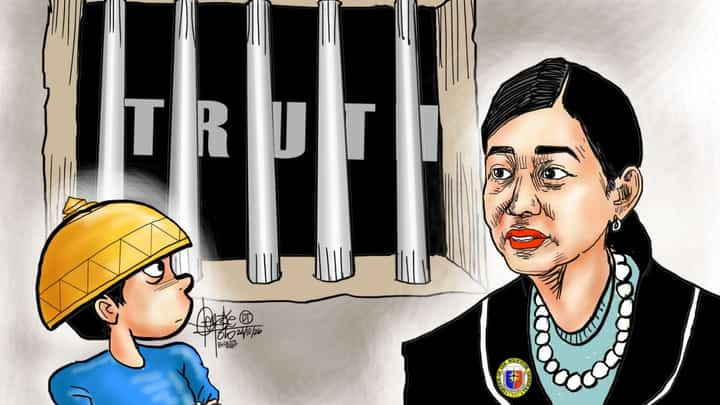
It must be excruciating for Solicitor General Darlene Berberabe to have to defend President Ferdinand Marcos Jr., who had publicly berated members of Congress, exclaiming “mahiya naman kayo” (have some shame), only to sign budgets that were later declared unconstitutional and riddled with corruption-tainted appropriations.
The Supreme Court, in a recent majority decision penned by Senior Associate Justice Marvic Leonen, declared the 2024 and 2025 General Appropriations Acts (GAA) unconstitutional, ruling that the Constitution prohibits Congress from increasing the President’s recommended expenditures, whether programmed or unprogrammed.
Congress’ Bicameral Conference Committee (Bicam) raised the 2024 Unprogrammed Appropriations (UA) from P281.9 billion in the President’s National Expenditure Program (NEP) to P731.4 billion in the GAA, an increase of P449.5 billion.
The staggering addition underscored the very budgetary maneuver the Court has now struck down. The Court declared the increase unconstitutional, along with the whole of Republic Act 11975, or the 2024 GAA, and ruled that the Bicam gravely abused its discretion.
The Court said the increase came from 43 new line items totaling P303.1 billion, plus large jumps in the Strengthening Assistance for Government Infrastructure and Social Programs, an item in the UAs of the 2024 and 2025 budgets, and the Support to Foreign-Assisted Projects.
The Court also faulted the Bicam for failing to keep records of its deliberations and provide documents justifying the changes it made to the budget.
On the 2025 budget, the Court struck down the P17.992-billion increase in the Department of Public Works and Highways’ Special Road Fund for the same ceiling violation and declared RA 12116, the 2025 GAA, unconstitutional.
The Court applied the doctrine of operative fact to spending already made under the invalidated 2024 and 2025 provisions, which protected completed projects and good-faith beneficiaries.
Nonetheless, the Supreme Court stressed that such protection does not extend to the authors, proponents and implementers of the laws, who remain liable for criminal, civil and administrative charges unless the proper tribunals explicitly find that they acted in good faith.
It did not determine individual liability, leaving that question to the appropriate authorities.
Berberabe filed a motion for reconsideration of the SC ruling on the orders of President Marcos, implying that he disagreed with the finding that the two budgets were unconstitutional.
Berberabe said the motion would question whether the SC overstepped its bounds, noting that Congress holds the power of the purse while the Executive prepares, proposes and executes the budget.
Berberabe, a former University of the Philippines College of Law dean, replaced Menardo Guevarra as SolGen. President Marcos appointed her on 29 May 2025.
In March 2025, Guevarra recused the OSG from defending the government in the habeas corpus petitions filed by former President Rodrigo Duterte’s children before the Supreme Court.
The petitions sought Duterte’s release from detention at the International Criminal Court (ICC) in The Hague, Netherlands.
Guevarra filed a manifestation withdrawing the OSG’s representation of the respondent officials, including Executive Secretary Lucas Bersamin and Justice Secretary Jesus Crispin Remulla.
He cited the government’s longstanding position that the ICC had no jurisdiction in the Philippines. He also said the OSG could no longer effectively represent the officials because the petitions accused them of unlawfully cooperating with the ICC.
The Palace had reacted sharply. Press Officer Claire Castro said it would be better for Guevarra to assess whether he could still serve. Not long after, he was replaced.
Budget watchdogs said the victory over the perversion of the national budget was far from complete, even with the SC decision.
The 2022 and 2023 budgets should also have been declared unconstitutional. No one brought a case before the Supreme Court.
In 2022, lawmakers added P100 billion to the unprogrammed appropriations without a corresponding reduction in the programmed budget, pushing total appropriations from P3.5 trillion in the NEP to P3.6 trillion in the GAA.
The same pattern recurred in 2023, when another P219 billion was added without cuts to the programmed budget, raising appropriations from P4.26 trillion to P4.48 trillion.
Applying the same test the Supreme Court used in its ruling, both budgets would likewise have breached the constitutional ceiling.
One can only sympathize with Berberabe, whose task is akin to that of a lawyer defending the Mafia and its boss while accusing the court of overreach for challenging their operations.