
Two-headed hydra
Members of the same political families now control as much as 85 percent of the House of Representatives.
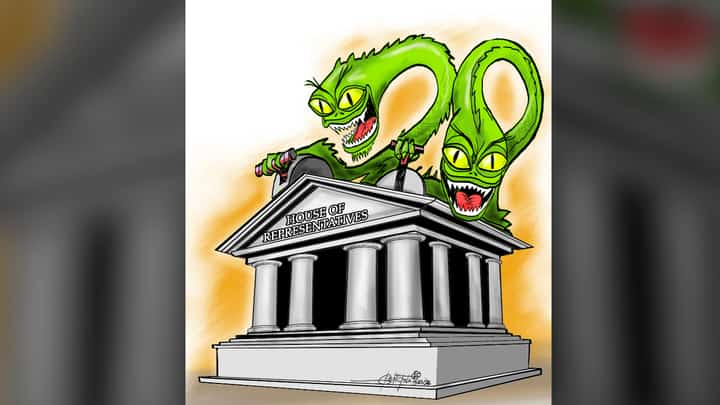
Corruption and political dynasties are mutually reinforcing evils, each helping the other survive and thrive.
Political families and their relatives occupying strategic positions in government have become instruments in the growing misuse of public funds.
Retired Senior Associate Justice Antonio Carpio noted that dynastic domination has grown unchecked, accelerating sharply in recent years.
Members of the same political families now control as much as 85 percent of the House of Representatives. When the 1987 Constitution was drafted, it was at only about 20 percent.
“Every year, they just keep growing, and now they’re still expanding,” Carpio lamented.
The trend has also affected the Senate, which now has about 75 percent of its members belonging to political dynasties.
Local governments are where the monopoly of power has its worst impact, as 87 percent of governors belong to dynasties.
About 75 percent of city and municipal mayors are also from political families. Carpio explained that dynastic officials have tightened their grip because, every year, with their control of the national budget in Congress, “they keep stuffing it with pork barrel funds.”
The pork barrel has thrived through a conspiracy among the House, the Senate, the Department of Budget and Management (DBM), and the Department of Public Works and Highways (DPWH).
Carpio said even President Ferdinand Marcos was involved since they all knew the money was supposedly intended for something like flood control projects.
“They had an unspoken deal to put money into the DPWH and (the late) Undersecretary Maria Catalina Cabral had a list of exactly what it was for.
Based on the testimony of former Public Works and Highways Undersecretary Roberto R. Bernardo, they were calling up the congressmen, ‘boss, you’ve got P1 billion here.’”
Such pillage resulted in substandard projects. “No steel bars, just bamboo holding everything together.”
The pocketed amounts were then used to buy votes, with a little amount for assistance, which fostered political patronage.
The dynasties and their cohorts drain funds meant for infrastructure projects, leaving the country behind its neighbors.
“That’s why everything here is falling apart,” Carpio said.
In countries like Malaysia and Vietnam, infrastructure fund leaks were only about 10 percent. Here, Bernardo said, it was as high as 70 percent.
“Our real problem is that Congress, which approves the annual budget, is controlled by political dynasties who use it to keep themselves in power and expand their influence. So yes, that’s the situation,” Carpio said.
He pointed out that what happened in 2024 was a classic example of how dynastic politicians ravaged the budget.
“They took the entire Philippine Health Insurance Corp. (PhilHealth) budget, so if you look at it, nothing will really happen to us. Every year, their numbers keep growing. In other words, they’ve turned the government into their business. It’s like their family business now,” Carpio said.
Yet the Constitution says the state should prohibit political dynasties as defined by law. It’s been 39 years since.
Budget watchdogs and other concerned citizens went to the Supreme Court and said this was a grave abuse of discretion.
“The SC, in two previous cases, said it can’t force Congress to pass a law because it’s an independent body, but we argued that there’s a constitutional provision, so not passing the law is a grave abuse of discretion,” Carpio averred.
The bills filed in the House may have turned into something that actually promotes political dynasties.
“Let’s say a province has 20 towns and cities, and each town or city can have, like, 20 siblings running. Each municipality, too. So what I said, I called this a political dynasty entrenchment and legitimization law. It’s not really an anti-political dynasty,” the respected magistrate said.
As long as political dynasties remain in control of Congress, “the more they will depend on the national budget to keep themselves in power,” he added.
Breaking this vicious cycle requires removing the perpetrators and beneficiaries of the dynastic system, without exception, from positions of power.