
Documenting heritage cemeteries long before social media
Three decades in the making, Marie Joy B. Rosal’s study of Iloilo’s Spanish colonial cemeteries reveals the history, artistry, and community memory preserved in eight burial grounds.

MARIE Joy Rosal presents NHCP chairman Regalado Trota Jose Jr. with a copy of her book as executive director Carminda Arevalo looks on.
Photographs by Edgar Allan Sembrano and Cristhom Setubal for DAILY TRIBUNE
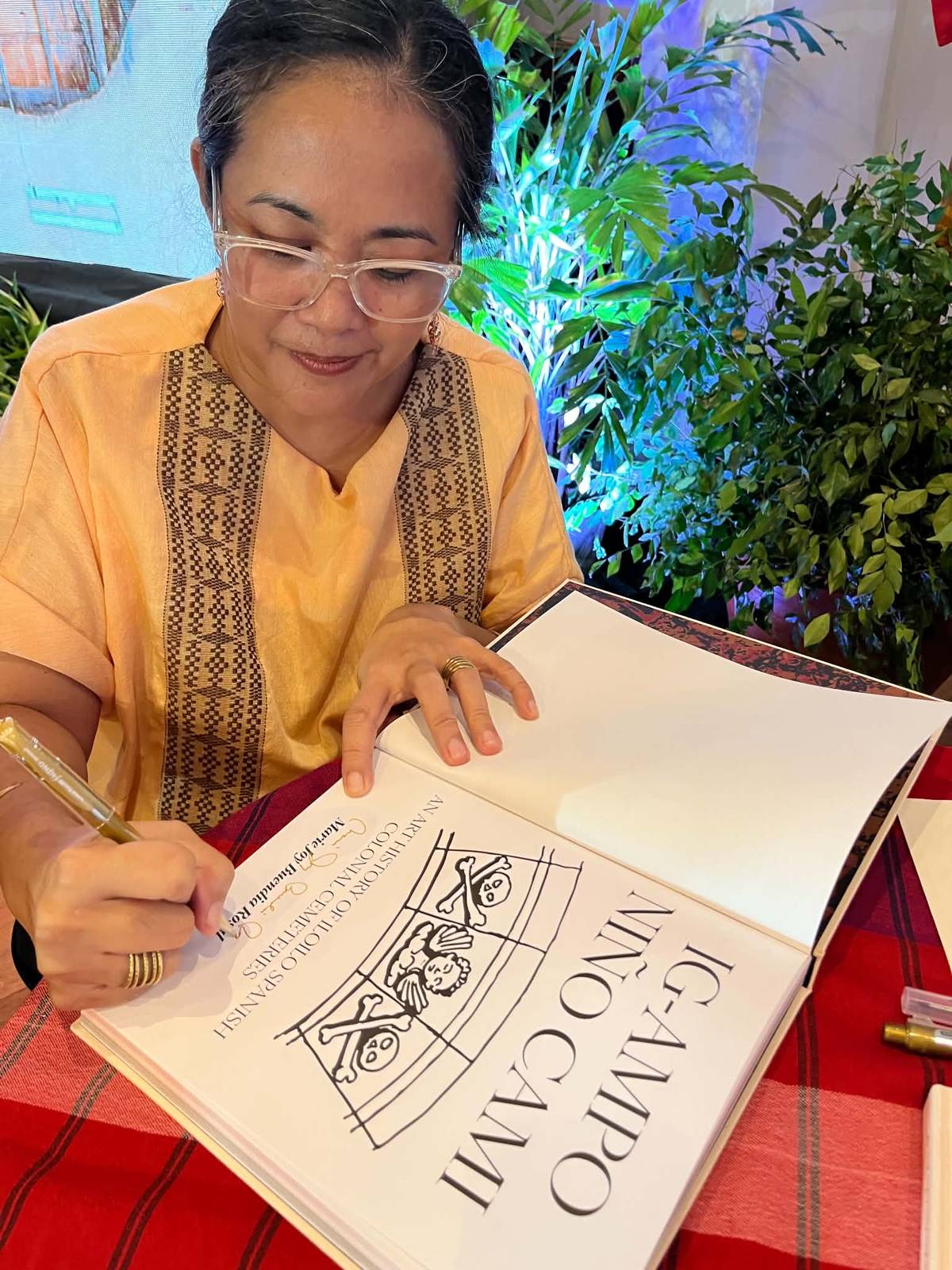
MARIE Joy Rosal signs a copy of her book, published three decades after its beginnings as a master’s thesis.
Three decades after it began as a master’s thesis, Marie Joy B. Rosal’s seminal study of Iloilo’s Spanish colonial cemeteries has finally been published. It is worth the wait.
Originally submitted to the University of the Philippines (UP) Diliman in 1995, Ig-ampo Niño Cami: An Art History of Iloilo Spanish Colonial Cemeteries was launched on 6 October at the University of the Philippines Visayas Main Building in Iloilo City, Iloilo.

‘IG-AMPO Niño Cami’ documents the history and artistry of eight Spanish colonial cemeteries in Iloilo.
Published by the National Historical Commission of the Philippines (NHCP), the book offers a detailed study of eight cemeteries in a province distinguished by its Spanish-era burial grounds.
The launch drew NHCP chairman Regalado Trota Jose, executive director Carminda Arevalo, UP Visayas chancellor Clement Camposano, National Museum Visayas director Ma. Cecilia Tirol, provincial information officer and local historian Nereo Lujan, and other guests from Iloilo and beyond.
Jose described the book as a landmark publication that explores an understudied aspect of the country’s Spanish colonial built heritage.
He called it an “entirely new avenue of inquiry” and hopes it will encourage others to research funerary art and architecture elsewhere in the Philippines.
“More than a survey of burial grounds, this book illuminates how cemeteries served as sacred spaces, repositories of memory, and enduring monuments to faith and community, as well as proffering identity with distinctive local expressions,” he noted.
He also commended Rosal for the “scholarly rigor, sensitivity, and profound appreciation” she brings to the study of Philippine built heritage.
Based on research conducted from 1993 to 1995, the book documents the history and significant artistic features of cemeteries in Dingle, Pototan, Janiuay, Cabatuan, Sta. Barbara, Oton, Miag-ao, and San Joaquin.
Among these, Janiuay’s cemetery stood out for its grandeur and beauty in its day, while San Joaquin’s, a National Cultural Treasure, is the province’s best-preserved example.
Rosal opens with an overview of Iloilo’s history, environment, and demographics before examining the role of the Augustinians, the religious order that carried out much of the missionary work and parish administration in Panay, including Iloilo.
She then traces burial practices and the development of cemeteries in the Philippines from precolonial times through the Spanish period. She examines the coral stone, sandstone, and bricks used to build Iloilo’s cemeteries, as well as the construction workers known as manogdagiao.
Each cemetery study begins with a brief history of the town, providing context for a closer examination of the burial ground’s history and artistic features.
Photographs from Rosal’s fieldwork in the 1990s and renderings of architectural and decorative details complement the text. A photo essay featuring more recent images by Stan Cabigas brings a more recent view to the sites she documented decades earlier.
Long before social media brought heritage sites to wider public attention, Rosal was already devoting years to the careful study of these burial grounds. The book reflects both the depth of that research and the perseverance required to see it through to publication.
Her determination to pursue a little-explored subject — and to bring her work to readers after three decades — deserves recognition. Perhaps a pat on the back, too, or a serving of her favorite yoghurt ice cream.