
Two young Philippine Eagles die of electrocution

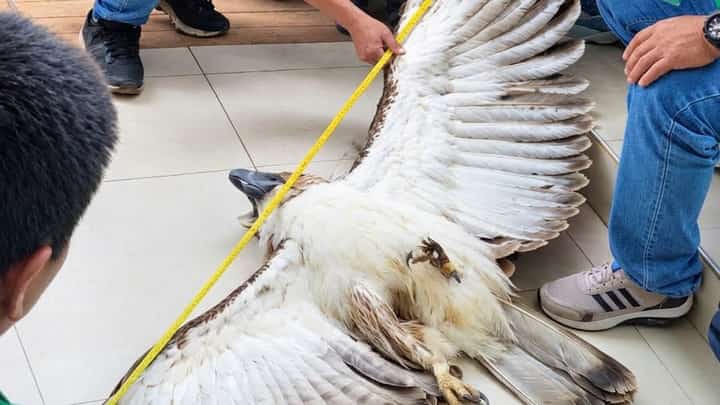
THE Department of Environment and Natural Resources Region X is investigating the death of a mature Philippine eagle found near an electrical post in Sitio Panghaon, Barangay Guinalaban, Salay, Misamis Oriental.
Photograph courtesy of denr X
CAGAYAN DE ORO CITY--- The Philippine Eagle Foundation (PEF) reported that the death of "Salay,” a young female eagle in Barangay Guinalaban, Salay, Misamis Oriental, was due to accidental electrocution.
In just three days, two young female Philippine Eagles died in Mindanao after contact with electrical infrastructure.
"Salay" was found dead beside an electric post in Barangay Guinalaban, Salay, Misamis Oriental last 1 October, where burns were found on her feet and the post-mortem findings were consistent with suspected electrocution.
Three days later, on 4 October, another young female Philippine Eagle was found dead in Barangay 7 Libertad, Arakan, North Cotabato, and burn marks were found on her left wing and right foot.
The veterinary examination confirmed that electrocution caused her death.
Philippine Eagles do not stay only deep inside forests. They also fly over farms, roads and villages near or inside their forest habitats.
Young eagles may be more at risk. As they leave their parents’ territories, they often use forest edges and open areas. They are also still learning how to move through the landscape.
On the eyes of a young eagle, a power pole may not look very different from a tree or a high place to rest.
Why power poles can become deadly
PEF cited the study of Dr. Andrew Dixon, Director of Science and Conservation at the Mohammed bin Zayed Raptor Conservation Fund (MBZRCF), who has spent years studying how power lines affect birds of prey.
His work in Mongolia show how serious electrocution can become when dangerous power lines cross important raptor habitats. His research has documented large numbers of electrocuted raptors, including threatened Saker Falcons, and has also tested ways to make dangerous poles safer.
“Power infrastructure makes an attractive perch for birds because it’s an elevated site. It gives them a good view of their surroundings.”
For large birds like the Philippine Eagle, their size can make the danger worse.
“What makes them particularly dangerous for eagles is that they have a large wingspan.”
A large eagle can accidentally touch two live parts at the same time. On some pole designs, touching one live wire while also touching a grounded part of the structure can also cause electrocution.
Dr. Dixon’s research in Mongolia did not stop at counting dead birds as his team also tested different ways to reduce electrocution. Changes in the pole design and insulation greatly reduced raptor deaths.
“There are solutions for designing safe lines in the first place, and there are solutions for ret rospectively fixing the existing dangerous lines.”