
Teachers’ Day class suspensions face scrutiny over legal basis
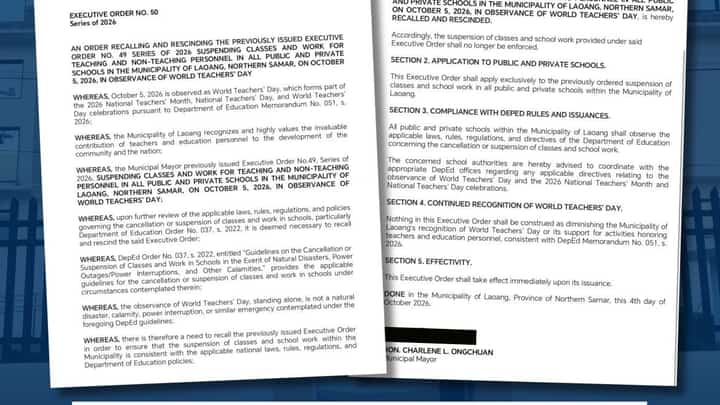
The legal basis for local government orders suspending classes solely for the observance of National Teachers’ Day is coming under scrutiny, with several local governments withdrawing or revising earlier directives while others continue to issue localized suspension orders for 5 October, Monday.
A Department of the Interior and Local Government (DILG) Central Office official familiar with the matter told the DAILY TRIBUNE that mayors do not have a general or blanket authority to suspend classes simply because of the observance of National Teachers’ Day.
The official, who is not authorized to publicly speak on behalf of the department, said the issue must be considered within the existing national rules governing the basic education calendar and the specific circumstances under which localized class suspensions may be ordered.
The official stressed that the question is not whether local governments may recognize teachers or facilitate their participation in Teachers’ Day activities, but whether the observance itself constitutes sufficient legal basis for a local chief executive to suspend classes.
The issue has emerged as local governments take different approaches to the 5 October observance.
The Presidential Communications Office on 4 October warned against a circulating graphic claiming that there would be a nationwide suspension of classes and work on Monday for World Teachers’ Day, describing the graphic as fake.
The absence of a nationwide suspension does not prevent local governments from issuing localized directives under the applicable rules.
Republic Act No. 10743 declares 5 October of every year as National Teachers’ Day and identifies it as a special working holiday.
The law directs heads of government agencies and instrumentalities, including local government units, to encourage and afford sufficient time and opportunities for their employees to participate in activities celebrating National Teachers’ Day.
It also designates the Department of Education as the lead agency in preparing and implementing the annual program of activities.
RA 10743, however, does not expressly declare 5 October a no-class day or provide a blanket authorization for mayors to suspend classes solely because of the observance.
The distinction is important because recognition of a national observance and the legal authority to cancel or suspend classes are separate questions.
Republic Act No. 9155, or the Governance of Basic Education Act of 2001, establishes the national governance framework for basic education, including the authority of the Education Secretary over national educational policies and standards.
DepEd Order No. 009, series of 2026, meanwhile, provides the guidelines for the implementation of the three-term school calendar for School Year 2026-2027.
The national framework does not, however, mean that local chief executives have no authority whatsoever over class suspensions.
Executive Order No. 66, series of 2012, expressly provides for localized cancellation or suspension of classes and work in government offices under specified circumstances.
In the absence of typhoon signal warnings from PAGASA, the order allows localized cancellation or suspension to be implemented by local chief executives, as chairpersons of their respective local disaster risk reduction and management councils, particularly in flood-prone or high-risk areas and in coordination with PAGASA and the NDRRMC.
It also provides for cancellation or suspension during disasters and calamities under specified circumstances.
DepEd's class-suspension framework likewise recognizes localized decisions under specified conditions involving hazards and emergencies.
The question raised by the DILG Central Office official is therefore narrower: whether National Teachers’ Day, standing alone, constitutes a sufficient basis for a mayoral class suspension.
That question has already prompted several local governments to revisit their earlier directives.
In Infanta, Pangasinan, the municipal government revoked Executive Order No. 101, series of 2026, which had provided for the suspension of classes.
In its public notice, the municipality said the order was officially revoked after Mayor Virgilio F. Vallarta was informed of the matter and after the local government reviewed the applicable laws, rules, regulations and guidelines governing class suspensions.
The municipality said the order would no longer be implemented and apologized for any confusion or inconvenience caused to students, parents, teachers and residents.
The revocation followed a review of the legal and administrative basis for the earlier directive. It does not, by itself, constitute an admission of wrongdoing by the local government.
In Godod, Zamboanga del Norte, the municipal government initially issued Executive Order No. 0041, series of 2026, suspending classes for 5 October.
The municipality subsequently cancelled the order.
The original issuance therefore forms part of the sequence of events but is no longer an operative suspension directive.
In Laoang, Northern Samar, the municipal government likewise recalled and rescinded an earlier order suspending classes and work for teaching and non-teaching personnel on 5 October.
The subsequent action cited applicable DepEd rules and distinguished the Teachers’ Day observance from the types of emergencies and calamities covered by the class-suspension guidelines.
In Bataraza, Palawan, Mayor Al-Shariff W. Ibba issued a subsequent executive order rectifying an earlier issuance and stating that there would be no suspension of classes for the Teachers’ Day celebration.
The municipality directed that the observance proceed in accordance with applicable DepEd guidelines and protocols.
In Narra, Palawan, an earlier executive order concerning 5 October was likewise subsequently marked cancelled.
The actions of these municipalities do not, by themselves, establish that their original orders were unlawful. They demonstrate instead that some LGUs have reviewed their earlier decisions and subsequently withdrawn or revised them.
The situation is not uniform.
In Dingras, Ilocos Norte, the municipal government announced an afternoon suspension of classes and work for teaching and non-teaching personnel in all public schools beginning at 1 p.m. on 5 October, pursuant to Executive Order No. 20, series of 2026.
The municipality said the measure was intended to provide teachers and school personnel an opportunity to participate in National Teachers’ Day activities, rest and spend time with their families.
Its public advisory also reminded the public to remain guided by applicable rules, regulations and directives of DepEd and the respective school administrations.
Private schools and the Mariano Marcos State University campus in Dingras were encouraged to provide their teaching and non-teaching personnel sufficient time and opportunity to participate, subject to applicable laws and their respective institutional policies.
The Dingras directive is distinct from a full-day suspension because it takes effect only from the afternoon.
In Banna, Ilocos Norte, Mayor Mary Chrislyn C. Abadilla issued Executive Order No. MCCA 2026-025 providing for the suspension of classes and work for teaching and non-teaching personnel in public and private educational institutions on 5 October.
In Badoc, Ilocos Norte, Mayor Virgilio M. Calajate likewise issued Executive Order No. 30, series of 2026, providing for the suspension of classes and work for teaching and non-teaching personnel in public schools.
The documents reviewed by The Daily Tribune did not contain subsequent cancellation or rescission notices for the Banna and Badoc orders.
The varying local directives are consistent with the absence of a nationwide suspension and reflect differing approaches by local governments to the observance.
The Municipality of Pio V. Corpus, Masbate, meanwhile, took a different approach.
Mayor Mark R. Antonio said he consulted DepEd officials and reviewed applicable laws and policies before deciding not to issue an executive order suspending classes for Teachers’ Day.
The mayor's statement recognized the importance of honoring teachers but said matters involving school schedules and the conduct of classes must remain within the applicable national education framework.
He also noted that RA 10743 makes 5 October a special working holiday but does not automatically suspend classes.
The decision represents another approach available to an LGU: supporting the national observance without issuing a local class-suspension order.
The developing issue should not be interpreted as a dispute over whether local governments can participate in National Teachers’ Day.
RA 10743 expressly encourages government agencies and LGUs to provide their personnel sufficient time and opportunities to participate in Teachers’ Day activities.
The question is the legal mechanism by which that participation is facilitated.
Local governments may recognize teachers, organize activities and coordinate with DepEd.
Whether those powers also encompass the authority to suspend classes solely because 5 October is National Teachers’ Day is the question now being raised.
That question is particularly relevant because DepEd maintains the national basic education framework and school calendar, while localized suspension authority exists under specific laws and regulations.
DepEd has also been calling for more localized and specific suspension decisions when hazards do not affect an entire jurisdiction, citing the need to protect instructional time while ensuring the safety of learners and school personnel.
The differing directives should not, by themselves, be interpreted as evidence that any mayor acted in bad faith or deliberately disregarded national policy.
The documents instead show different approaches among local governments, with some reviewing and withdrawing earlier directives while others continue to implement full or partial suspensions.
The Daily Tribune is not making an independent finding that any local chief executive acted unlawfully.
Rather, the issue concerns differing interpretations of the legal and administrative rules governing class suspensions and the relationship between local executive authority and the national basic education framework.
The Daily Tribune sought comment from DILG Secretary Jonvic Remulla regarding the scope of mayoral authority in this particular situation but had received no response as of press time.
The developments ahead of 5 October have left LGUs, schools, teachers, parents and students dealing with differing local directives.
Infanta, Godod, Laoang, Bataraza and Narra have withdrawn, cancelled or revised earlier directives based on the documents reviewed by The Daily Tribune.
Dingras has announced an afternoon suspension, while Banna and Badoc have issued their own suspension orders. Pio V. Corpus, meanwhile, opted not to suspend classes after reviewing the applicable rules and consulting education officials.
The divergence underscores the need for a clear and uniform understanding of the rules, particularly where a local directive affects the operation of schools and the national basic education calendar.
The issue is ultimately not whether teachers deserve to be recognized. They do, and national law expressly provides for their recognition on 5 October. The question is how that recognition may be carried out within the existing legal and administrative framework governing basic education and class suspensions.
For now, the record shows differing local approaches rather than a nationwide suspension, with the legal question over whether Teachers’ Day, standing alone, provides sufficient basis for a local class suspension remaining at the center of the discussion.