
Phl AI adoption hits security wall


SYNOLOGY Philippines country manager Claire Huang discusses how businesses can scale artificial intelligence adoption while keeping tighter control over data, security and recovery during the Synology Annual Media Event 2026 in Makati City.
Photographs courtesy of SYNOLOGY
Philippine businesses are increasingly treating artificial intelligence (AI) as a productivity tool rather than an experiment, but concerns over data security and privacy remain a major obstacle to wider adoption.
More than 90 percent of Philippine respondents in a Synology ASEAN survey said AI-ready infrastructure is important to improving workflow efficiency and productivity, while 70 percent identified data security and privacy as a key challenge.
The findings were presented Wednesday during Synology’s 2026 Annual Media Event in Makati City, where the data-management company examined how businesses are preparing their infrastructure, cybersecurity and workplaces for wider AI adoption.
Claire Huang, Synology country manager for the Philippines, said AI is increasingly becoming part of companies’ core information technology infrastructure as businesses use it to automate processes and improve decision-making.
“AI is no longer experimental and it’s becoming a part of the core IT infrastructure,” Huang said.
But she warned that adoption also creates greater complexity and exposure to risk as businesses generate and connect larger volumes of data.
The survey found that about 47 percent of Philippine respondents view data quality and availability as challenges to AI adoption, while 40 percent said their information remains scattered across different environments.
Nearly 40 percent also said they lack visibility into how data submitted to third-party AI services is handled.
That becomes particularly significant as employees increasingly use publicly available AI tools for everyday work.
“Does the company allow you to use third-party AI? And using that AI, are you uploading your business, your company’s data to that AI?” Huang asked.
More than 60 percent of businesses surveyed do not actively enforce technical controls over employee AI use, while only about 40 percent are fully confident they could produce a complete record of AI activity within their organization.
“Without clear visibility and control, sensitive business information may be shared with AI services without the IT actually being aware,” Huang said.
Data behind the AI
Antoine Yang, Synology regional sales manager for Southeast Asia, said businesses also face the challenge of preparing fragmented and unstructured information before it can be effectively used by AI systems.
He cited a newsroom as an example, where an interview video might be stored on one employee’s computer, supporting documents in email and corrections sent through another messaging platform.
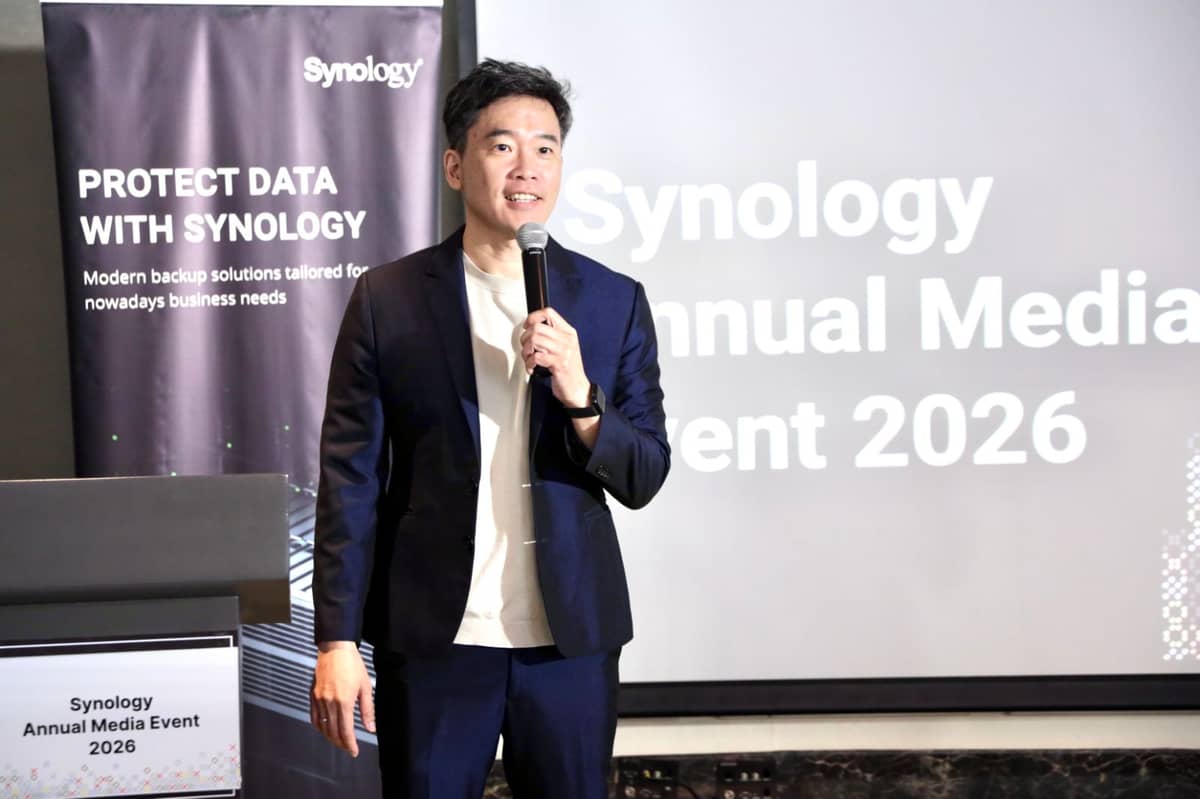
SYNOLOGY Southeast Asia head Antoine Yang stresses that businesses need accessible, well-managed and secure data infrastructure for artificial intelligence to deliver meaningful productivity gains.
“When using AI, the AI needs the right information from every source to give the precise answer,” Yang said.
He added that companies need to decide which information can be used in cloud-based AI services and which sensitive information should remain under tighter control.
“Every business still needs to define their boundaries, like where their data belongs, to use the AI where it makes sense, while keeping control of their data,” Yang said.
The survey found 74.1 percent of Philippine respondents favor on-premises or hybrid infrastructure, compared with 9.9 percent that prioritize public cloud.
Huang said the shift does not necessarily mean businesses are abandoning cloud services.
“Hybrid is really the main thing,” she said. “You are able to flexibly scale. You are able to decide which ones you want to take ownership of.”
Security concerns extend beyond data leakage.
Synology’s survey found only 14 percent of Philippine businesses consider themselves fully prepared to defend against and recover from AI-driven cyber threats, while only about a quarter are very confident they can quickly restore operations with protected backups following an attack.
Huang said AI transformation therefore cannot be reduced to simply deploying more applications.
“It’s not more AI that we need,” she said. “It’s the data environment or the infrastructure behind it that needs to evolve.”