
DepEd to launch digital safety campaign after Banga school shooting

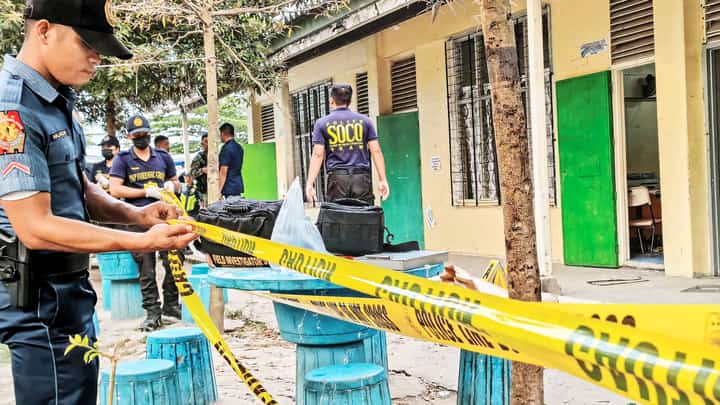
YELLOW tape now surrounds another crime scene of a shooting incident in a high school. The teen student who opened fire and killed at least two fellow students on 18 September in Banga town, South Cotabato, eventually turned the gun on himself, officials said. It is the country’s third deadly campus attack since June.
Photograph courtesy of STR/AGENCE FRANCE-PRESSE
The Department of Education (DepEd) will launch a digital safety campaign for students, teachers and parents as part of its response to recent school shooting incidents, including the deadly attack at Banga National High School in South Cotabato.
The campaign will focus on risks children face online, including grooming, child exploitation, cyberbullying, harassment, scams, exposure to violent or harmful content and the misuse of personal information, DepEd said Monday
“Keeping our children safe today means understanding that their world extends beyond the classroom and into their phones, games, group chats, and social media,” Education Secretary Sonny Angara said.
“We need to give children, parents, and teachers the knowledge and tools to navigate these spaces safely,” he added.
It will also provide guidance on social media and gaming safety, screen time, digital well-being, and how students, parents and school personnel should report and respond to potentially harmful online activity.
The campaign will complement existing DepEd measures on physical security, child protection and emergency preparedness, including the use of closed-circuit television cameras, metal detectors and perimeter fencing, as well as the deployment of security guards, School Counselor Associates, Learner Formation Officers and Child Protection Committees.
DepEd said the campaign will also strengthen the ability of teachers and school personnel to recognize warning signs and use proper reporting and referral mechanisms when students encounter threats or other harmful experiences online.
Parents will be given guidance on how to talk with children about their online activities, identify possible warning signs and establish appropriate boundaries without cutting off communication.
“Parents do not have to know every app or platform their children use. But they need to keep the lines of communication open,” Angara said.
“Our children should know that when something online scares them, pressures them, or makes them uncomfortable, they can tell a trusted adult and ask for help,” he added.
Building on curriculum
DepEd said the campaign will build on digital citizenship and online safety lessons already incorporated into the revised K to 10 curriculum.
Topics such as netiquette, online safety and responsible technology use are integrated into subjects including Edukasyong Pantahanan at Pangkabuhayan/Technology and Livelihood Education, Values Education, and Physical Education and Health for Grades 4 to 10.
The department said the campaign would translate those lessons into practical measures that families and schools can use in everyday situations.
Among the issues to be covered are safe online communication, privacy and protection of personal information, cyberbullying, online harassment, grooming, online child exploitation, scams, gaming, harmful content and digital well-being.
It will also include guidance on warning signs, reporting, referral and where children and families can seek assistance.
“We cannot leave our children to navigate the digital world on their own. Keeping them safe is a shared responsibility of the school, the home, government, and the community,” Angara said.