
Garin: Salary hikes, LGU allocations drive shifts in 2027 budget

The House of Representatives explained that changes in the budgets of some government agencies are due to increased spending on government employees’ salaries and higher allocations for local government units (LGUs).
Speaking at the Saturday News Forum, House Deputy Speaker and Iloilo First District Representative Janette Garin said salary increases for government personnel and higher LGU allocations took up a significant portion of the proposed ₱7.2-trillion national budget for 2027, resulting in reduced allocations for several government agencies.
“If you look at it as a whole, the biggest increase in the budget is in personnel salaries. Because the fourth tranche of the salary standardization has taken effect, it has taken up quite a large portion of our budget,” Garin said in Filipino.
“Second, there is the Mandanas law, which provides the legal basis for increasing the allocation for our provinces, cities, and municipalities. So, those are the two things that really took up a portion of the Philippine budget,” she added.
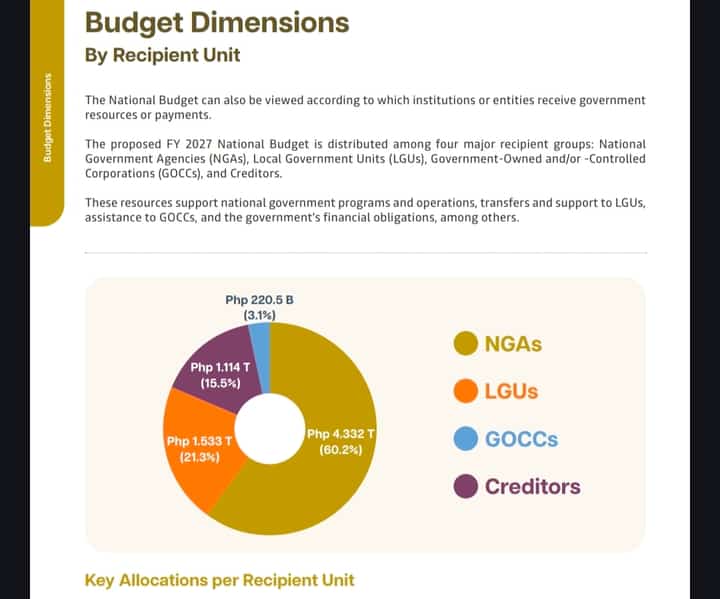
The proposed FY 2027 budget for LGUs rose to ₱1.533 trillion, from the ₱1.393-trillion approved budget for 2026.
The LGU allocation includes ₱1.056 trillion for the National Tax Allotment, ₱328.1 billion for infrastructure, and ₱78.4 billion for the Bangsamoro Autonomous Region in Muslim Mindanao Annual Block Grant.
According to the Department of Budget and Management (DBM), LGUs receive transfers and budgetary support from the national government to provide vital community services, implement local reforms, and cater to the needs of various sectors at the grassroots level.
Garin, however, stressed that the government continues to address the country’s pressing challenges, particularly the need to strengthen social services. The congresswoman also reiterated that long-term investments, including infrastructure projects, will not be neglected in the national budget.
The proposed national budget for 2027 amounts to ₱7.2 trillion, 6 percent higher than the ₱6.793-trillion approved budget for 2026, according to the DBM. The agency said a significant portion of the increase reflects mandatory funding requirements, including the fourth tranche of salary adjustments for civilian government employees and higher National Tax Allotment for LGUs.
National government agencies accounted for the largest share of the proposed 2027 budget at 60.2 percent, or ₱4.332 trillion, followed by LGUs with 21.3 percent, or ₱1.533 trillion; government-owned and controlled corporations with 15.5 percent, or ₱1.114 trillion; and creditors with 3.1 percent, or ₱220.5 billion.
Agencies whose proposed budgets decreased from the approved 2026 levels include the Department of Education, from ₱1.015 trillion to ₱976 billion; Department of Health, from ₱448.1 billion to ₱353.8 billion; Department of Agriculture, from ₱297.1 billion to ₱261.7 billion; and Department of Social Welfare and Development, from ₱270.2 billion to ₱241.6 billion.
Meanwhile, proposed allocations increased for the Department of Public Works and Highways, from ₱530.9 billion to ₱644 billion; Department of the Interior and Local Government, from ₱310.5 billion to ₱332.5 billion; Department of National Defense, from ₱310 billion to ₱328.8 billion; and Department of Transportation, from ₱141 billion to ₱302.2 billion. The DBM has listed the latter figures among the major department allocations in the proposed 2027 budget.