
Japanese firms deepen ASEAN ties beyond investment

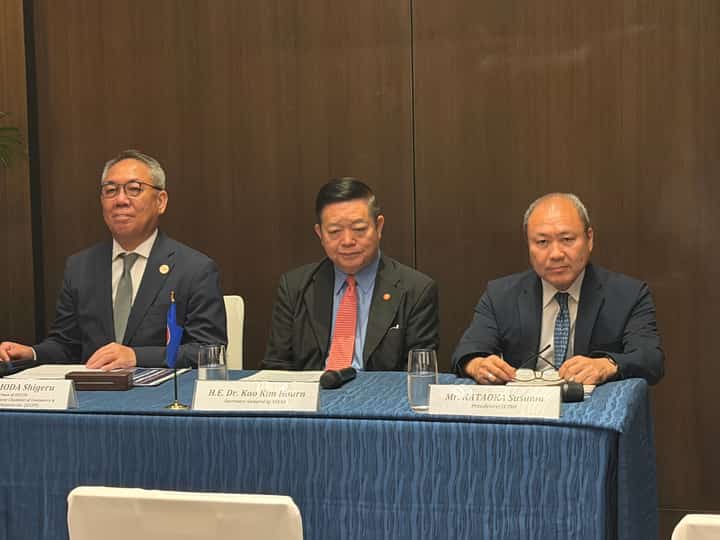
the 18th Dialogue with the Secretary-General of ASEAN, eith the Federation of Japanese Chambers of Commerce and Industry in ASEAN (FJCCIA) with ASEAN Secretary-General Dr. Kao Kim Hourn.
Jefferson Fernando
Japanese businesses are looking beyond the traditional investor role in Southeast Asia, positioning themselves as long-term partners in the region’s growth as ASEAN begins implementing its vision for the next two decades.
This direction took center stage at the 18th Dialogue with the Secretary-General of ASEAN, held in Manila on September 18, where the Federation of Japanese Chambers of Commerce and Industry in ASEAN (FJCCIA) met with ASEAN Secretary-General Dr. Kao Kim Hourn.
The discussions came as businesses confront what participants described as an era of “permanent disruption,” shaped by geopolitical tensions, changing high-tech supply chains and logistics uncertainties.
With ASEAN moving from its Economic Community Blueprint 2025 toward the ASEAN Community Vision 2045, FJCCIA presented proposals for strengthening cooperation between Japan and the 10-member regional bloc.
At the heart of the recommendations are four areas: stronger and more sophisticated supply chains and connectivity; a green economy and sustainable industrial foundations; the digital economy, innovation and artificial intelligence governance; and inclusive growth coupled with stronger human-resource connectivity.
The proposals include improving institutional and digital links, supporting decarbonization and a region-wide power grid, advancing Data Free Flow with Trust, and making it easier for highly skilled workers to move within ASEAN.
The growing integration of Japanese companies into Southeast Asian economies was also reflected in the FJCCIA Survey 2026, which gathered 1,041 valid responses from member companies.
About 77 percent said they were involved in production, trade or collaboration with ASEAN countries beyond the member state where their operations are based. Another 48 percent said the strategic importance of their ASEAN bases had increased compared with five years earlier, while 52 percent were either expanding or considering expanding their investments.
The survey also showed that approximately 63 percent had established partnerships with local companies, while 74.81 percent had appointed local talent to management or department-head positions.
More than 90 percent of respondents, meanwhile, called for revisions to the ASEAN-Japan Comprehensive Economic Partnership.
FJCCIA Chairman Shigeru Shimoda, who is also chairman of the Philippine-Japanese Chamber of Commerce and Industry, raised concerns about protectionism and increasingly opaque non-tariff measures, saying these developments could make investment decisions less predictable.
But Shimoda emphasized that Japanese businesses want their relationship with Southeast Asia to extend beyond capital and investment.
“Japanese companies are not merely external investors; as ‘ASEAN Citizens’ deeply rooted in local communities, we want to build prosperity together with ASEAN toward 2045,” he said.
JETRO President Susumu Kataoka likewise underscored ASEAN’s growing importance as a trusted partner amid global uncertainty. He identified resilient and diversified supply chains, green cooperation, innovation including AI and digital technologies, and inclusive growth as major areas for future collaboration.
Programs such as the ASEAN-Japan Fast Track Pitch and exchanges involving young business leaders were cited as examples of initiatives already bringing the co-creation concept into practice.
The Manila dialogue was held alongside meetings related to the ASEAN Economic Ministers and brought together representatives from Japanese business and government institutions. Economic Research Institute for ASEAN and East Asia President Tetsuya Watanabe and representatives of Japan’s Ministry of Economy, Trade and Industry were also among the participants, while JETRO coordinated the dialogue.
FJCCIA represents Japanese chambers of commerce and industry across all 10 ASEAN countries. As of August 2026, it had 7,420 member companies and has conducted an annual dialogue with the ASEAN Secretary-General since 2008.
As ASEAN charts its course toward 2045, the latest dialogue signals an effort by Japanese businesses to deepen their roots in Southeast Asia—not simply by investing in the region, but through technology, local talent, sustainability and economic partnerships designed to grow alongside it.