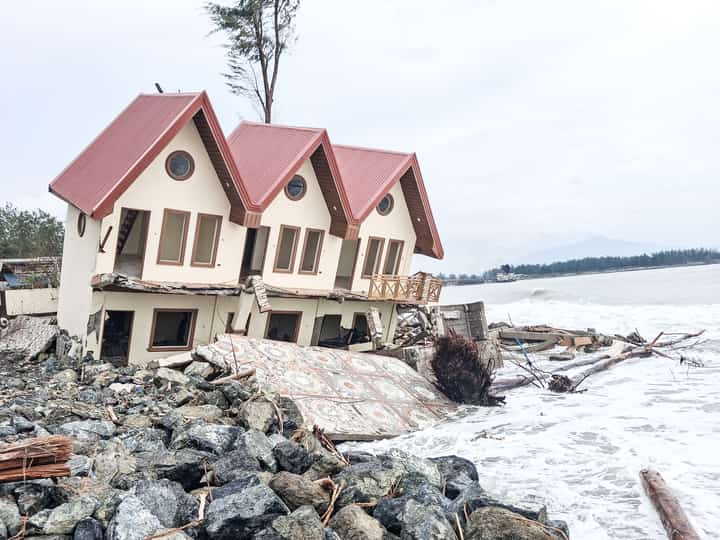
The stopgap fortification failed as portions of the rock barrier were easily washed away, unable to withstand the sea's force.
The setback raised questions about what longer term coastal defense the area may need as erosion continues to eat into resort properties.
Local officials have yet to address media queries over the worsening situation in their jurisdiction.
The DAILY TRIBUNE tried to reach Mayor Reinhard “Hart” E. Jeresano of San Felipe, Zambales, but was told he was on a trip.
Through his staff, the mayor said he could respond to media questions on Monday.
Fisherfolk and ecology groups have long linked Liwliwa's disappearing shoreline to sand and gravel extraction upriver and offshore.
Dredging and quarrying operations in Zambales have been blamed for stripping the coast of the sediment that once replenished its beaches naturally, leaving the shore more exposed to wave action with each passing monsoon season.
That degradation, residents said, is what doomed the original dike and now threatens to undo the armor rocks as well, a stopgap measure applied to a coastline already weakened by years of upstream extraction.
Water does damage
As a result of the periodic monsoon rains and recent tropical cyclones, the armor rocks placed along the Liwliwa’s coastline crumbled from the strong waves, leaving nearby properties vulnerable to the overpowering water.
In the first week of September, affected resorts brought in more armor rocks to protect their establishments from coastal erosion and the dike's collapse.
Locals counted on the dike to protect the Liwliwa area, but sections of it have since collapsed as waves continued to batter the shoreline.
“When the [Santo Tomas] river rose, the dike stopped the water from flooding the houses below,” a resident of Sitio Liwliwa told Daily Tribune.
“The dike started from a bridge in Macolcol. They built a new 100-meter dike, but the new structure stretching toward the area near the sea, all of that was damaged,” the resident said.
He warned that if the remaining sections of the dike collapse, seawater could reach nearby homes and properties.
Nine establishments on ground zero reported damage, while other resorts in the area sustained losses of up to 50 to 70 percent, resulting in 200 workers being idled for about two months.
Officials from the San Felipe local government inspected the Liwliwa coastline in July and August to assess the condition of the roads, rivers, waterways and other critical areas, including the dike and affected establishments.
Shrinking catch, income
Fisherfolk in Sitio Liwliwa have also endured difficulty in going out to sea because of strong waves and unfavorable weather conditions.
Daily Tribune interviewed locals who said the fishermen usually went out as early as 4 a.m. to catch swordfish and other species.
After six hours at sea, roughly 500 meters away from the shoreline, the fishermen now return at 10 a.m., having caught less than five kilos of fish.
“One and a half [kilo for us],” a Liwliwa local said, referring to their family’s catch.
The residents have lived in Sitio Liwliwa for decades, with fishing as their primary source of livelihood.
Before the Covid-19 pandemic, locals said they could catch several baskets of fish, providing them with a stable daily income.
Fast-forward to the third quarter of 2026, from July to September, and the fishermen said they had only recently been able to return to sea due to the habagat, with their catch now reduced to a few kilos.
Locals said they have also been affected by the temporary closure of resorts in Liwliwa due to the bad weather and coastal erosion, as the fishermen traditionally sold their catch to the resorts.
“Before, when the shoreline had not yet been damaged, even when the waves were big, the fishermen could still earn income,” a local told Daily Tribune.
The resident said fishermen also earned additional income by working as lifeguards when the resorts were still operating. But with several resorts temporarily closed because of the damage and weather conditions, they have lost another source of income.
Vessels near river mouth
Sand dredging operations in the province were blamed for the coastal erosion in Zambales.
Last 12 September, eight vessels were positioned beyond and near the mouth of the Santo Tomas River as monitored through the Marine Traffic satellite. Meanwhile, three to five vessels were clearly visible from the resorts in Sitio Liwliwa.
“Erosion, unemployment, and the destruction of the environment are the issues. The beach is for the people, fishermen, residents, and tourists who pay environmental fees for every entry to the area,” a representative of a non-government organization told Daily Tribune.
“Why do we need to sacrifice Zambales's shores to build other islands in other provinces?” the NGO official asked.