
Tracking how trillions of pesos were burned
Her assessment is striking: Of the P7.2 trillion proposed for 2027, only about 16 percent, or roughly P1.15 trillion, represents the government’s actual fiscal space for priority programs.


SWEET victory Budget watcher Zy-za Nadine Suzara, who is an amicus curiae in the PhilHealth cash sweep case before the Supreme Court, with University of the Philippines School of Economics professor JC Punongbayan during the oral arguments that resulted in the decision that the transfer of PhilHealth excess funds to the National Treasury is unconstitutional.
Photograph courtesy of JC Punongbayan/FB
Count P7.2 trillion. It sounds like a government flush with cash. But public finance specialist Zy-za Nadine Suzara wants Filipinos to look past the headline number, and follow where the money actually goes.
For Suzara, the proposed 2027 national budget is not simply a record-sized spending plan. It tests the government’s priorities, fiscal discipline, and commitment to transparency.
As a former key official of the Department of Budget and Management and executive of the Institution for Leadership, Empowerment and Democracy (ILEAD), Suzara has been closely examining the proposed National Expenditure Program, particularly the funds that remain after the government’s mandatory obligations are settled.
Her assessment is striking: Of the P7.2 trillion proposed for 2027, only about 16 percent, or roughly P1.15 trillion, represents the government’s actual fiscal space for priority programs.
“The 2027 budget is about 6 percent higher than the current year’s budget,” Suzara said in an interview on DAILY TRIBUNE’s Straight Talk.
“But the first point I’d like to raise is that there is very little fiscal space.”
The rest, she explained, is largely absorbed by obligations that government has little discretion over — including debt servicing, the national tax allotment for local governments and the cost of running government.
That narrow fiscal space is where Suzara’s scrutiny begins.
Following the money
Suzara said her analysis of the initial figures in the 2027 National Expenditure Program shows that more than P400 billion of the available fiscal space is allocated to what she describes as populist and patronage-driven programs and projects.
She groups these into “soft pork,” “hard pork” and discretionary funding under the Local Government Support Fund.
Soft pork includes assistance programs such as ayuda, medical assistance and the TUPAD program.
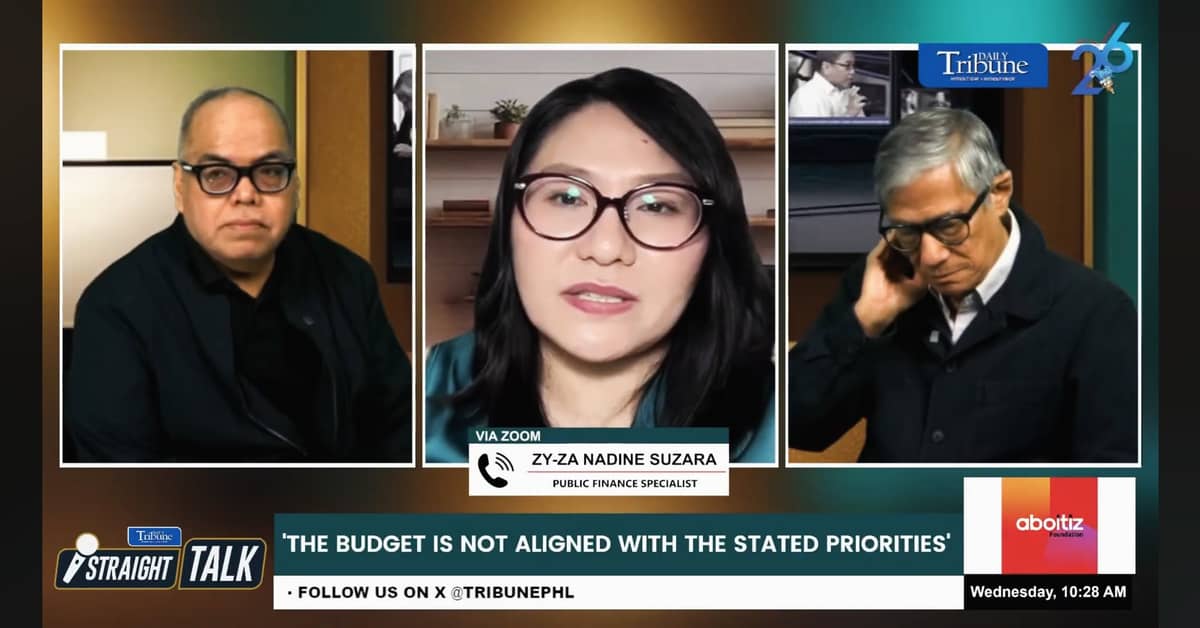
INSIDE the numbers Former Budget department official Zy-za Nadine Suzara, takes Straight Talk hosts Chito Lozada (left) and Teddy Montelibano inside the machinery of government budgeting, where every peso tells a story.
Screengrab from Straight Talk
Hard pork refers largely to infrastructure projects, including those under the Department of Public Works and Highways and farm-to-market roads under the Department of Agriculture.
Suzara also pointed to the Local Government Support Fund, which she described as a discretionary fund rather than a mandatory share of local governments.
For her, the issue is not merely how much is allocated, but whether those allocations reflect the government’s stated development priorities.
“I think there’s a very, very huge disconnect there,” she said.
Borrowing cost
Suzara’s scrutiny also extends to the country’s rising debt-servicing burden.
The proposed 2027 budget includes about P1.1 trillion for interest payments alone, according to her analysis. That is higher than the P950 billion allocated for interest payments in the 2026 General Appropriations Act and more than P800 billion in 2025.
The proposed interest payments account for about 15.5 percent of the P7.2-trillion budget.
For Suzara, the growing debt burden is a reminder that today’s fiscal decisions can narrow tomorrow’s options.
“When you borrow more, you have to pay,” she said.
She linked the higher deficit and borrowing requirements to a range of fiscal issues and controversies in previous years, including the use of health funds, the cash sweep involving the Philippine Deposit Insurance Corp., flood control projects and unprogrammed appropriations.

DECODING budget Zy-za Nadine Suzara, a seasoned public budgeting and fiscal management expert, brings clarity to the numbers behind government spending and how officials entrusted to ensure its efficient use abuse it.
Photograph courtesy of Zy-za Nadine Suzara/FB
Suzara said her analysis of the initial figures in the 2027 National Expenditure Program shows that more than P400 billion of the available fiscal space is allocated to what she describes as populist and patronage-driven programs and projects.
Keeping watch
Suzara’s work does not stop with analyzing the executive branch’s budget proposal.
She is also watching what happens when the budget reaches Congress, particularly the Bicameral Conference Committee, or Bicam.
While the Department of Budget and Management proposes a relatively modest level of unprogrammed appropriations in the National Expenditure Program, Suzara noted that these amounts have been increased during congressional deliberations in previous years.
That makes the legislative process an important part of her scrutiny.
Even livestreaming the Bicam proceedings, she said, does not eliminate the need for public vigilance.
For Suzara, transparency ultimately depends on people paying attention to the numbers and tracking how they change throughout the budget process.
She recalled that during the previous year’s budget deliberations, a livestream was cut for more than six hours. Budget monitors later observed increases in allocations for guarantee letters, ayuda programs and other appropriations, she said.
Suzara’s reading of the 2027 budget comes down to a simple distinction: P7.2 trillion may be the headline, but P1.15 trillion is where much of the government’s real discretion lies.
And with that space tightening, Suzara argues the more important question is not how big the national budget is.
It is what government chooses to do with the little room it has left.