
Robotics powered surgery shaping next era of medicine
Beyond individual systems, the real transformation lies in the convergence of AI, robotics and data. These technologies are enabling precision medicine, where treatments are tailored to each patient’s anatomy and condition.

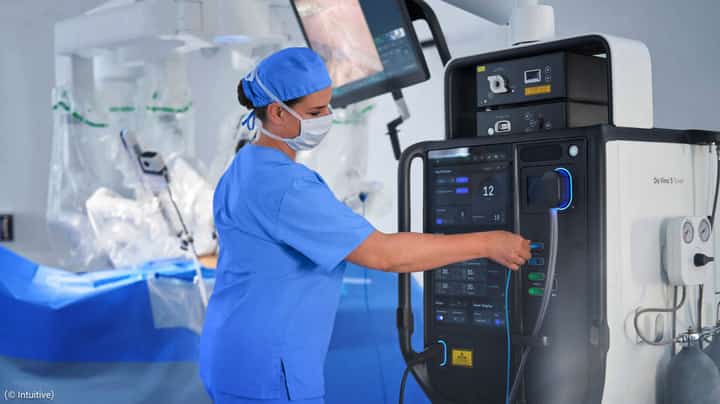
AI and robotics are transforming modern surgery, with systems like the da Vinci 5 using real-time AI data to improve precision, safety, and patient outcomes in the operating room.
Photograph courtesy of Intuitive
Surgical care is entering a new era where artificial intelligence and robotics are reshaping what is possible inside the operating room. From ultra-precise robotic arms to satellite-powered remote operations, these advancements are reducing risks, improving accuracy, and expanding access to life-saving procedures. What once required large incisions and long recovery periods is now becoming minimally invasive, data-driven, and highly personalized.
One of the most remarkable breakthroughs in 2026 came from satellite liver surgery, where Chinese medical teams successfully performed remote operations across more than 3,100 miles between Lhasa and Beijing. Using the Apstar-6D satellite, surgeons overcame a 632-millisecond signal delay through advanced correction software, achieving robotic precision within just 0.32 mm. This milestone showed that distance is no longer a barrier when intelligent systems can stabilize surgical movements in real time.
In the United States, robotic-assisted surgery continues to evolve through systems like the da Vinci platform by Intuitive Surgical. With over 20 million procedures performed globally, it allows surgeons to operate through smaller incisions, reducing blood loss and speeding recovery. The latest da Vinci 5 integrates AI features that provide tactile feedback, helping surgeons sense resistance and adjust force in real time, improving safety during delicate procedures.
Another innovation is the MIRA surgical system developed by Virtual Incision. Weighing under one kilogram, this miniaturized robot can be moved between operating rooms and used in intestinal and other procedures. Its compact design reduces setup time while maintaining precision. Future versions are expected to integrate AI-assisted decision-making and remote surgery capabilities, already tested with NASA aboard the International Space Station.
AI is also transforming early detection. The Ion robotic bronchoscopy system enables minimally invasive lung biopsies that detect cancer earlier. With AI navigation, it analyzes live imaging and adjusts surgical paths like a GPS rerouting around obstacles. This improves diagnostic accuracy and patient outcomes, with hundreds of systems now operating worldwide.
In orthopedics, robotic platforms like the Mako system by Stryker are improving joint replacement procedures. Using AI-driven planning, it assists surgeons in aligning implants with high precision while preserving healthy bone. The result is better joint stability and longer-lasting outcomes for knee and hip replacements.
Beyond individual systems, the real transformation lies in the convergence of AI, robotics, and data. These technologies are enabling precision medicine, where treatments are tailored to each patient’s anatomy and condition. Surgeons are no longer working alone but alongside intelligent systems that enhance decision-making, reduce errors, and improve consistency.
As surgical robotics evolves, the biggest win is human impact. Patients experience less trauma, faster recovery, and improved survival rates, while doctors gain tools that expand their wcapabilities. The operating room of the future is becoming safer, smarter, and more connected, marking a turning point in how medicine heals and saves lives.