
LRA eyes fully digital land titling, cashless payments

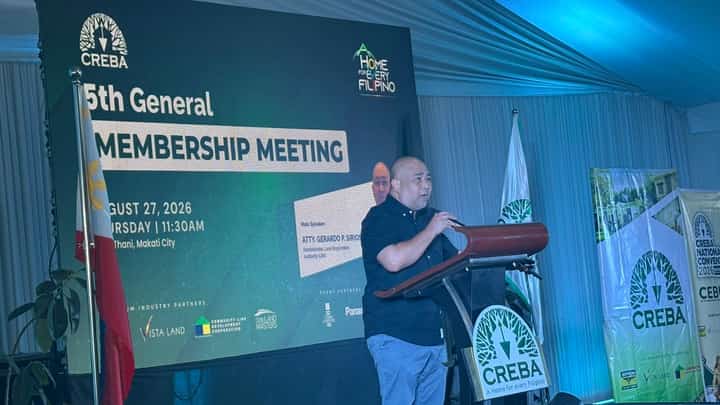
Land Registration Authority Administrator Gerardo Panga Sirios discusses the agency’s push toward cashless payments and a fully digital land titling system during the CREBA 5th General Membership Summit.
Photograph by Mico Virata for DAILY TRIBUNE
The Land Registration Authority (LRA) is moving toward a fully digital land titling system that could eventually eliminate problems involving lost titles, overlapping properties and fake land documents, as the government pursues wider reforms to make property transactions faster and more convenient.
Speaking at the Chamber of Real Estate and Builders’ Associations Inc. (CREBA) 5th General Membership Summit, LRA Administrator Gerardo Panga Sirios said the agency has already opened its services to cashless payments and is preparing for a broader shift toward end-to-end digital transactions.
New technology system
Sirios said the LRA recently concluded negotiations on a public-private partnership proposal for a new information technology system that could provide digital titles and other online services. The proposal will undergo review by the Department of Justice and a Swiss challenge process before development can proceed.
If implemented, the system could take about two years to develop, with the LRA targeting a fully digital land registration system over the next five to 10 years.
“With a fully digital title, the loss is gone,” Sirios said, explaining that digital records could remove the need for court proceedings to replace lost owner’s or registry copies of land titles.
The LRA is also exploring a system that would digitally map land titles, which Sirios said could help address overlapping claims and fraudulent or “fake” titles.
The digitalization push comes as developers continue to seek reforms that would reduce delays and regulatory costs in housing and property development.
CREBA national president Noel “Toti” Cariño said the group is pushing for policies that protect buyers while ensuring that regulations do not make housing development more difficult or commercially unviable.
“Balanced housing policies must ultimately encourage more housing production, not make it more difficult to build homes and communities,” Cariño said.
Among the industry’s priorities are proposed amendments to the balanced housing provisions of the Urban Development and Housing Act, reforms to the Maceda Law, and continued discussions on the proposed real property valuation and assessment reforms.
Deferment of property valuation reforms welcomed
CREBA welcomed the deferment of the real property valuation reforms, saying the additional time should be used for consultations, capacity building and an assessment of the potential impact on property costs, housing prices and investments.
The group is also preparing to engage the judiciary on housing and land-related issues while continuing discussions with regulators and lawmakers.
Beyond legislation, Sirios said the LRA is coordinating with other government agencies to link databases and reduce duplicate documentary submissions. The agency is also working with the Supreme Court on integrating electronic notarization into future digital property transactions.
Land and Justice Summit
The Supreme Court is likewise preparing a Land and Justice Summit, which will bring together stakeholders to address longstanding issues involving land disputes, title registration and other legal concerns affecting property development.
For CREBA, the reforms ultimately come back to a broader goal: making it easier to produce more homes while improving the systems that support land ownership and property development.
“Our industry today faces many challenges, but it also carries an enormous responsibility,” Cariño said. “Every policy we advocate, every law that we seek to improve, and every project our members undertake ultimately has one purpose, to help more Filipino families realize the dream of owning a decent home in better communities.”