
The architectural terror of backrooms
‘Liminal space is designed to trigger this specific reaction in us.’


Backrooms is finally out on streaming, and this is my call for everyone who loves architecture and horror to give this one a watch. It follows a frustrated furniture store owner who discovers a series of huge, empty rooms, “the backrooms,” hidden behind a wall in his store’s basement. He explores these spaces to uncover their meaning and purpose, all while trying to avoid the strange and supernatural forces he and others encounter there. The movie is based on an internet thread that gained fame for focusing on liminal spaces and the creepypasta genre. The thread attracted so much attention that YouTuber Kane Parsons, who also directed the film, created a Backrooms web series. Since then, the story has captured the public’s imagination and become A24’s highest-grossing film so far.
It’s easy to see why the film has been so successful, as Backrooms lingered in my mind long after the credits rolled, particularly due to its use of unsettling architectural interiors. As an architect and a big fan of horror movies, I feel its impact as well, as do other moviegoers (as seen in online reviews); however, I want to architecturally pinpoint what makes its horror so profound for us all.
Backrooms, as a movie, immerses viewers in liminal spaces — places that create a strange feeling, as if something is off. These spaces can unnerve, unsettle, or even scare you. Horror movies often feature liminal spaces in their settings to evoke a looming sense of dread. For example, The Shining traps viewers in terror with the Overlook Hotel’s empty ballrooms and deserted Art Deco hallways. It Follows, one of my recent favorites, isolates its characters in Detroit’s run-down cityscape. Backrooms intensifies this idea of dread; its creative, unsettling sets amplify these emotions tenfold.
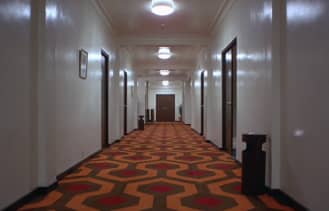
THE interior architecture of ‘The Shining.’
Photo courtesy of the warner brothers
The film’s characters step through the furniture store’s basement wall and find themselves in new rooms that look normal at first. But if you look more closely and really scrutinize the space, you eventually notice small oddities. There might be a door with three doorknobs, an empty room with a hole in the floor leading to total blackness, or a pitch-black room lit red by a Christmas tree. This also gives more weight to the “uncanny valley effect,” a psychological phenomenon that occurs when realistic things appear almost real (but never completely do), triggering unease and revulsion. As the characters move from room to room, the interior architecture gives rise to even more disturbing and grotesque scenes (which I won’t spoil here).
Humans, like most animals, have a “fight or flight” response. This is perceived by the amygdala, a small cluster of nuclei in our brain’s temporal lobes. Backrooms is so scary because liminal space is designed to trigger this specific reaction in us. Humans are social creatures who rely on others for comfort and safety. When we find ourselves in empty, unfamiliar spaces without people, we feel more vulnerable and uneasy. Our brains are wired to interpret such uncertainty as a potential threat. As the characters in Backrooms travel from one room to another, sometimes at alarming speed, we have no clue what monstrosities its interior architecture will manifest. This triggers our amygdala, leading to shortness of breath and a spike in adrenaline, and sends our nervous system into overdrive. The film is so creative that you never know what kind of horror the characters will face next. And this is the reason why I think it terrifies many of its viewers.
Most of my favorite horror films are those that forgo predictable jump scares and let the film’s overall tone and atmosphere be the sole reason I get scared. Backrooms succeeds in that in spades, but being an architect, I can’t help but appreciate the film even more because it frames “architecture” as the film’s main villain.