
DepEd seeks school-level authority to resume classes after disasters

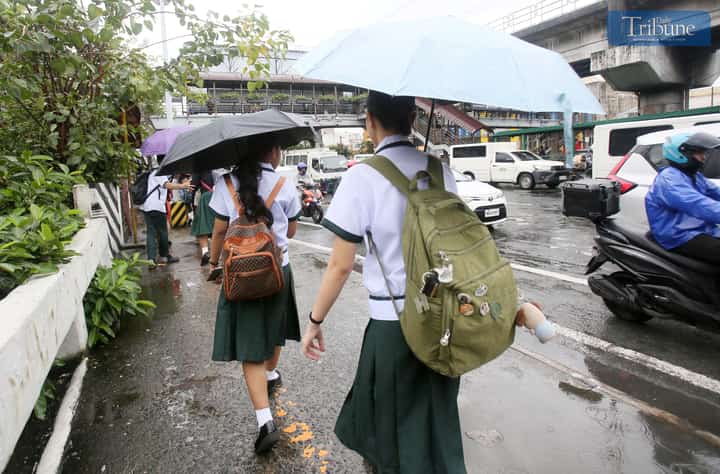
(JULY 3, 2025) Students of Ramon Magsaysay High School in Cubao, Quezon City seen headed home after the Quezon City LGU announce the suspension of classes in the afternoon due to the bad weather, PAGASA said A Low Pressure area LPA inside the Philippine Area of Responsibility (PAR) has a "MEDIUM" potential to develop into a tropical depression within the next 24 hours. on Thursday July 3 2025. Photo/Analy Labor
The Department of Education (DepEd) is seeking new rules that would allow individual schools to resume in-person classes even when class suspensions remain in effect across an entire city or municipality, in a bid to prevent prolonged learning disruptions after disasters and severe weather.
Under a proposed executive order, schools that are safe, accessible and have recovered from an emergency could reopen based on a site-specific safety assessment, subject to concurrence from the local chief executive.
“While safety will always remain our non-negotiable priority, we can no longer rely on broad, blanket suspensions where an entire city shuts down even when individual campuses are dry, safe, and ready to teach,” said Education Secretary Sonny Angara.
“If a school is clear, accessible, and certified safe, our learners should be back in the classroom without delay,” he added.
The proposed order would update Executive Order No. 66, issued in 2012, which established automatic and localized suspension of classes and work in government offices during weather disturbances and calamities.
The new framework would cover a broader range of hazards, including extreme heat, earthquakes, power outages and poor air quality, while setting rules not only for suspending classes but also for resuming them.
Public school heads could initiate a return to in-person classes while a city- or municipality-wide suspension remains active, provided they complete a documented assessment of conditions at their campus and obtain the concurrence of the local chief executive.
Meanwhile, private schools would be allowed to declare class resumptions in prompt coordination with the local chief executive.
DepEd said local governments and schools division offices would have a structured one-hour window to concur with a school's safety assessment.
The proposal would retain the authority of school heads to suspend in-person classes when hazards are confined to individual campuses, such as localized flooding or power failures. Such suspensions require the concurrence of the schools division superintendent under DepEd's existing rules.
DepEd's current disaster guidelines, issued under DepEd Order No. 22, emphasize localized assessments and learning continuity measures, including alternative delivery modes such as modular, online and blended learning when in-person classes are disrupted.