
THEATER REVIEW: 'Endo,' a solid narrative competing with constant motion
Despite the technical noise and the over-eager staging, the story remains deeply resonant.


I caught the 18 April matinee of the stage adaptation of the 2007 Cinemalaya film Endo (which I didn’t get to watch), starring Royce Cabrera as Leo, Rissey Reyes-Robinson as Tanya, and Kate Alejandrino as Candy.
Written by Liza Magtoto, with dramaturg Eric Dela Cruz and direction by Melvin Lee, the play is set in today’s TikTok age. Within the gig economy, the central male character, Leo, is a courier caught in a relentless paycheck-to-paycheck cycle.
It’s a world defined by zero security and no benefits, where Leo's whole life is tied to the next booking. Without a degree or a safety net, his life is a cycle of chasing the next delivery just to eat— a reality that feels painfully familiar in today’s economy.
But at its core, Endo is a romantic drama gasping for air under economic pressure. Leo’s girlfriend, Tanya, is a nursing grad who can’t afford to work in a Philippine hospital because the pay is a joke. She represents labor migration—the idea that to have a future, you have to leave the country. So, the conflict of the story is not "do they love each other?" but rather "can they afford to stay together?"
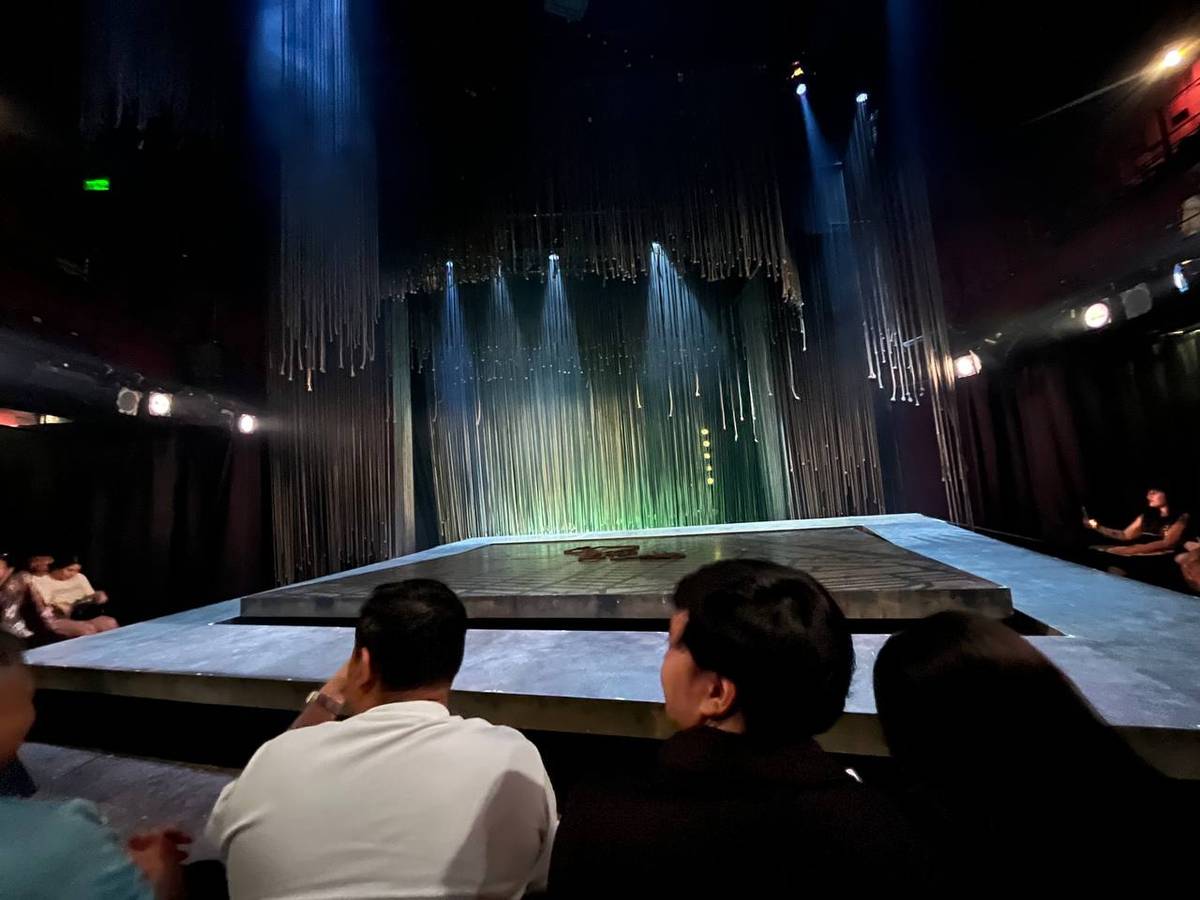
The stage features a central articulated platform that tilts and shifts.
Stephanie Mayo
Cabrera and Reyes-Robinson’s chemistry is real, but the production often gets in its own way. There's the ensemble that functions as a physical chorus, using a movement-based performance language derived from contemporary dance under choreographer Christine Crame. They shift across functions— simulating traffic, appearing as background workers, taking on minor speaking roles, and at times serving as human props.
Unfortunately, this often leads to competing stage action. When you’re trying to hear a heart-to-heart conversation but five people are doing interpretive dance in the background, the emotional resonance gets lost.
In fact, the staging relies on constant motion to maintain engagement, as if stillness and text alone are insufficient. At times, the movements are also unintentionally comical, disrupting the seriousness of the moment.
The scenography is the show’s most ambitious gamble. The stage features a central articulated platform that tilts and shifts, forcing the actors to fight for balance. Surrounding it is a circulation track where Leo circles on his scooter.
This places a significant physical burden on the cast. Performers deliver lines while adjusting to an unstable surface, at times executing complex choreography. The effort is visible, and the audience becomes acutely aware of the risk of slipping or falling.
And by the time we get to Leo and Tanya's third love scene, it feels like dramaturgical redundancy. Instead of feeling the intimacy, you’re just watching the technical effort.
The moving stage platform also creaks loudly, and because that noise is not part of the sound design, it’s a constant reminder that you’re watching a play.
But there are also nice touches. Overhead, a forest of hanging vertical ropes symbolizes how the characters are bound by debt, duty, and an absolute lack of freedom.
There’s also the clever bit of digital dramaturgy where the characters' mobile phones glow with yellow light—symbolizing how apps dictate the mechanics of survival. The glow signals access to bookings, and other opportunities within a system that depends on constant connectivity.
But despite the technical noise and the over-eager staging, the story remains deeply resonant. It captures the "precarity" of modern life. The feeling that one bad day could ruin everything.
Leo is a solidly written character. You cannot judge him for being unambitious, as his life situation requires immediate money. With a hand-to-mouth existence and a sick father and brother depending on him, how can he carve out time for long-term planning, such as working abroad?
The three leads deliver solid performances. Alejandrino provides well-timed comic relief, while Cabrera and Reyes-Robinson meet the physical demands of the roles even as the staging exposes the sheer effort required.
The supporting cast remains competent throughout. The humor is unapologetically broad and on-the-nose, but feels appropriate for the setting.
Endo is an interesting experiment in concept-driven staging. It might be a bit too busy for its own good, but for anyone who wants to see how theater can physically manifest the stress of the hustle, it is a ride worth taking.
ENDO runs from 10 April to 10 May 2026 at the PETA Theater Center in Quezon City.