
Big break for bamboo
House Bill 10312 requires government agencies to progressively increase the use of bamboo in public infrastructure projects.

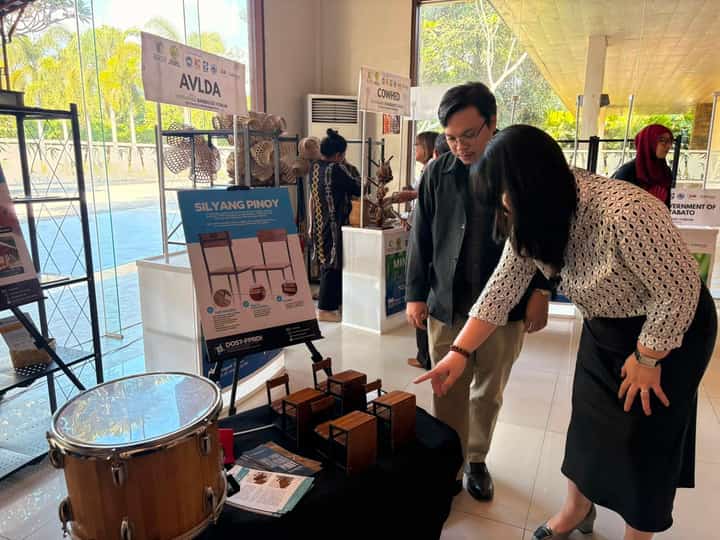
SCALE models of classroom desk and chair made from bamboo are featured at the exhibition area of the Mindanao Bamboost Forum.
PHOTOGRAPH COURTESY OF DOST XII
Support is swelling for the economic exploitation of bamboo.
The House of Representatives approved on second reading House Bill 10312, entitled “An Act Mainstreaming The Use Of Bamboo As A Sustainable And Climate-Resilient Material For The Built Environment” on 5 August 2026. The bill seeks to mainstream the use of bamboo in construction and establishes a national framework for its use in the country’s construction sector by developing uniform standards for its design, engineering, certification and application in both public and private construction projects, according to bill sponsor Antipolo City Rep. Philip Conrad M. Acop.
The frameworks are the Bamboo Architectural Code and a Bamboo Structural Code, which will be integrated into the country’s architectural and structural codes to ensure the safe and standardized use of bamboo in construction.
Under the bill, the Department of Public Works and Highways will also establish certification systems for bamboo products and streamline the permitting process for bamboo-based projects.
The bill also requires government agencies to progressively increase the use of bamboo in public infrastructure projects, with at least 30 percent of wood-based requirements sourced from bamboo within three years and 50 percent within five years, subject to supply availability. It further provides fiscal and non-fiscal incentives, including tax and duty exemptions, financing support, insurance coverage, and regulatory incentives for bamboo farmers, cooperatives, processors and investors.
Meanwhile, the Mindanao Bamboost Forum: The South Cotabato Experience happened on 7 August 2026, at The Farm @ Carpenter Hill, South Cotabato.
The organizers were Base Bahay Foundation, the South Cotabato Bamboo Industry Development Council, the Provincial Government of South Cotabato, the Mindanao Development Authority, the Department of Science and Technology Region XII, the Mahintana Foundation, Dole Philippines and the ChildFund Philippines.
The event has an exhibit where the South Cotabato State College showcased innovative BambooPel (bamboo paper) and PalayPel (rice straw paper) developed by students.
The BambooPel is derived from bamboo fibers, demonstrating the versatility of the grass beyond construction.
The forum featured discussions on strengthening the bamboo value chain, showcasing bamboo-based technologies and projects, and encouraging wider adoption of bamboo in both public and private sector construction.
“Climate action must translate into solutions that are practical, scalable, and responsive to the realities of our communities. Bamboo offers an opportunity to connect resilience with sustainable development by harnessing a locally available resource for climate-responsive construction,” Climate Change Commission vice chairperson and executive director Robert E.A. Borje said.
Borje added that the country’s ambition for bamboo should go beyond producing raw materials. “The goal should be to create greater value through research, engineering, design, manufacturing, and construction, allowing more of the industry’s economic value to remain in the country,” he said.