
NYC mayor proposes $127B budget, property tax hike for the wealthy
Mayor says taxing the wealthy is fairer route than broad property tax increases to close city budget gap.


New York City Mayor Zohran Mamdani on 17 February 2026 released a preliminary $127 billion budget for fiscal year 2027 that would raise taxes on wealthy New Yorkers and profitable corporations, or alternatively impose a 9.5 percent property tax increase if the state does not approve income tax hikes. The plan aims to close an estimated $5.4 billion budget gap after updated revenue projections, city savings initiatives, and $1.5 billion in support from Governor Kathy Hochul reduced the projected shortfall from over $12 billion.
Mamdani, a Democratic socialist, described the budget gap as a major challenge and framed his preferred solution as one that shifts the burden to high earners and corporations rather than working‑ and middle-class residents. He said, “If we do not fix this structural imbalance and do not heed the calls of New Yorkers to raise taxes on the wealthy, this crisis will not disappear.”
Under the mayor’s preferred approach, personal income taxes would rise for the roughly 33,000 New Yorkers earning more than $1 million annually, and the most profitable corporations would also face higher taxes. Mamdani called this “the most sustainable and the fairest” path. However, these changes require approval from the New York State Legislature in Albany, and is considered as the "last resort."
If the first path fails, the city would resort to raising property taxes by 9.5 percent, generating approximately $3.7 billion in revenue while also drawing on city reserves. The property tax increase would affect around three million residential units and 100,000 commercial properties.
Examples illustrate the potential impact: in Brooklyn’s Park Slope, a single-family home assessed at $44,000 could see annual taxes rise to about $9,500 from roughly $8,700, while a condominium assessed at $120,000 might see taxes increase to $16,345 from roughly $14,926. Property taxes in New York City have not been raised since shortly after the 11 September 2001 attacks.
The $127 billion proposed budget is nearly $10 billion higher than the entire state budget of Florida, even though Florida’s population is roughly three times that of New York City. The scale of the budget reflects the city’s extensive responsibilities in education, social services, transportation, and public safety.
Mamdani’s plan includes significant spending increases, such as:
$38 billion for the Department of Education, about $3 billion more than the previous year.
$1.64 billion for homelessness support programs.
Expanded legal support for immigrants and community food security initiatives.
Funding for 200 additional attorneys and support staff in the city’s Law Department.
City agencies are required to designate Chief Savings Officers to identify efficiencies, projected to save $1.77 billion over two fiscal years.
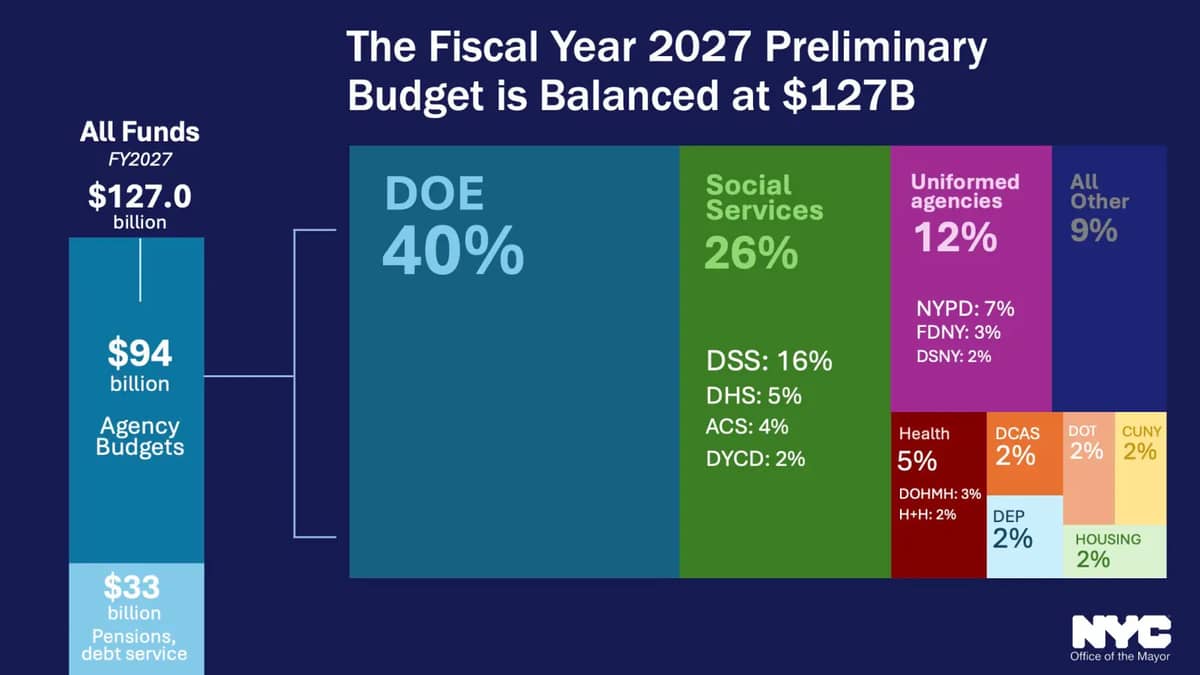
A breakdown of Mamdani's budget proposal.
Photo from City of New York.
Critics warned that broad property tax increases could be regressive and exacerbate affordability challenges. City Comptroller Mark Levine said the proposal could have “dire consequences” for residents, while real estate experts noted landlords might pass higher costs to tenants, potentially pushing some to move to lower-tax states such as Florida or Texas.
Local political leaders also expressed opposition. City Council Speaker Julie Menin said a property tax increase should not be considered while many New Yorkers face affordability struggles, and Queens Borough President Donovan Richards called the proposed hike “a nonstarter,” especially for homeowners on fixed incomes and small neighborhood businesses.
Governor Hochul has consistently opposed broad property tax increases and income tax hikes on the wealthy, although the final decision on income tax authority lies with the state legislature, while local property taxes require City Council approval.
Political analysts described Mamdani’s strategy as bold but risky. A Democratic insider called it “stunningly risky,” noting the unpopularity of broad property tax increases and the challenges of negotiating with Albany.
The preliminary budget now enters negotiation with the City Council and state lawmakers. A final adopted budget is due by 05 June 2026 and will take effect on 01 July 2026.