
Statue toppled as Australians reckon with bloody past
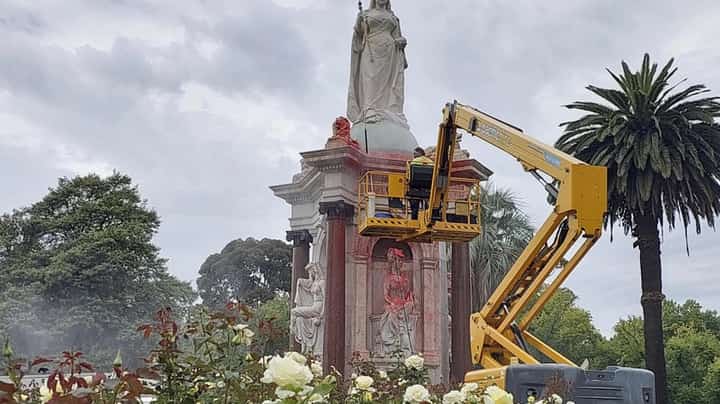
Statues of British colonial figures Captain James Cook and Queen Victoria were damaged in Melbourne on Thursday, as annual Australia Day celebrations were again marked by division and protest.
On the eve of the country's national holiday, a now-traditional row over Australia's often brutal past re-erupted.
In the southern city of Melbourne, a statue of the British explorer was felled -- apparently cut off at the shins -- and its plinth sprayed with the words "The colony will fall."
Meanwhile, a nearby likeness of British monarch Queen Victoria was daubed with red paint.
"This sort of vandalism has no place in our community," said Victoria state premier Jacinta Allan.
Australia Day is held every year on 26 January.
For most Australians, it is synonymous with a day off work, a barbecue, a trip to the beach and the end of the summer holidays.
But the choice of date -- celebrating the arrival of European settlers at Sydney Harbour in 1788 -- has become increasingly contentious.
A US-style culture war has developed, with activists demanding colonial figures be celebrated, or decrying "Invasion Day" as a celebration of cultural genocide.
Polls show a majority of Australians have a more nuanced view, and are keen to keep the public holiday and the name, but are more split about changing the date.
"Australians love their public holidays, I love my public holidays. If we want a public holiday let's just rebrand it, rebadge it, but let's move Australia Day to another date," 50-year-old Melbourne resident Michelle Slater told AFP.
With views on the date mostly split along party political lines -- with the right against changes and the left in favor -- politicians have at times appeared keen to fan the flames of division.
Conservative opposition leader Peter Dutton recently denounced a "woke" grocery chain that stopped selling Australia Day-branded paraphernalia.
"For Woolworths to start taking political positions to oppose Australia Day is against the national interest," he claimed.
A recent YouGov poll showed 20 percent of Australians agreed with Dutton's call for a boycott of the store, while 66 percent said they were more concerned with supermarkets' high prices.
Cricket captain Pat Cummins, perhaps the country's most prominent sports personality, has also weighed in, suggesting a more inclusive date could be found.
"I absolutely love Australia. It is the best country in the world by a mile," he said.
"We should have an Australia Day, but we can probably find a more appropriate day to celebrate it."
Late last year, Australians rejected changes to the 1901 constitution that would have recognized the country's first inhabitants and created an Indigenous consultative body -- a "Voice" to Parliament.
The proposal was defeated in every state across the country.
Just under four percent of Australia's 26 million population are Indigenous.