





SEA’s digital economy seen doubling at $3 trillion by 2030
ASEAN economic ministers expect the region’s digital economy to reach $3 trillion by 2030, driven by the ASEAN Digital Economy Framework Agreement and deeper…
Tip: add a year in your query (e.g. Eala 2022) or use the year filter.
90,801 results for “digital economy developing countries”
ASEAN economic ministers expect the region’s digital economy to reach $3 trillion by 2030, driven by the ASEAN Digital Economy Framework Agreement and deeper…
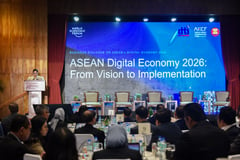
The World Economic Forum, in collaboration with the ASEAN-Korea Cooperation Fund, convenes the Business Dialogue on ASEAN’s Digital Economy 2026, bringing…

DICT’s Digital Bayanihan Caravan is transforming Palawan’s digital economy with 621 free Wi-Fi hotspots in 207 public schools, new computer sets, telehealth…

Developed countries must triple adaptation finance.

Discover how DOST-MIRDC is driving industrial development in the Philippines through cutting-edge metals and engineering research, technical training, and…

ASEAN has concluded negotiations for the Digital Economy Framework Agreement (DEFA), a landmark regional pact aimed at boosting cross-border digital trade,…



BCDA partners with digital energy firm Esyasoft Technologies Asia to accelerate the Philippines’ transition to cleaner, more reliable power in New Clark City…

A new study highlights the Philippines’ rapid shift toward digital financial services alongside persistent inclusion gaps, as Iligan City pushes AI-driven…


Participants gained foundational skills in data annotation — an essential component in training Artificial Intelligence systems.

A proposed bill seeks to recognize YWC, a gold-backed stablecoin, as legal tender in Indigenous Peoples’ ancestral domains, leveraging blockchain to enable…

The Philippine digital economy is set to hit $36 billion GMV by 2025, driven by e-commerce, digital payments, and rising AI adoption, making the country a…


‘A successful transition to a digital and green economy requires a training system that quickly adjusts to the evolving skills needs of the labor market.’