
Phl businesses lag two years behind global A.I. adoption
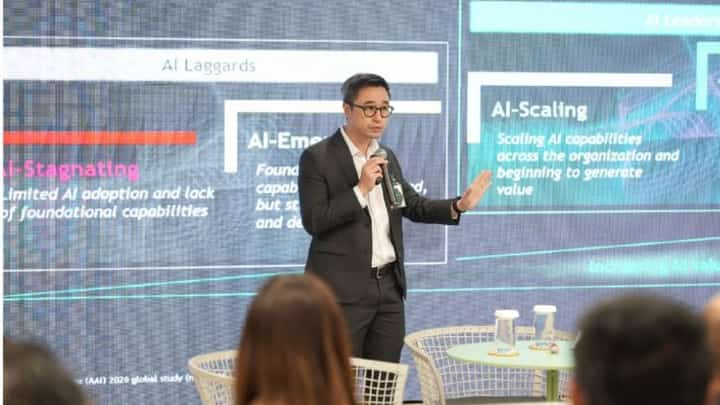
BCG Manila managing director and partner Julian Cua said Philippine businesses recognize AI’s potential but face challenges in converting investments into tangible results.
PHOTOGRAPH COURTESY OF BGC
Philippine businesses are approximately two years behind the global artificial intelligence (AI) maturity curve, with many companies struggling to translate investments in the technology into measurable business results, according to a new study.
The Philippine AI Maturity Report, released by Boston Consulting Group (BCG) and the Makati Business Club (MBC) on 11 November 2026, found that 60 percent of surveyed companies remained in the lowest two categories of AI maturity.
None of the 35 large Philippine companies surveyed had reached the highest category, known as “Future-built,” although 54 percent aim to achieve that level by 2029.
The study covered 12 industries and used a framework based on BCG’s global Applied AI Index, which surveyed more than 1,330 organizations across over 60 countries.
Researchers found that the Philippines’ average AI maturity in 2026 was closer to the global average recorded in 2024 than to current international levels.
“Philippine business leaders are recognizing the potential of AI, as seen through their ambitious AI targets. The gap is in turning this ambition into real business value,” said Julian Cua, BCG Manila managing director and partner.
The study found that companies performed better in building AI infrastructure than in generating business outcomes.
AI-enabling capabilities, including technology, data, personnel and operating models, averaged 46 points, compared with 37 points for business outcomes such as innovation, customer experience and operations.
The gap was particularly evident in AI-powered customer services, marketing, pricing and personalization.
Higher-performing companies also invested more heavily in AI, allocating 13.4 percent of their IT budgets to the technology, compared with 7.7 percent among less mature firms.
Meanwhile, 80 percent of the top 10 companies had deployed AI in IT and data workflows, compared with just 20 percent of the bottom 10.
The report identified three major barriers to wider adoption: outdated technology systems, shortages of AI-skilled workers and the high cost of AI relative to local labor expenses.
Although 74 percent of surveyed enterprises had migrated most or all of their IT infrastructure to the cloud, 49 percent still considered legacy systems a major obstacle.
Demand for AI skills has also surged, with job postings requiring such capabilities increasing more than sixfold between 2021 and 2025.
However, only 17 percent of organizations said they could recruit and retain enough AI-skilled workers.
The findings raised concerns about the Philippines’ competitiveness, particularly in the information technology and business process management sector, where automation could threaten work traditionally supported by the country’s labor-cost advantage.
MBC executive director Julia Abad said the country had the foundations for an AI-driven economy but needed to turn that potential into tangible results.
“Factors such as a young, digitally engaged population, a world-class service workforce, and a business sector eager to innovate provide our country with the potential to create an AI-enabled economy,” Abad said.
The report urged businesses to prioritize measurable AI outcomes, invest in workforce training and strengthen data infrastructure.
It also called for closer government-industry cooperation to address talent shortages, fragmented data systems and the cost of deploying AI at scale.