
Are we becoming a digital dumping ground?
We need strict legislative teeth to close legal loopholes, mandate total transparency from any company claiming to be a legitimate recycling locator.
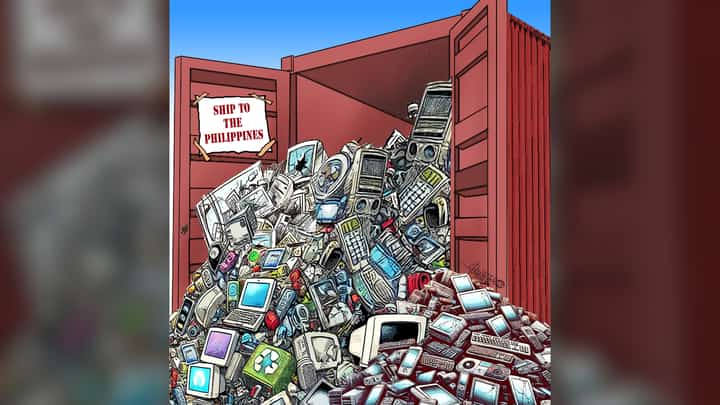
Even as territorial waters remain a bone of contention to this day, recent events at the Subic Bay Freeport have exposed another glaring vulnerability in the country’s boundaries.
Over the past few months, the Bureau of Customs (BoC) and environmental watchdog groups have flagged hundreds of container vans carrying suspected electronic waste shipped straight from the United States.
Often labeled deceptively as scrap metal, copper or reusable materials, these shipments highlight a deeply troubling trend: wealthy, industrialized nations attempting to offload their toxic digital garbage onto developing countries under the friendly guise of “recycling.”
While frontline agencies like the BoC deserve credit for stepping up multi-agency checks and actively blocking suspicious cargo — such as the interceptions of shipments arriving on vessels like the MV Dallas and MV Tokyo Express — these victories should serve as a wake-up call rather than a cause for celebration. They prove beyond a doubt that our special economic zones remain prime targets for international waste brokers looking for the path of least resistance.
Special economic zones were originally created to accelerate legitimate global trade, boost regional economies and attract responsible, high-value investments. They were never meant to serve as legal blind spots or convenient backdoors that override national environmental protection laws.
When obsolete electronics slip past our port authorities, the true cost is paid entirely by local communities.
E-waste is not ordinary trash. It contains hazardous materials like lead, mercury, cadmium and brominated flame retardants. When these items are improperly handled, abandoned or burned, these heavy metals leach directly into local soil and water tables. They quietly poison the very ecosystems that surrounding neighborhoods rely on for drinking water, farming and daily life, creating silent public health crises that take years to uncover.
“We cannot allow our country to be treated as a dumping ground for the digital debris of wealthier nations,” warned Reyvel Leonora, program campaigner at BAN Toxics. “When oversight fails at our ports, it is local communities and future generations who bear the toxic burden of unregulated electronic waste.”
The international dimension of this problem makes our vulnerability even more glaring. Because the US remains a glaring outlier as one of the few developed nations that is not a party to the Basel Convention, the landmark global treaty designed to control the movement of hazardous wastes across borders, waste brokers routinely exploit regulatory gaps between US export policies and Philippine environmental laws. They view our free ports as low-risk entry points where oversight can sometimes get lost in jurisdictional red tape.
To put a definitive stop to this practice, the government must act decisively on multiple fronts.
First, enforcement agencies must maintain a unified, ironclad front. Free port authorities, environmental protection watchdogs and customs regulators must work hand-in-hand rather than operating in silos or conflicting over jurisdiction. A fragmented border defense is an open invitation for smugglers.
Second, lawmakers must push forward with thorough investigations, such as those called for in congressional resolutions tracking hundreds of flagged containers arriving in Subic. We need strict legislative teeth to close legal loopholes, mandate total transparency from any company claiming to be a legitimate recycling locator, and impose crippling penalties on local entities that act as willing conduits for international toxic waste.
The message we send to the global community must be crystal clear: the Philippines is a home for sustainable, forward-looking growth, not a digital dumping ground for the rest of the world. It is time to prove that our borders are not open for exploitation and that our environment is not for sale.