
Give peace a chance
The military posturing on the Korean Peninsula could add another painful chapter to the history of a country divided by ideology more than 70 years ago.
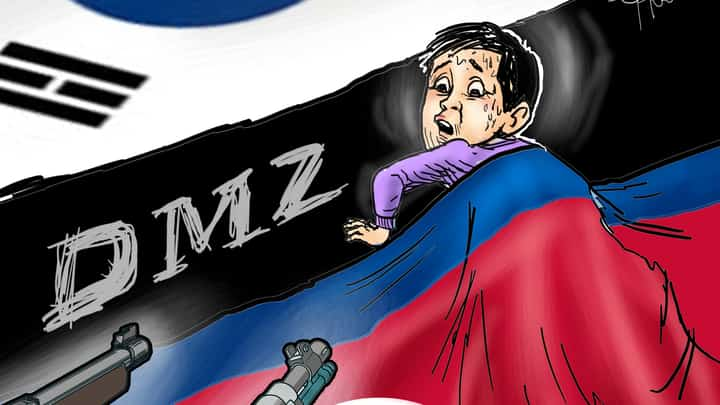
Outside Seoul’s bustling night markets and lively streets, a dangerous military standoff is unfolding along the border of the Korean Peninsula.
North Korean forces have started installing heavy artillery and howitzers on their side of the Demilitarized Zone (DMZ), an act of aggression that experts believe could escalate into a full-blown war.
The 250-kilometer border dividing the two Koreas has long been fortified. Under the 1953 Armistice Agreement, however, the four-kilometer-wide zone was meant to serve as a buffer between the two countries.
North Korea has planted some 960,000 landmines and is constructing barriers made up of wire fencing, tactical roads and anti-tank defenses on ground stripped of vegetation.
Tensions came to a head on 21 September when three South Korean soldiers were injured in a landmine explosion. Following a joint South Korea-United Nations investigation, Seoul demanded an apology, but Pyongyang rejected the findings, telling the UN Security Council that the incident was fabricated to evade responsibility for rising tensions.
Kim Yo Jong, the powerful sister of North Korean leader Kim Jong Un, called Seoul’s demand for an apology “despicable” and rejected an offer of medical equipment from the South.
North Korea has since further fortified its defenses, building barricades and placing heavy artillery and howitzers visible from the Aegibong Peace Ecopark observation deck in Gimpo, a popular tourist destination.
South Korea proposed military talks to calm the situation but also launched joint military exercises with the United States, involving stealth jets flying out of Kunsan Air Base from 26 October to 6 November.
The military buildup threatens to reopen wounds left by the Korean War, which divided countless families between 1950 and 1953.
For millions of relatives, the passage of decades has not eased the pain of separation or the uncertainty over loved ones they may never see again.
A North Korean woman who defected to South Korea in 2005 recently shared her story with tourists visiting the DMZ. She fled with her husband and nine-year-old son aboard a small makeshift pump boat, seeking not only escape from poverty and harsh living conditions but also reunion with relatives in the South.
They carried rat poison, which they planned to take before jumping into the sea if North Korean soldiers captured them. Fortunately, a South Korean navy boat spotted them and brought them to Incheon, where they underwent a three-month debriefing before being integrated into South Korean society.
Not every defection ends so well. Those who attempt the dangerous journey risk capture, torture or confinement in labor camps. Their families left behind may also face collective punishment.
For those who make it across, relief is tempered by the knowledge that loved ones in the North may never be seen or heard from again.
The DMZ is more than a military frontline. It is a physical barrier dividing families and separating people who risk everything for freedom.
As Pyongyang strengthens its defenses and Seoul conducts military exercises, peace is more than a sentimental plea. It is an urgent necessity.
Security on the Korean Peninsula cannot rest on an endless cycle of threats and military posturing. Diplomatic dialogue is essential not only to prevent another catastrophic conflict but also to give future generations a chance at healing and reconciliation.
The North Korean defector acknowledged that the wounds of the Korean War remain unhealed. She said many like her might even accept another war if it ultimately reunified the country and allowed separated families to embrace once more.
But reunification achieved through another war would come at an unbearable cost. The two Koreas must give peace a chance before another generation inherits the same grief.