
Beijing‘s quiet grip
The threat is made of ordinary parts, such as shares, contracts, software, and credit, which is why it is so easy to deny and so hard to remove.

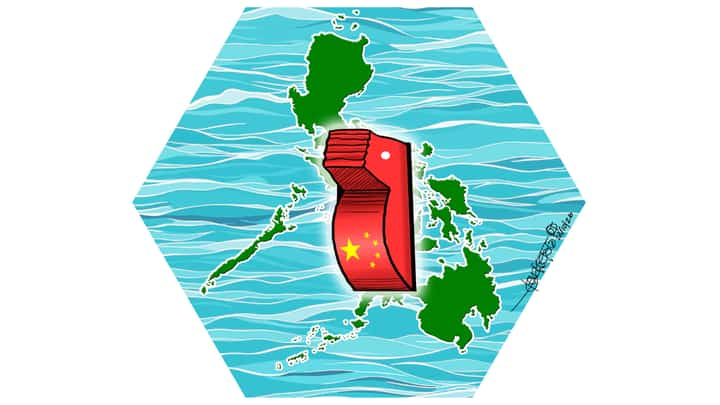
With the flick of a switch, the nation can be paralyzed, exposing a clear and present danger that emboldens Chinese officials to threaten Filipinos.
When Chinese Ambassador Jing Quan told reporters that “If we want to use force, we may easily win. But no, we will not use force. You know, we love peace, and in this region, we enjoy the peace,” he was being brutally frank about the disparity in military power between China and the Philippines.
But the threat to national security extends beyond the disputed West Philippine Sea, since China has significant control over the power transmission system operator, raising questions about the security of a utility firm vital to the country’s economy and defense.
This is the setting in which the ambassador’s boast must be read. A diplomat who says his country “may easily win” describes a contest he believes is already tilted in his favor, and the quiet holdings behind him give the words weight.
This is what subtle control means, and it is why the ambassador’s boast carries weight. Beijing doesn’t have to fire a shot to make its point — it can lean on a power line here, a loan there, and a network somewhere else, then remind Manila, in friendly words, how easy things could be.
This unseen grip was how the Asian power exerted control over many of its poorer neighbors.
The threat is made of ordinary parts, such as shares, contracts, software and credit, which is why it is so easy to deny and so hard to remove.
The envoy’s remark came as sea clashes grew sharper, and he warned of greater risk if military talks stayed closed. The message was that peace is available, but on their terms.
The question is what that kind of influence can do. Officials told a House panel hearing that the operator could cut power to most of the country if it chose to.
Foreign influence isn’t only at sea; it runs through phone networks, bank loans, mines, local politics, and the social media feeds Filipinos read. Each piece is small and easy to deny until someone puts them side by side.
Start with telecommunications. Dito Telecommunity was set up as a consortium in which China Telecom, a Chinese state-owned firm, held a 40 percent stake before November 2020.
Next is credit. Independent research found that nearly $9 billion in Chinese loans reached the private sector over two decades, and that a $3.9 billion syndicated loan to Dito in 2023 was the largest China-backed private loan ever made to the country.
Then there is espionage, which is the part most often made public. In January 2025, authorities arrested Deng Yuanqing, a Chinese national said to be linked to a military university of the People’s Liberation Army, along with two Filipinos.
In March 2026, three Filipinos who worked for the Department of Defense, the Navy and the Coast Guard were held for allegedly passing lists of military personnel to their Chinese handlers.
The Chinese embassy has dismissed all the allegations.
At a 2025 Senate hearing, documents linked the Chinese embassy to a Makati firm hired to run a troll farm, including a P930,000 payment made in September 2023.
A senior security official told the hearing there were signs of Chinese state-sponsored information operations that were interfering with the coming elections. The embassy answered by rejecting what it called a heinous accusation by opportunistic politicians.
Local government has not been spared. The Philippine Offshore Gaming Operators boom showed how a foreign network can sit inside a town hall, since the fingerprints of dismissed Bamban Mayor Alice Guo matched those of a Chinese national named Guo Hua Ping.
A mayor with the wrong papers, a gambling hub on her land, and a trail of money point to a sleeper and to how easily someone with the right connections can slip into public office.
Hundreds of foreign workers, mostly Chinese, were deported after the ban, but senators have warned that illegal hubs kept operating even after the ban.
The Philippines is also the world’s second-largest producer of mined nickel, and major Chinese firms in clean energy and electric vehicles have shown strong interest in expanding there. These metals are the stuff of modern batteries, so whoever buys and processes them gains a supply advantage.
The grid, however, is the clearest case, but it is not the only one.
A US research group found that Chinese lenders gave nearly $9 billion to the Philippine private sector over two decades, including a $3.9 billion syndicated loan to Dito in 2023.
None of this strategic money proves that Beijing intends to pull the switch.
A country that cannot say for certain who holds its light switch, its phone lines, and its debts cannot say it is free to answer a bully with a plain “no.”