
Breaking dynasties from ground up
Regular elections give citizens the opportunity to retain leaders who perform well and remove those who do not.

FROM one hurdle to another Former University of the Philippines professor and historian Roland Simbulan wrote The Bases of Our Insecurity: A Study of the US Military Bases in the Philippines. Simbulan now turns his attention to ending the deeply ingrained dynastic nature of Philippine politics.
Photograph courtesy of Roland Simbulan/FB
For political scientist Roland Simbulan, the barangay is more than the country’s smallest unit of government. It is where political power can take root, where family names can build influence and, potentially, where the grip of political dynasties can begin to loosen.
“The political dynasties have shown historically that they begin their monopoly of power starting with the barangays,” Simbulan, chairperson of the Center for People’s Empowerment in Governance (CENPEG), said in an interview with DAILY TRIBUNE’s Straight Talk.
“That’s where they start, where members of their families are put up to run for public office. First at the barangay level and then it goes up in future elections,” he explained.
Through this lens, Simbulan views the postponement of the Barangay and Sangguniang Kabataan Elections to 2028 not simply as a change in the electoral calendar, but as part of a larger question of who holds political power and how voters hold their leaders accountable.
For Simbulan, regular elections give citizens the opportunity to retain leaders who perform well and remove those who do not.
“Elections are not a mere administrative mechanism,” he stated.
“They are actually the means for the people to elect the leaders that they like to retain, the leaders who are doing their job, and to withdraw their support from leaders who are not doing their job,” Simbulan claimed.
Power at the grassroots
CENPEG has raised concerns over the political implications of extending the tenure of incumbent barangay officials ahead of the 2028 national elections.
Simbulan argued that officials who receive longer terms without facing voters could become politically indebted to those who grant the extension.
For him, that matters because barangays occupy a strategic position in Philippine politics.
“Remember, the barangays are very, very strategic because they are the unit in our government, the basic unit in our government that is closest to the people,” he said.
Their grassroots reach, Simbulan argued, makes barangay officials potentially important in mobilizing political support during national elections.
The issue also feeds into one of CENPEG’s longstanding concerns: the persistence of political dynasties.
The 1987 Constitution directs the State to prohibit political dynasties as may be defined by law, but Congress has yet to enact an enabling law.
Simbulan sees a fundamental contradiction in expecting Congress to solve the problem when many lawmakers themselves come from political families.
“That constitutional provision in the 1987 Constitution was not put there as a decoration,” he said. “It was actually a command, an order, and it’s supposed to be mandatory.”
For Simbulan, the failure to translate that constitutional provision into law boils down to a conflict of interest.
“You are asking these people in Congress to legislate against their own vested and family interests,” the CENPEG chief stated.
“The problem here is really the conflict of interest because you are asking members of Congress to behave against human nature.”
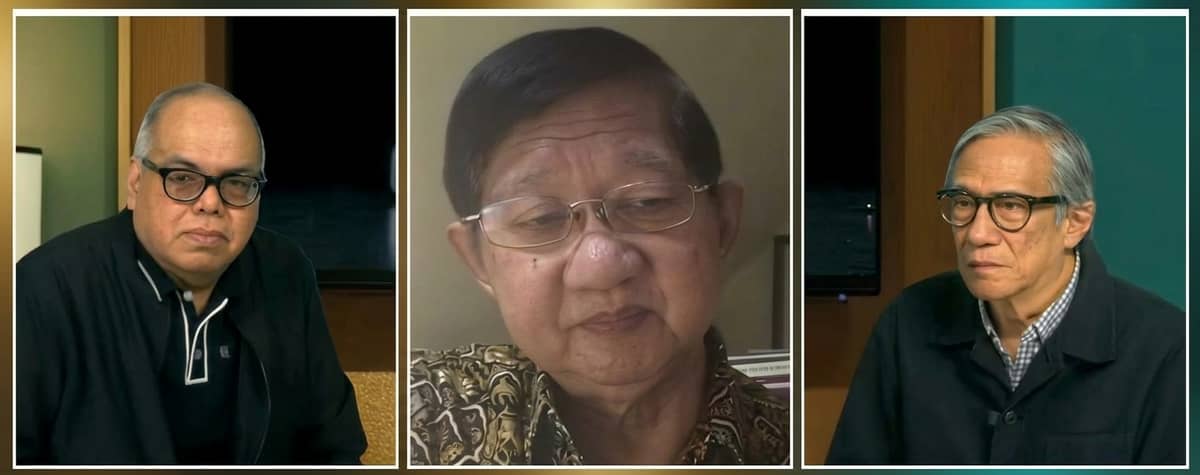
IGNORED command Roland Simbulan, chairperson of the Center for People’s Empowerment in Governance (center), told Straight Talk hosts Chito Lozada (left) and Teddy Montelibano that the provision in the 1987 Constitution prohibiting political dynasty was not there as a decoration. ‘It was actually a command, an order and it’s supposed to be mandatory.’
Screengrab from Straight Talk
Fake reform protects the system
Simbulan’s criticism comes not only from observing Congress from the outside.
He participated in House public hearings on anti-political dynasty proposals, an experience that left him skeptical that lawmakers would impose restrictions strong enough to dismantle entrenched family rule.
“During that public hearing, I could already sense that many of the congressmen were not open to the possibility of working against their own interests,” Simbulan shared.
He argued that the result could be an anti-dynasty measure that does little to dismantle the system it is supposed to restrict.
“I think the result of all these public hearings and deliberations that they held in the past months which started last year were all meant to pass or show off an anti-dynasty law that was in fact a legitimation of political dynasties,” he believed.
Under limited restrictions, Simbulan explained, relatives could still occupy positions at different levels of government.
“But the prohibition is very limited and selective because it still allows relatives to run in other levels of government,” he said.
“Because it’s so limited, all these restrictions, it would practically legitimize political dynasties.”
Simbulan acknowledged, however, that imposing stronger restrictions would be an uphill battle, particularly with political families deeply represented in Congress.
Beyond blood and wealth
Legislation, however, is only one part of CENPEG’s proposed solution.
Simbulan believes weakening dynastic politics will ultimately require genuine political parties built around principles, programs and platforms rather than personalities and family names.
He pointed to the experience of other countries where entrenched families gradually lost political dominance as organized parties and citizens’ movements became stronger.
Under such a system, Simbulan said, candidates would be judged less by their surname or financial resources and more by their performance and commitment to a political program.
“This election will not be based on wealth, will not be based on blood, but based on performance of these people that they select,” he said.
For the Philippines, however, he recognizes the scale of the challenge. Elections remain expensive, giving established political families with money, machinery and name recognition an advantage over candidates without the same resources.
Breaking that cycle, Simbulan said, would therefore require not only legislation but greater political organization and education among citizens.
Starting from below
That brings Simbulan back to where the problem often begins: the barangay.
If political families can build their machinery from the grassroots, he believes reform can take the same route.
At the community level, voters are closer to their leaders. They can observe their performance, demand services and directly hold officials accountable.
“If there is going to be an emergence of genuine political parties in the Philippines, it’s going to start at the barangay level,” Simbulan said.
“I believe that’s where it should begin because everything has to begin somewhere, especially at the people where it counts most.”
For Simbulan and CENPEG, dismantling a political system built over generations will not happen through a single election or piece of legislation.
But if dynasties can grow from the ground up, the effort to challenge them can begin there, too.
“We have to start somewhere,” Simbulan said.