
TURNING A DEAF EAR? China asserts sovereignty over Batanes waters despite warning
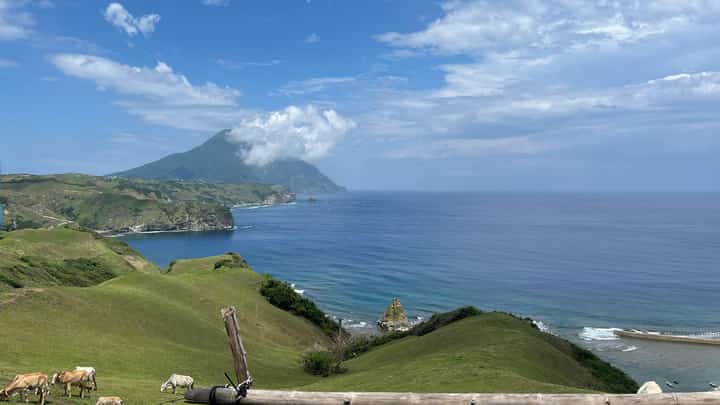
Cows are freely thriving in the hills of Tayid Lighthouse in the Municipality of Mahatao, taking advantage of the three-month dry season in the province which rain and typhoons are very prevalent, Batanes.
Raffy Ayeng
China doubled down on its “sovereign rights” and “jurisdiction” over the waters off Batanes after the Philippines strongly denounced on Friday a Beijing research vessel that entered approximately 37 nautical miles northwest of Itbayat earlier this week.
The Department of Foreign Affairs said the area falls “well within the Philippines’ exclusive economic zone (EEZ)” and that the Chinese research and survey ship, JIA HAI KE 7, sailed the waters and carried out the marine scientific research (MSR) without informing nor consent from Manila.
The DFA argued that the move violated Article 246 of the United Nations Convention on the Law of the Sea (UNCLOS), which stipulates that “marine scientific research in the EEZ and on the continental shelf shall be conducted with the consent of the coastal state.”
“We strongly call on China to fulfill its obligations under international law and avoid actions that are counter-productive and undermine efforts to rebuild mutual trust,” the DFA pointed out as it firmly rejects the Chinese Embassy's maritime claims over Batanes.
“The Philippines will continue to uphold the country's sovereign rights and jurisdiction in its EEZ peacefully and responsibly in accordance with international law,” the statement further reads.
The statement came in response to Chinese Embassy in Manila Deputy spokesperson Guo Wei’s remarks on Thursday that the Beijing research vessel was “conducting normal operations in waters under China’s jurisdiction,” and that the Philippine Coast Guard “harassed” the vessel and “infringed upon China’s sovereign rights.”
In rebuttal, the DFA argued that the PCG vessel was exercising “lawful and routine law enforcement operations in response to a suspected unauthorized MSR activity in the waters off Batanes.”
The Chinese embassy quickly refuted the DFA’s statement and asserted that it has sovereign rights over the waters of Batanes in accordance with international law, including UNCLOS.
“China and the Philippines have overlapping maritime claims in the relevant waters. In accordance with the provisions of UNCLOS Articles 74 and 83, as well as the consensus reached between China and the Philippines, the matter should be properly resolved through negotiations,” the embassy’s statement released shortly after that of the DFA reads.
The embassy accused the Philippines side of “violating international law and the norms governing international relations, and endangering the safety of the Chinese vessel and personnel.”
It also warned that Beijing would not bow down and would take the necessary measures to “safeguard its legitimate rights and interests.”
“China calls on the Philippines to genuinely respect China’s sovereign rights and jurisdiction over the relevant waters, immediately cease provocative interference with China’s normal scientific research activities, and return to the proper path of managing maritime differences through dialogue and consultation,” the embassy concluded.
PCG spokesperson for the West Philippine Sea, Rear Adm. Jay Tarriela, said the Chinese vessel had been spotted about 37 nautical miles northwest of Itbayat since Monday, 28 September, and only left at noon on Thursday, following intense pressure from PCG vessels.
Tarriela said the BRP Teresa Magbanua had since shadowed the Chinese research vessel, and eventually disrupted its “illegal MSR” by driving it away from Philippine waters despite a China Coast Guard vessel repeatedly trying to block the PCG ship.
In late June, Chinese scholars at a symposium at Jinan University explicitly claimed that Bataan, the northernmost island province of the Philippines, is a “natural geographical extension” of Taiwan.
The academics argued that because Beijing claims Taiwan as its own territory, China’s sovereignty naturally extends to Batanes, which lies south of Taiwan, across the Luzon Strait.
At the time, the Chinese embassy did not address the issue until Beijing’s MSR in Batanes last week.