
Let’s do it, if Congress won’t
The push gained momentum amid the flood control scandal, which Carpio has linked to the broader problem of political dynasties and their control over public funds.

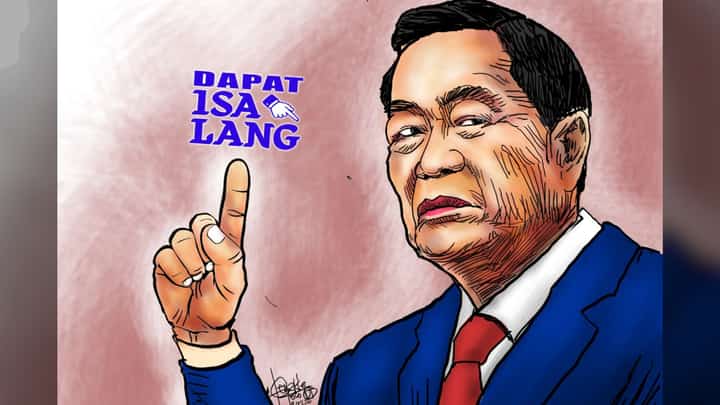
Several groups have joined forces to gather signatures for a people’s initiative, arguing that Congress, where political families abound, has shown little inclination to pass a meaningful Anti-Political Dynasty Law on its own.
The campaign, called Dapat Isa Lang, is led in part by retired Supreme Court senior associate Justice Antonio Carpio, who held that the time has come for citizens to exercise their power to write the law themselves. The coalition is seeking to enact an Anti-Political Dynasty Act through a people’s initiative.
The push gained momentum amid the flood control scandal, which Carpio has linked to the broader problem of political dynasties and their control over public funds. He has argued that preventing political dynasties from controlling the national budget is essential to breaking what he described as a cycle of corruption.
Carpio has also alleged that while Congress publicly deliberates and approves the annual appropriations law, lawmakers can reach informal arrangements with budget and executive agencies to allocate funds to individual legislators. That allegation remains a claim advanced by Carpio, rather than an established finding.
Because the flood control projects alone have reached about P1.7 trillion and around 70 percent of government funds are lost to corruption, the damage has become too large to ignore.
Political families use this money to keep and expand their hold on power, making the dynasty system and the corruption problem peas in one pod. Since the officials who control the budget can pay for votes and projects, ordinary people who want to serve cannot compete with them, and the cycle repeats in every election.
The Constitution prohibits political dynasties, but it leaves the definition of the term to Congress. Although 39 years have passed since the Charter took effect, Congress has never defined the term or passed the needed law.
The Supreme Court has recently said that Congress must act, even though the Court cannot tell lawmakers what the law should contain, and Carpio said the deadline to comply has long passed.
Meanwhile, there is no hope for the perfunctory bill that the House has approved. Carpio and several law experts said the bill, sponsored by the Speaker and the House majority leader, would protect and strengthen dynasties instead of limiting them. It legitimizes political families.
If the choice is left to the congressmen and senators, they will not sign what amounts to their own death certificate, so the people must act.
A genuine anti-dynasty measure is simple, according to Carpio. Under it, only one member of a political family may run for a national position and only one may run for a provincial position.
Anyone from the same family who runs for another post would be disqualified. He said this rule would open the door to capable people who want to serve but lack the money or a famous surname, since public office would then be within the reach of more citizens.
Carpio also hopes the change would clean up the budget. If the flood control projects stop being ghost or poorly built projects, and if the share of funds lost to corruption falls from about 70 percent to about 10 percent, he believes the country’s roads, bridges, and flood defenses could catch up with those of its neighbors.
In his words, infrastructure money would finally go to infrastructure instead of politicians’ pockets.
Asked if voters, who often see powerful families as a lifeline, would sign the petition, Carpio pointed to recent surveys that showed 60 to 70 percent of Filipinos want an anti-dynasty law.
People may accept help from politicians, but that does not mean they want the system to go on, because they know it hurts the country.
The timing, however, is a hurdle. Carpio says the ideal outcome would be a vote before the 2028 elections, but Congress is unlikely to pay for a separate referendum, since doing so would hurt its own members. Without separate funding, the groups plan to place the question on the ballot of the 2028 presidential election, which means that any new law would take effect only after that vote.
To do so, the law requires the signatures of three percent of registered voters in every legislative district and of 10 percent nationwide.
Since it is hard to visit every district, and because political families in some areas could block the signature gathering, the organizers built a digital platform. Overseas voters were able to cast ballots online in the last election, so Carpio considers online signing a valid means.
Those who sign the appeal become co-petitioners in the case to be filed with the Commission on Elections. The platform is already open to anyone, anywhere in the world, at d1l.org, and signing up takes less than three minutes.
The campaign is a message to those in power. After decades of waiting for Congress to act, the people are now ready to exercise their right to propose laws.
Those who have long benefited from the dynasties will have to back off.