
Inâ comes home by river at night
The fluvial procession of the 2026 Festivities of the Divino Rostro and Our Lady of Peñafrancia in Naga City

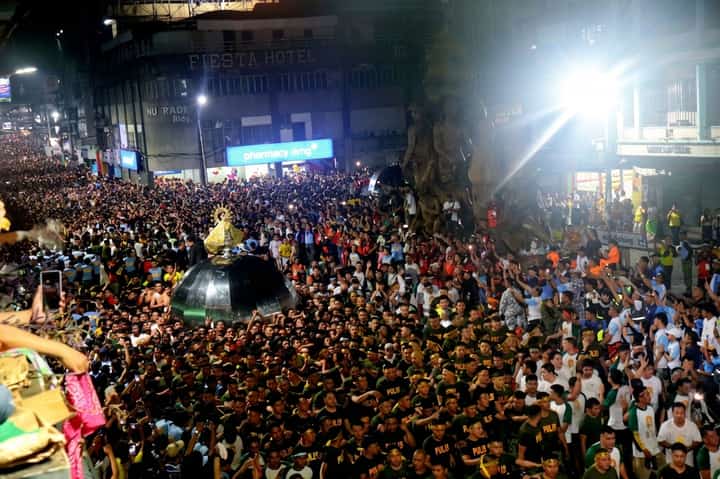
THE image of Our Lady of Peñafrancia surrounded by throngs of devotees as she makes her way to the Naga River from the Naga Metropolitan Cathedral.
Photographs by Roel Hoang Manipon for DAILY TRIBUNE
Night had settled over Naga City, the economic and educational hub of the Bicol Region in southern Luzon, when the pagoda finally moved. Along the riverbanks, candles and phone lights trembled in the dark, boats waited on the water, and the cries of “Viva la Virgen!” and “Viva El Divino Rostro!” traveled ahead of the vessel. At its center were the sacred images of Our Lady of Peñafrancia — fondly called Inâ (mother), the patroness of Kabikolan — and El Divino Rostro, the Holy Face of Jesus, making the homeward journey to the Minor Basilica and National Shrine of Our Lady of Peñafrancia, the permanent home of Inâ.
Traditionally an afternoon rite, the fluvial procession of 19 September, the bisperas of the Solemnity of Our Lady of Peñafrancia, was delayed by the unusually low water level of the Naga River. At the Danlugan ni Inâ near Tabuco Bridge, Archbishop of Cáceres Rex Andrew C. Alarcon announced that the departure would be delayed and led the rosary while waiting for the tide to rise. After several minutes, he suddenly announced that the water was high enough, finally permitting the pagoda to sail. The procession unfolded under evening lights, many say for the first time.
This riverine ritual was the culminating highlight of the 2026 Festivities of the Divino Rostro and Our Lady of Peñafrancia — an almost month-long convergence of liturgy, pilgrimage, civic celebration and popular piety from 2 to 20 September. The city’s Emergency Operations Center-Incident Management Team estimated that 1.2 million devotees, pilgrims and visitors gathered for the fluvial procession, filling streets, bridges and riverbanks despite the sudden change of schedule.
This year’s observance joined several milestones. It marked the 144th Feast of El Divino Rostro and the 316th Solemnity of Our Lady of Peñafrancia, as well as the diamond jubilee of the Archdiocese of Cáceres, elevated to a metropolitan see in 1951. Its theme, “Inâ: Nurturing a Growing Church,” defined growth not merely by the size of the multitude but by communion, participation and mission. The archdiocese expressed that call in the Bikol phrase “Gabos kaayon, gabos may gibúhon” — everyone belongs, and everyone has a vital role.
DEVOTEE paddlers accompanying the images of El Divino Rostro and Our Lady of Peñafrancia during the fluvial procession.
THE image of Our Lady of Peñafrancia arrives at the Danlungan ni Ina and is received by officials of the Archdiocese of Caceres led by Most Rev. Father Rex Andrew Alarcon, DD.
THE two revered images arriving at port near the Minor Basilica and National Shrine of Our Lady of Peñafrancia.
DEVOTEES flock to Minor Basilica and National Shrine of Our Lady of Peñafrancia on the Solemnity of Our Lady of Peñafrancia on 20 September
Then and now
The devotion to Inâ took root in Nueva Cáceres, now Naga, around 1710 through Father Miguel Robles de Covarrubias, who commissioned a local artisan to carve an image based on a holy picture of Nuestra Señora de Peña de Francia that he carried. The devotion to El Divino Rostro became inseparable from it during the cholera epidemic of 1882. Father Pedro de la Torre brought an image of the Holy Face to the cathedral, while Bishop Casimiro Herrera called for the image of Our Lady of Peñafrancia. The faithful prayed before the two images together, and after the epidemic, their thanksgiving became linked annual celebrations.
The 2026 festivities began on 1 September with the Pagbalyo ki El Divino Rostro from the basilica to the Old Shrine, followed by its novena from 2 to 10 September. Before dawn on 11 September, thousands accompanied Inâ from the basilica to the Old Shrine in the Pagbalyo ki Inâ. There, Mother and Son were reunited. Later that day, the Traslación bore both images through rain and dense crowds to the Naga Metropolitan Cathedral, closing the Feast of El Divino Rostro and opening the nine-day novena to Inâ. Officials placed the Traslación crowd at about 820,000.
Delayed by unusually low water, the riverine ritual, which drew an estimated 1.2 million people, continued the centuries-old tradition of communal devotion.
Between the great road procession and the river homecoming, the cathedral became the devotional center of the city. Novena Masses continued through 19 September, while pilgrims queued for an opportunity to approach Inâ. Religious, cultural and civic events moved around that liturgical core. From 15 to 17 September, 299 registered priests from across Bicol gathered for the Union of Bicol Clergy. Its closing Mass on 17 September also celebrated the inter-diocesan diamond jubilee, with Apostolic Nuncio to the Philippines Archbishop Charles John Brown presiding alongside the region’s bishops and clergy. Patronal images from Bicol’s dioceses joined a procession that presented the region as one Marian family.
Before sunrise on 18 September, another multitude joined the second dawn procession. Female voyadores were among those who carried and accompanied the images through the city, extending the year’s emphasis on participation. By then, the pagoda had reached the Danlugan and waited for the final journey.
Illuminated pagoda
On 19 September, the culminating rites began at the Naga Metropolitan Cathedral with the final novena and Pontifical Mass by four in the afternoon. Devotees on boats gathered around the Danlugan. Around 6:30 p.m., the image of El Divino Rostro was taken out for a land procession to the Danlugan, followed by the image of Our Lady of Peñafrancia. Voyadores pressed close to the andas, and thousands took their places beside the river.
There the procession encountered the condition that would make the 2026 homecoming unlike any before it: the water was too shallow for the pagoda to proceed safely. Yet the delay did not dissolve the gathering. The rosary continued; lights multiplied along the banks. Once the tide rose, the images were transferred to the flower-decked pagoda. Devotee paddlers and a flotilla of boats accompanied it along the Naga River as prayers, hymns and shouts rose from both shores.
The changed hour transformed the visual language of the tradition. The river, usually bright beneath an afternoon sky, became a dark current traced by flickering lights. The illuminated pagoda seemed to carry its own horizon, advancing slowly between walls of people. Inâ’s return remained solemn and exuberant at once: a ritual of departure from the cathedral, passage through the city and restoration to her permanent home.
At about 10:30 p.m., the images reached the basilica, where waiting devotees received them, and the concluding Mass followed.
The next day, devotees flocked to the basilica to celebrate the Feast of Our Lady of Peñafrancia and personally honor their patroness.
For the Archdiocese of Cáceres, the fluvial procession is more than a spectacular finale. It describes the Naga River as a living sign of the baptismal waters that form one family under Inâ. The delayed voyage also exposed how closely a centuries-old devotion depends on the health and rhythms of the river that carries it, giving the celebration an unforeseen call to stewardship.
In the end, the low water did not diminish the homecoming. It asked the multitude to wait. And when the pagoda entered the night, the theme of a growing Church became visible — not only in the extraordinary number of people present, but in a community praying, serving, adjusting and moving together. Along the darkened river, Bicol’s Mother came home, and her children kept pace from both water and shore.