
Powell connects volatile WPS dots
In 2023, Powell officially launched SeaLight, a nonprofit initiative that closely tracks Chinese activities and gray-zone tactics in the West Philippine Sea and the broader South China Sea.
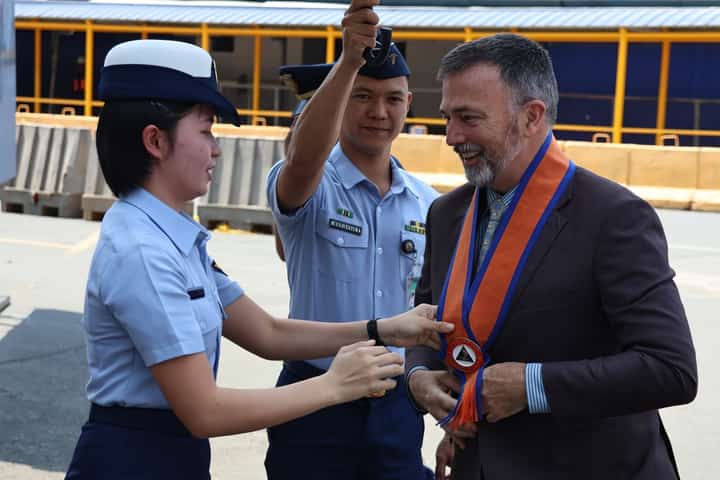
CONTRIBUTION valued SeaLight Foundation executive director Raymond Powell was commended by the Philippine Coast Guard for his steadfast support in documenting and addressing operational challenges in the West Philippine Sea, during an official visit to PCG headquarters in Port Area, Manila.
Photograph courtesy of PCG
Thousands of kilometers away from the West Philippine Sea (WPS), an eye carefully watches tiny dots move across a screen: Ships coursing through the disputed waters, their movements connected to tell a much bigger story.
That watchful eye belongs to maritime security expert Ray Powell, who has made it his mission to track the movements and patterns unfolding across waters far from where he sits.
In 2023, Powell officially launched SeaLight, a nonprofit initiative that closely tracks Chinese activities and gray-zone tactics in the West Philippine Sea and the broader South China Sea.
SeaLight monitors the movements of Chinese Coast Guard (CCG) and maritime militia vessels using open-source information and ship-tracking data, piecing together patterns that help bring activities at sea into public view.
For Powell, the work goes beyond simply identifying where ships are. It is also about understanding what their movements could mean and the broader strategy unfolding behind them.
“In fact, I was just looking at the ship tracking this morning and noticed that even third-country flagged cargo ships take a wide berth; they actually go around Scarborough Shoal around this exclusion zone,” Powell said.
One area that has remained under Powell’s watch is Scarborough Shoal, which he described as particularly active over the past two years. SeaLight considers China’s presence around the shoal an effective “exclusion zone,” with Powell noting that even third-country cargo vessels have been taking wider routes around the area.
But his watch extends farther north.
Powell pointed to what he considers a particularly concerning development: Chinese Coast Guard operations in waters east of Batanes — an area he said lies even beyond Beijing’s ten-dash line.
“There’s a China Coast Guard ship out there right now patrolling the waters east of Batanes,” he revealed.

CIA cash? If only Retired US Air Force Col. Raymond Powell (center) told ‘Straight Talk’ hosts Chito Lozada (left) and Teddy Montelibano that SeaLight Foundation, the research institution he founded, is frequently accused of receiving CIA funding. Powell joked that he wished the allegations were true, given that his advocacy organization runs on a shoestring budget. The initiative began with Stanford’s Gordian Knot Center.
VIDEO grab from Straight Talk
Wide Sino sweep
SeaLight had been tracking the movements since early June, he said, as he tried to understand what justification Beijing could invoke for operating in an area beyond even its ten-dash line.
Powell eventually found what he saw as a possible clue in reports from Chinese universities asserting claims involving Batanes, which he believes could provide a narrative for extending Chinese maritime activity into the Philippine Sea.
“What they’re trying to do is they’re trying to justify why they should now be the ones who are now patrolling not just in the West Philippine Sea, but in the Philippine Sea east of Batanes,” he deduced.
Yet Powell is careful not to interpret every movement on his screen as a sign of an impending confrontation. He said he does not believe China intends to invade or blockade the northern Philippine islands.
“I don’t think they plan to invade Batanes. I don’t think they intend to blockade Batanes, but they’re using the claim to Batanes to justify why they should own the water east of Batanes,” he guessed.
Making the unseen visible
For a maritime watchdog whose work revolves around observing activities often taking place far from public view, watching is only part of the job. Making those activities visible, Powell believes, can be just as important.
The Philippines has increasingly relied on transparency by releasing photographs, videos and information about confrontations in the West Philippine Sea. Powell acknowledged that exposing such encounters has not visibly stopped Beijing from continuing its activities.
But deterrence, he argued, is not the only measure of whether transparency works.
“Although China has not been deterred by the use of transparency, at least that we can see, what has happened is the Philippine public has rallied behind the government and has begun to take steps basically to build national resilience,” Powell highlighted.
For him, images reaching television screens and mobile phones turn distant maritime encounters into something Filipinos can see for themselves. That visibility, he said, helps the public understand why the country is investing in its Coast Guard, Navy and Air Force.
Powell also believes it has helped the Philippines draw support from international partners, which have provided ships, radars, detection capabilities and other forms of assistance.
Lesson from his father
Long before Powell began watching vessels move through Philippine waters, his own family had experienced how bringing something into public view could become part of a much larger struggle.
His father, Powell recalled, was a Freedom Rider during the civil rights movement in the United States. As a white man, he boarded public transportation and sat in a section designated for Black passengers, while his Black companions moved into the whites-only section.
The act eventually landed his father in jail.
“My father went to jail. And by making a public spectacle and making everybody pay attention to the injustice, eventually the injustice ended,” Powell recalled.
The experience became part of Powell’s explanation of how he views resistance: Not necessarily as a struggle decided quickly by the stronger side, but one sustained through endurance and an ability to keep public attention fixed on what is happening.
“It was not an easy struggle. It was not a fast struggle, but it was a successful struggle,” he said.
This story of his offers a glimpse into the way he talks about transparency, resistance and the importance of keeping actions that might otherwise go unnoticed in public view.
That same philosophy shapes how Powell views the Philippines’ predicament in the West Philippine Sea.
With China holding an overwhelming advantage in the number and size of vessels it can deploy, the maritime expert sees little prospect of the maritime dispute in the foreseeable future.
Instead, he believes the Philippines must prepare itself for a prolonged conflict.
“When I talk about struggle, I think in terms of a resistance. How does a resistance succeed against an oppressor? It succeeds by outlasting it,” Powell said.
For him, outlasting does not mean simply waiting. It means developing the ability to withstand pressure while ensuring the Philippines does not face the challenge alone.
“This is the time to build capacity, to build resilience, to build alliances and friendships so that you can resist over a long period of time,” he added.
Powell also rejects the idea that the present situation is necessarily permanent. Countries gain and lose power, governments change and policies that once appeared immovable can eventually shift.
“The truth is that nothing is ever forever, right? So countries rise and fall. Countries wax and wane,” he stated.
For Powell, whose work centers on movements that can disappear from view as quickly as they emerge, his message to the Philippines is fittingly simple: Keep watching, keep showing, and be prepared to endure.