
Buck stops with SBP
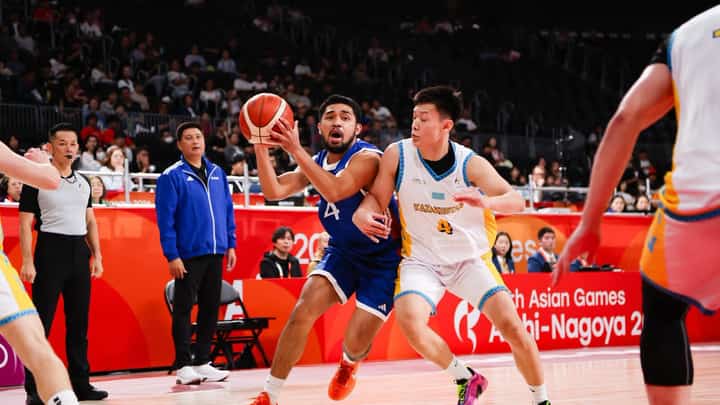
There will be plenty of people to blame for what happened to the Gilas Pilipinas men’s basketball team in Nagoya.
The players. The coach. Injuries. Scheduling. The Japanese and Korean leagues.
But where should the buck stop? Shouldn’t it rightfully be with the Samahang Basketbol ng Pilipinas (SBP)?
Because the SBP is supposed to develop Philippine basketball, build our national teams and provide the direction for the sport. It cannot simply be the organization that assembles a team and then points to the coach when things go wrong.
What happened in Nagoya was a failure of planning.
We went into the Asian Games as defending champions and ended up with our worst finish ever in men’s basketball.
We lost to Bahrain, 89-85, while Bahrain had four naturalized players. We had none.
And this wasn’t because the Philippines didn’t have naturalized players.
During Erika Dy’s tenure as SBP executive director, the federation worked to naturalize Malick Diouf and Bennie Boatwright. Diouf eventually obtained his Philippine passport, while Boatwright’s naturalization finally became law — but too late for the Asian Games. And probably a little mismanagement as well on the side of the SBP.
If Justin Brownlee was unavailable because of injury, where was the contingency plan?
A 38-year-old Brownlee had already carried an enormous load for Gilas in the past. Was it really reasonable to assume that he would always be available to rescue the national team?
Then came China.
A 44-point defeat is not just a bad game. It is an organizational alarm bell.
Would Diouf or Boatwright have guaranteed a victory? Of course not.
But having even one legitimate naturalized big available could have made a huge difference, particularly against the size and physicality of China.
And that’s the point.
The SBP should be thinking two or three moves ahead.
It may be run today by people deeply connected to the PBA. But the SBP is not the PBA, and the PBA is not the SBP. Maybe it’s time to clearly delineate that.
The PBA has its own teams, business, calendar and interests. The SBP’s job is Philippine basketball as a whole.
And here’s where I think Philippine basketball needs to rethink the entire Gilas model.
With all due respect to a few, the best Filipino players are no longer necessarily in the PBA.
Look at this group: Kai Sotto, AJ Edu, Dwight Ramos, Carl Tamayo, Kevin Quiambao, SJ Belangel, Matthew Wright, Kiefer and Thirdy Ravena, Quentin Millora-Brown, Rhenz Abando, Bobby Ray Parks, Arvin Tolentino, Mike Phillips and Will Navarro.
All young, gifted and talented. Maybe that’s why they are earning more in Japan and Korea than most of their PBA counterparts.
Give me Sotto, Edu, Ramos, Kiefer and Tolentino as a starting five with the rest as reserves, then tell me a current all-PBA selection today would automatically beat them.
I’m not so sure.
Japan and Korea have something we don’t seem to have anymore: leagues that recognize the national team as part of the country’s basketball ecosystem.
Perhaps it’s time for the SBP to go back to a dedicated national-team program for FIBA competitions instead of continually disrupting the PBA calendar and hoping enough PBA players can be assembled at the right time.
The PBA can still supply players. It should.
But it should no longer dictate the national team’s composition simply because that was where the country’s best players happened to be 10 or 15 years ago.
And for the Asian Games?
That’s a quadrennial event. Prepare for it years in advance. Build a large pool for this Philippine passport-only qualification event (we have many of them). Also naturalize strategically. Select the head coach early. Give that coach a free hand.
The SBP’s mandate is not to disrupt the PBA calendar.
It is to build the best Philippine basketball program possible.
That is why, after Nagoya, I don’t think the first question should be: Who should be blamed?
It should be: What was SBP’s plan under Dy — and why wasn’t it good enough?
Because ultimately, the buck stops with the SBP.