
‘All means all’: Azcuna insists 16-vote threshold fixed
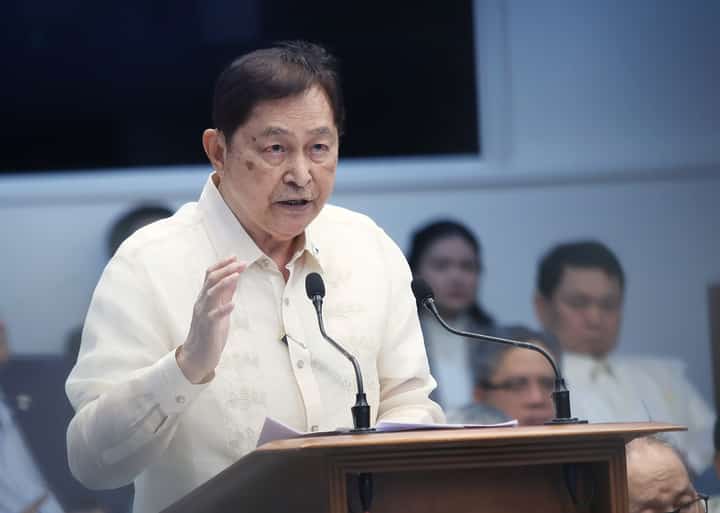
Retired Supreme Court Associate Justice Adolfo Azcuna, one of the framers of the 1987 Constitution, took the Senate podium on Wednesday, 16 September, to express his position against lowering the 16-vote threshold needed to convict an impeached official, in this case, Vice President Sara Duterte. He was tapped as one of the amici curiae.
Senate PRIB
Retired Supreme Court Associate Justice Adolfo Azcuna, one of the framers of the 1987 Constitution, offered the simplest interpretation on Wednesday of the provision setting the conviction threshold for Vice President Sara Duterte’s impeachment trial: all means all.
This means that with 24 members in the Senate, the two-thirds threshold for conviction is 16 votes, regardless of how many senator-judges are able to attend the trial, he said.
Azcuna’s position differed from those of retired SC chief justices Hilario Davide Jr., Reynato Puno and Artemio Panganiban.
They were tapped by the Senate impeachment court as amici curiae (friends of the court) to advise senator-judges on how to lawfully interpret Article XI, Section 3(6) of the 1987 Constitution to prevent a possible deadlock on the day of judgment amid the absence of four of their colleagues, who may be unable to vote.
“I respectfully submit, Your Honors, that the reference in this provision is to all members of the Senate. As long as they are members of the Senate, they constitute the denominator and compute the threshold of two-thirds because all means all,” Azcuna said.
He warned that lowering the threshold to a simple majority could allow a dominant faction in the Senate to have the upper hand in determining the outcome, reducing the trial to a mere “formality rather than a genuine deliberative check.”
Azcuna argued that the framers of the Constitution intentionally set a higher threshold, requiring the concurrence of a supermajority to insulate impeachment proceedings from “factional and partisan abuse.”
“Impeachment is a political judicial hybrid exercise. It is not an ordinary voting procedure. [It] removes a sitting publicly accountable official often directly elected before the end of a fixed term,” he stressed.
A convicted impeached official faces removal from office and perpetual disqualification from holding public office.
Azcuna noted that these serious penalties are precisely why the framers deliberately set a higher bar for conviction, as a conviction in an impeachment proceeding is “final and largely irreversible.”
“A decision this hard to undo warrants a higher threshold of agreement than routine business,” he stressed.
“The framers […] fear that impeachment could become a tool for a transient legislative majority to remove a political rival or an official from this favored party, effectively overturning an election resolved through legislative fire rather than through the ballot box,” he pointed out.
Senators Jinggoy Estrada and Rodante Marcoleta, both detained on plunder charges, and Bato dela Rosa, who remains abroad amid an International Criminal Court warrant, have been unable to attend Duterte’s trial since it began on 6 July.
Senator Loren Legarda, meanwhile, has missed the proceedings since 3 August after going on medical leave abroad amid a preliminary investigation by the Ombudsman into plunder and graft complaints.
Critics have argued that their absence effectively altered the Senate’s composition and therefore necessitates lowering the base of the conviction threshold from 24 to either 20 or 21.
Azcuna, however, cautioned that reducing the conviction threshold to a simple majority or two-thirds of a quorum present at trial would make conviction achievable by a coalition that dominates the Senate.
“Requiring two-thirds forces conviction to rest on a coalition that cuts across ordinary partisan lines, which is precisely the point,” he argued.
More importantly, Avelino v. Cuenco, which was previously used by the Senate to establish a quorum of only 12, is not applicable to Duterte’s impeachment case, according to Azcuna.
This is mainly because, he said, the Supreme Court’s jurisprudence was based on the 1935 Constitution, which uses “different” wording from the 1987 Constitution.
“The quorum requirement under the 1935 Constitution says a majority of the Senate. It didn't say all the members,” he said.
As for allowing senator-judges who missed a substantial part of the trial to cast their votes, Azcuna said the Senate should allow them, given that the proceedings are recorded and a transcript is available for their review.
Several senators have raised concerns that because some of their colleagues are unable to monitor the proceedings, they cannot “vote intelligently” and may end up voting solely on political allegiance.
For these reasons, Azcuna maintained that an impeached official shall only be convicted with the concurrence of two-thirds of all 24 members of the Senate.
The Senate impeachment court is set to put to rest the debate on whether to maintain or lower the threshold on 23 September, after the defense and prosecution panels present their respective positions in oral arguments on the same day.