
Revisiting 16-vote ruling does not violate VP Sara right to due process – ex-justices

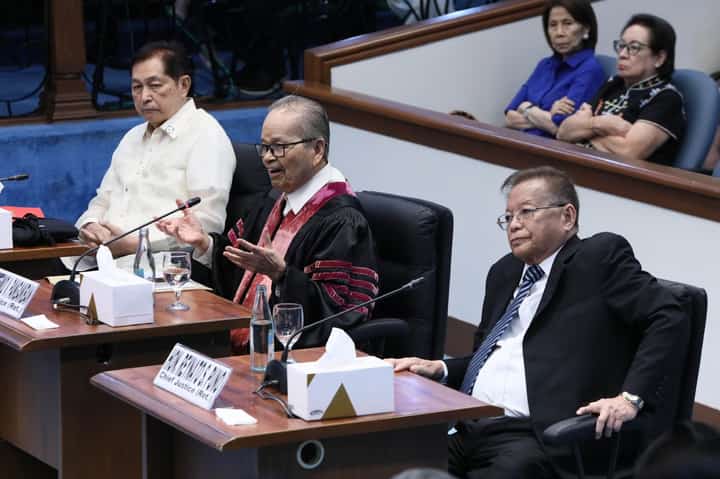
Members of the amici curiae answering inquiries from the Senate as the impeachment court revisited its ruling on the impeachment vote threshold on Wednesday, 16 September.
Aram Lascano
The Senate’s decision to re-open discussions into the prior ruling of presiding officer Senator Francis “Chiz” Escudero regarding the conviction threshold on impeachment does not violate the right of Vice President Sara Duterte to due process, former Supreme Court justices said.
Taking into account some narratives that were being shared online, Senator Francis “Kiko” Pangilinan consulted with members of the amici curiae (friends of court) on whether a potential change to the impeachment court’s rulings went against court guidelines.
The senator mentioned that commentary on the matter claimed that the Senate, in its capacity as impeachment court, could not change its rules as the “due process clause” would be affected given that the trial was already ongoing.
“Is it true that there was a vote to change the initial ruling of the presiding officer that it would violate the due process of the accused or the respondent,” Pangilinan asked.
Responding to the query, Ret. Chief Justice Artemo Panganiban explained that the Vice President’s right to due process was not immediately a matter of concern since senator-judges have yet to actually vote on what the rule should be.
At this point in the trial, Panganiban said that the Senate was merely anticipating an issue that would soon be raised before the court–particularly a potential filing of a case for grave abuse of discretion.
The retired justice, however, maintained that the upper chamber has yet to overstep when it came to the impeachment.
“There is no grave abuse of discretion, in my humble opinion, as of now,” Panganiban said.
Echoing his point, Ret. Chief Justice Reynato Puno said that their discussions into the matter were not an actual “change” to the rule given the fact that there has been no legal precedent that has been established on how the rule should be interpreted.
He further stated that provision on the impeachment threshold had “plenty of reasonable interpretations” and that it would ultimately be the Supreme Court that could have a final say on how it should be viewed.
Even with such sentiments, however, Puno said that the matter could not yet be forwarded to the high court given that the issue was not yet “ripe,” and that it could not yet be adjudicated.
“The Supreme Court will not accept this issue at this point, it’s a matter of perfect timing,” the retired justice said.
Ret. Chief Justice Adolf Azcuna, on the other hand, explained that the issue facing the Senate was merely a “procedural matter” and that any ruling on the same was “retroactive” as there was “no vested right to a procedure.”
Azcuna, who was one of the framers of the 1987 Constitution, said that procedural changes could be applied to pending cases, even if the same proceeding was already midway through.
He maintained that any rulings on the threshold did not constitute a violation of due process given that there was no “vested right” in the first place.
“The rule is if it is procedural it can be applied to pending cases so even if the trial has already started, you are midway through the trial and you can change the interpretation of the presiding officer,” he said.
“I think there is no violation of due process, there has been no vested right that has been violated,” he added.
Commenting on the answers of the amici curiae, Escudero explained that he had made his ruling to establish a 16-vote threshold so that the parties participating in the proceedings could take the matter to the Supreme Court.
The senator said that he did not want to arrive at a scenario wherein the issue was prolonged after the Senate had already voted on the matter.
He explained that he would prefer for the issue to be officially settled before Duterte was ultimately convicted or acquitted from the allegations.
“I don’t think our country and people deserve that for this to be prolonged than it should be,” he said.
The Senate is set to decide on the impeachment threshold on 23 September in consideration of the presentations of the amici curiae and the stance of both the prosecution and the defense.