
A private garden bursts into bloom: Lawyer unveils first art exhibit where flowers, lives and worlds meet
In her first solo exhibition, Benedicta ‘Dick’ Du-Baladad brings nearly 80 works shaped by nature, quiet contemplation, and the meeting of discipline with creative freedom.


'SLEEPING Gumamela' (watercolor on paper, 55 by 62 cm, 2019).
Flowers open in exuberant colors. Birds, butterflies and other pollinators move among dense foliage. Human figures emerge from layers of light, texture and botanical forms, appearing not as masters of the natural world but as lives entwined with it.
In A Blissful Coexistence, the first solo exhibition of lawyer Benedicta “Dick” Du-Baladad, nature is more than subject or ornament. It is a living presence — and a reminder that human existence unfolds within a vast web of relationships.
The exhibition opened on 9 September at The Podium Atrium in Mandaluyong City, bringing together nearly 80 works in oil, acrylic and mixed media, as well as works on paper, studies and smaller pieces. Running until 14 September and curated by Randel Urbano, the show gathers the fruits of about 18 years of intermittent painting and introduces an artist who has pursued her practice quietly alongside a demanding professional life.
Known primarily as a lawyer and certified public accountant, Du-Baladad is the founding partner and chief executive officer of Du-Baladad and Associates, or BDB Law, a Philippine firm specializing in tax and corporate law. The precision, structure, and measured judgment required by these professions might appear far removed from the spontaneity of a brush moving across canvas. In her paintings, however, they become counterbalancing forces.
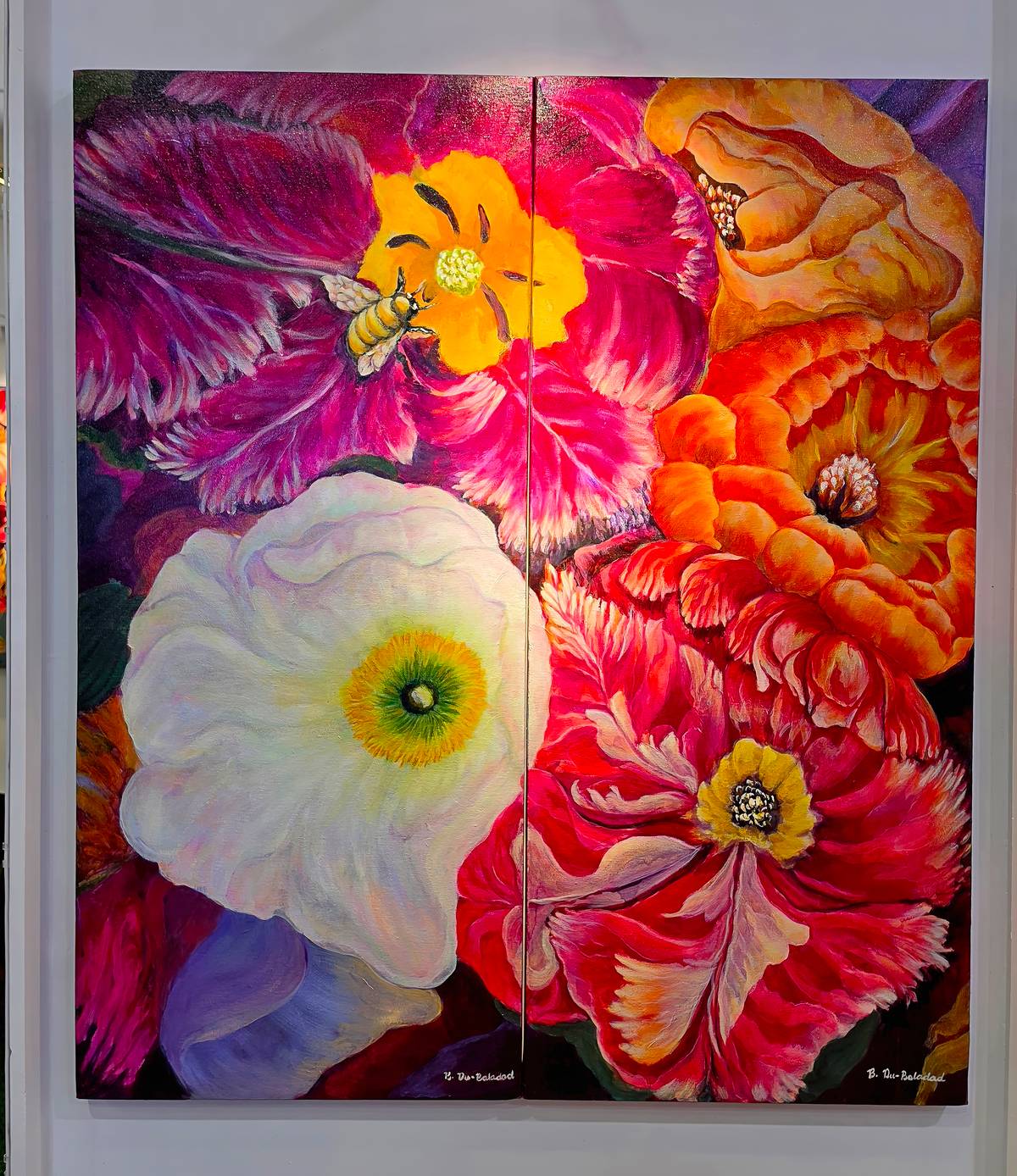
'WHERE Petals Breathe, Series III (Between Blossoms)' (diptych, acrylic and oil on canvas, 53.1 by 61 cm, 2025).
The exhibition finds its pulse in this meeting: logic and intuition, discipline and abandon, stillness and movement, the analytical mind and the creative spirit. Instead of keeping the different parts of her life apart, Du-Baladad permits them to coexist — and from their encounter, another language blooms.
“A Blissful Coexistence marks an important moment in the artistic journey of Benedicta ‘Dick’ Du-Baladad,” said Michael Albaña of the Management Association of the Philippines, organizer of the exhibition, during the opening. “In this first solo exhibition, we encounter an artist whose works reflect years of quiet exploration, discipline, and an enduring fascination with the natural world.”
That fascination began long before the exhibition took form.
“As far back as I can remember, I have been drawn to coloring and drawing as early as five years old,” Du-Baladad recalled during the opening, which coincided with her 65th birthday. “And I found that the things that amazed me before — flowers, the pollinators, bees, butterflies, birds — are the very same subjects that you now find on my canvas.”
Painting began as a personal interest in watercolor before developing into a sustained practice encompassing oil, acrylic and mixed media. Largely self-taught, Du-Baladad learned through observation, experimentation and an enduring willingness to explore. She later completed an intensive one-year Art Mastery Program at the Milan Art Institute in the United States and became a member of the Society of Professional Artists.
A constant source of inspiration has been her garden at Juanita’s Farm in southern Luzon, where she has cultivated a collection of flowering plants. Gradually, the life surrounding her — flowers, leaves, birds, butterflies, and other small visitors to the garden — found its way into her art.
The natural world appears in her compositions not through clinical documentation but through emotional translation. Vivid colors, accumulating textures, and expressive brushwork transform familiar organic forms. Light and shadow create visual planes, while clusters of blooms generate movement and chromatic density. Nature is observed, absorbed, and then allowed to reappear according to the artist’s instincts.
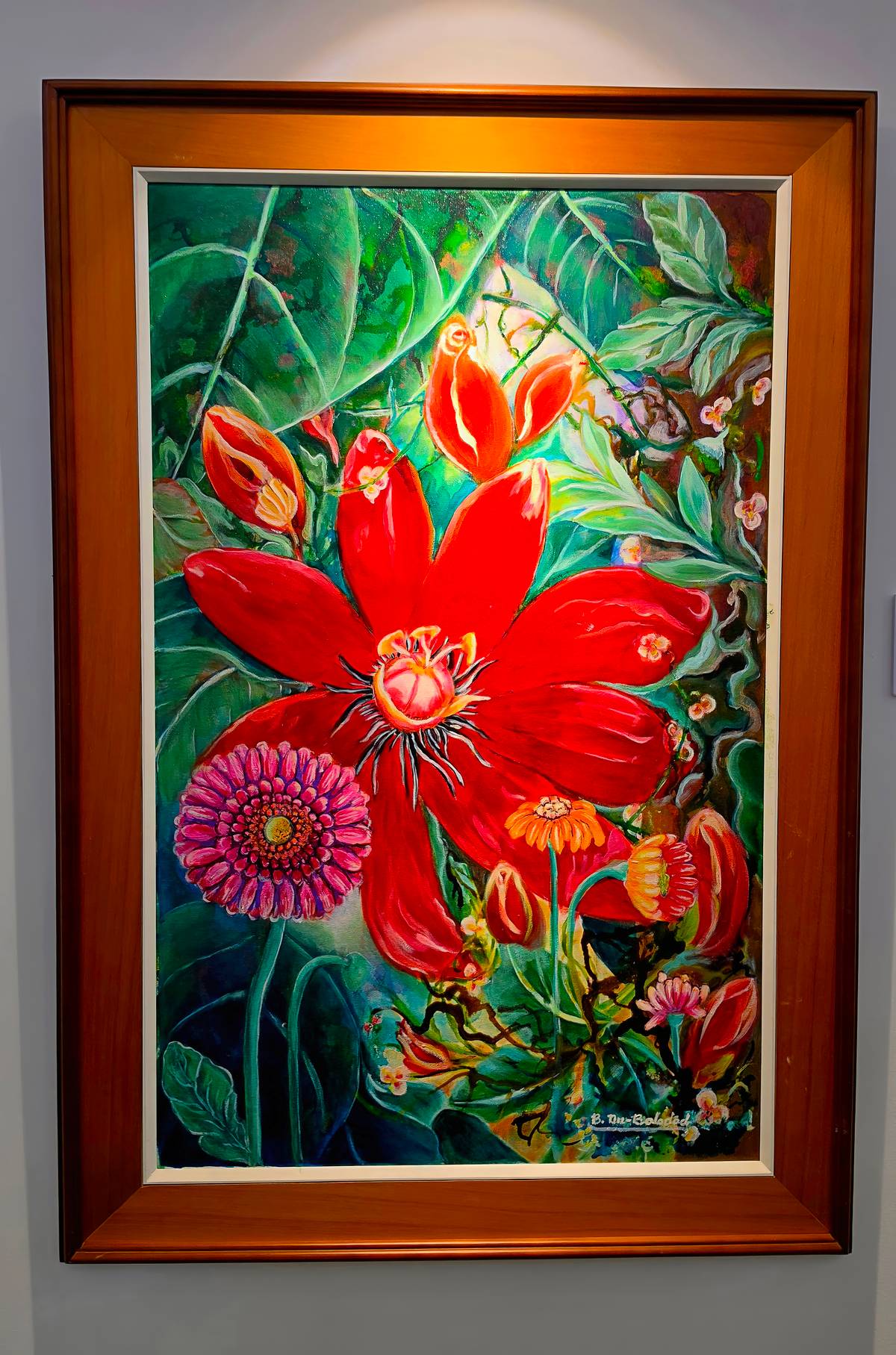
'SCARLET Passion Flower (Passiflora)' (acrylic and oil on canvas, 60 by 95 cm, 2025).
“Even when I try painting something subdued or muted, I eventually find myself adding more color. I want the work to feel alive,” Du-Baladad said. “To me, flowers are living beings with their own voice, and vibrant color is how I allow that voice to be heard.”
This vitality courses through several bodies of work, including the Where Petals Breathe Series, which explores flowers and organic forms in motion, and the Garden of Thoughts Series, where female figures, floral imagery and pollinators gather in richly layered compositions.
Her use of acrylic and oil also reflects the balance at the heart of her practice. Acrylic allows immediacy, capturing spontaneous gestures while establishing structural layers. Oil contributes luminosity, richness, and tactile depth. One medium gives the work its bones; the other allows it to breathe.
“My creative process is intuitive and contemplative,” she explained. “I build each painting gradually, allowing layers of color, texture, and form to evolve organically. I’m drawn to the balance between structure and freedom — the discipline that gives a work direction and the creative instinct that allows it to take on a life of its own.”
Although her botanical abstractions evoke comparisons with American painter Georgia O’Keeffe, the exhibition text also situates Du-Baladad within a broader lineage of Filipina modernists, noting thematic and structural affinities with Anita Magsaysay-Ho, Nena Saguil and Rosario Bitanga. The comparison does not confine her to their vocabulary. Instead, it locates her emerging practice within a history of women artists who developed distinct ways of seeing — and reshaping — their worlds.
In Du-Baladad’s case, painting offers room for a self not always visible in the formal realms of law, taxation, and business. It permits her to pause, experiment, and follow an idea simply because it stirs her curiosity.
Yet A Blissful Coexistence extends beyond personal expression and the immediate beauty of its flowerscapes. Beneath the color and profusion lies a meditation on interdependence. Nature, for the artist, is neither a decorative backdrop nor a possession. It is a larger living system to which humanity belongs.
“We are surrounded by life that is not ours to possess, but ours to appreciate, respect and protect,” she said in the exhibition material. “Nature reminds us that we are part of something far greater than ourselves — an intricate world in which every living form has its own purpose, beauty and place.”
The idea acquires urgency at a time marked by ecological deterioration, climate anxiety, social fragmentation and digital isolation. A flower depends upon soil, rain, sunlight and pollinators. Human beings, despite illusions of independence, remain similarly bound to other people and forms of life. The paintings become gentle but insistent reminders that nothing flourishes entirely on its own.
“At its heart, A Blissful Coexistence is about interdependence, the recognition that people, nature, and all living things are part of a larger and delicate ecosystem,” Albaña said. “Through this collection, the artist reminds us that harmony is possible when we learn to appreciate, respect, and care for the world we share.”
For Du-Baladad, however, coexistence does not mean the erasure of differences. Its deeper promise lies in allowing distinct lives, temperaments, and ways of being to occupy the same world without diminishing one another.
The exhibition’s title, suggested by her eldest son, Brian, crystallized this idea.
“It is not simply about creating beautiful images or bringing different objects together,” Du-Baladad explained. “It is about finding harmony in the midst of differences. It is about recognizing that life becomes richer when we allow one another to exist, to grow, and to be seen.”
Opening the exhibition on her birthday gave the occasion another layer of meaning. The show became not only the public arrival of an artist but also a reckoning with a life shaped by many identities: lawyer, accountant, business leader, advocate, mother and, increasingly, painter.
She founded the BDB Law Foundation in 2015 to help address gaps in education, livelihood and public health. Her interests also encompass writing, fashion design and gardening. Rather than treating these pursuits as unrelated, her art suggests that a life may hold different callings without requiring one to silence another.
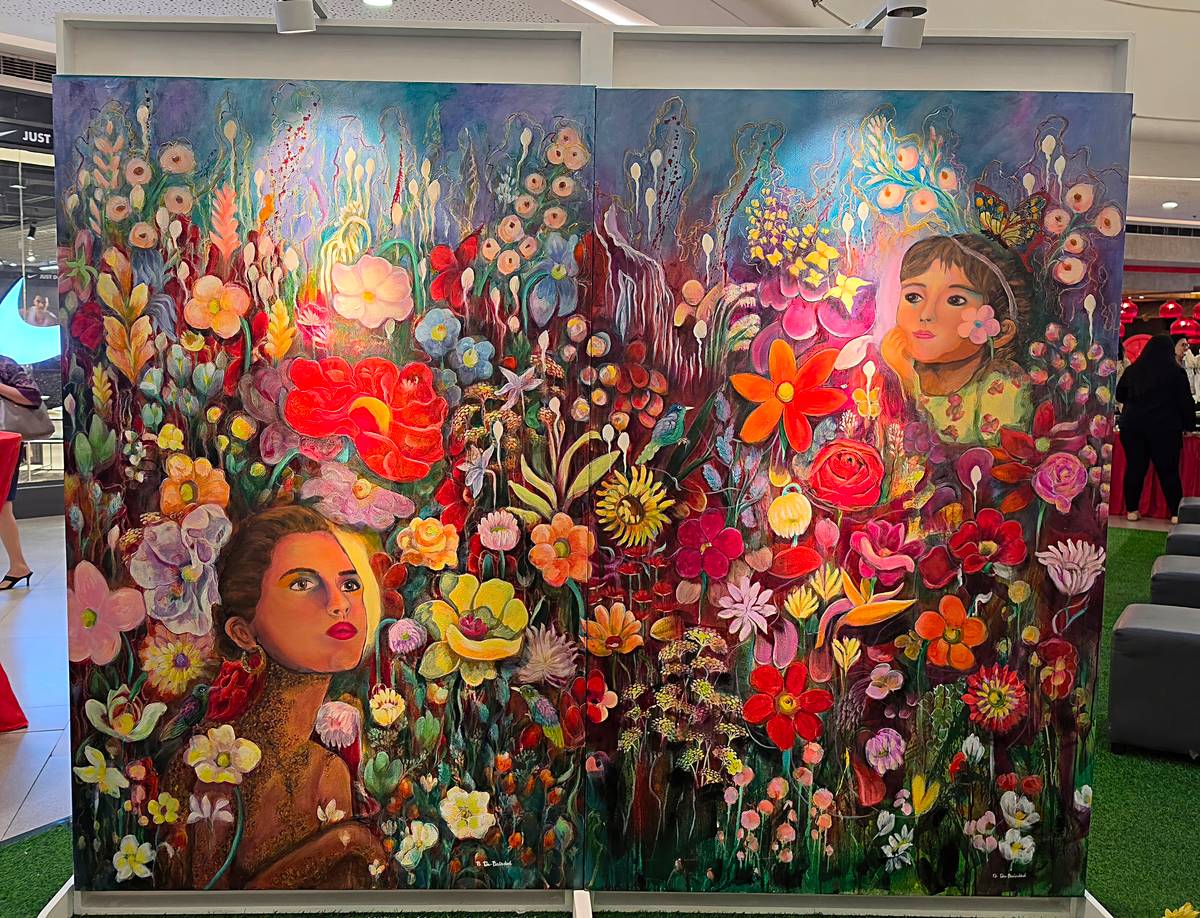
'BLISSFUL Coexistence, Series 1 and 2' (diptych, ccrylic and oil on canvas, 178 by 122 cm, 2026).
“Life is made up of moments, relationships, experiences, and memories that come together to shape who we are,” she reflected. “Each of us carries different stories, but these stories are what make us whole.”
Each painting, she added, bears a part of that reflection. One may reach a viewer through color, another through form, and still another through the unexpected stirring of a memory.
“I hope that as you go and move through the gallery,” she told her guests, “you will find something that resonates with you personally.”
In the end, A Blissful Coexistence asks its viewers to look at nature — and at themselves — with renewed attention. Its blossoming fields and winged creatures speak of beauty, but also of kinship and responsibility. They invite us to recognize that coexistence is not merely the condition of living beside one another. It is the difficult and necessary art of making room: for another person, another story, another form of life and even another self waiting, patiently, to flower.