
Furoshiki and Ikebana: traditions that keep unfolding

Ms. Connie Y. Gonzales of Ikebana International Manila Chapter 108 - Group 4's teacher, demonstrating Ikebana using Fukien tea branch and antique Coca-Cola bottle.
Photograph by Chynna Basillaje for DAILY TRIBUNE
For a while, something rooted in the past can still find its place in the present—improved, evolved, and reinvented into innovative forms that adapt to the changes of every generation.
Ikebana International Manila Chapter featured Japanese culture and tradition for the month of September, sharing the beauty of Japan through ikebana, friendship, and Japanese culture during its event on 8 September 2026 at BGC, Taguig City.
Guest speakers from Ikebana International Chapter 108 – Group 4, Ms. Vicky Ortega and Ms. Neneth Sadiua, demonstrated different furoshiki knots and techniques using the traditional Japanese wrapping cloth. The two learned these techniques after studying at a furoshiki shop in Kyoto and Nagoya as part of their celebration of 35 years of friendship.
The term “furoshiki” comes from the Japanese words “furo”, meaning “bath,” and “shiki”, meaning “to spread.” Dating back to the Edo period in Japan, square pieces of cloth were used to wrap clothes when people visited public baths, helping prevent their belongings from being mixed up with those of others. Over time, furoshiki evolved beyond its original purpose and became a practical way to transport items, wrap gifts, carry belongings, and even serve as an element of fashion and home decoration.
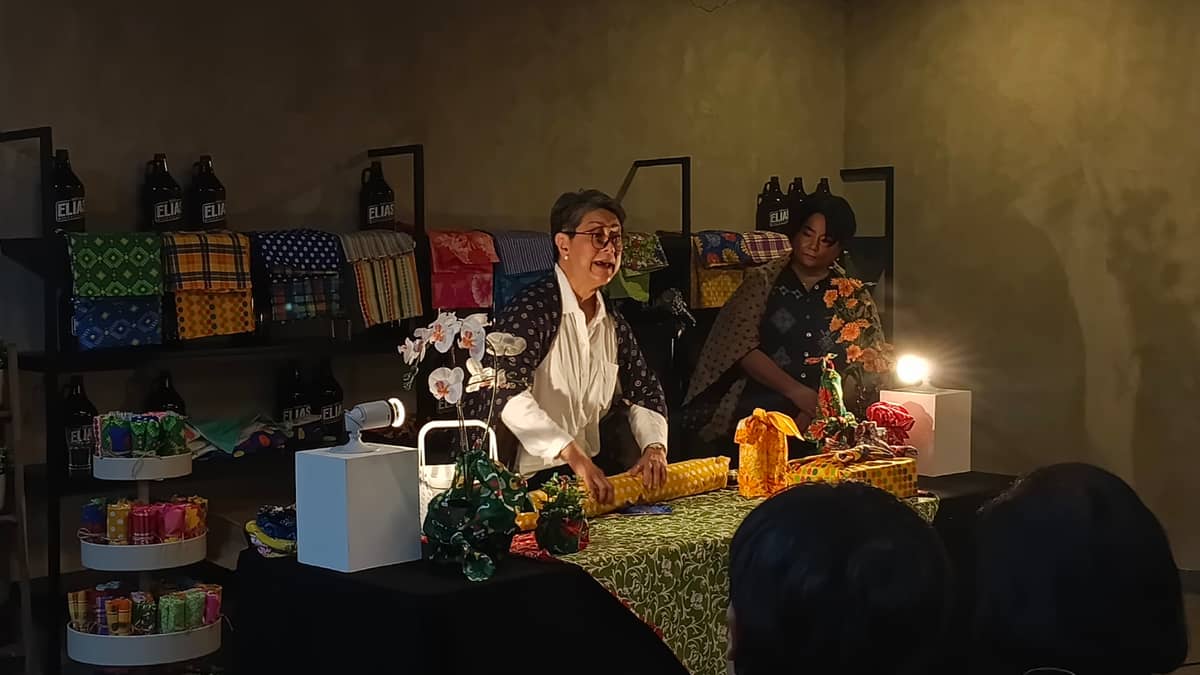
Guest speakers from Ikebana International Chapter 108 – Group 4, Ms. Vicky Ortega and Ms. Neneth Sadiua demonstrating Furoshiki to attendees.
Photograph by Chynna Basillaje for DAILY TRIBUNE
During Ikebana International’s event, Ortega and Sadiua demonstrated how furoshiki can be used to wrap boxes, bottles, and plants, offering a secure and sustainable alternative to conventional wrapping. Its versatility makes it suitable for gift-giving as well as decorating and carrying various household items.
“In furoshiki, you can create all sorts of things. For example, the big cloth that they now have in Japan—many modern Japanese women use furoshiki to carry their dogs. Sometimes, they put a collar around the dog, and when they go to the grocery, they take the dog out and use the furoshiki for their groceries,” Ortega shared.
The etiquette of giving
The speakers also shared the basic rules of furoshiki, emphasizing that the wrapping should always be neat and presentable. In Japan, gifts are not simply wrapped in any piece of cloth and presented at random. Different fabrics, patterns, and designs are chosen depending on the occasion and purpose of the gift.
They also explained that the direction of the folds carries meaning. For happy occasions, the fold should face upward, while for occasions associated with sadness, it should be folded in the opposite direction.
“Because the gift is meant to honor. The wrapping is meant to honor. So, while they use a lot of different cloths now, when it’s for very important occasions, there are cloths and designs that are made for those occasions,” Ortega added.
Going global
Following the informative session and engaging demonstration, Ms. Connie Y. Gonzales shared her knowledge of ikebana, the traditional Japanese art of flower arrangement.
For Gonzales, Japan is a country where culture, tradition, and innovation coexist. Traditional designs can be preserved while also being reinterpreted into something new. She also shared that loving and appreciating the subtleties of nature is an important part of Japanese culture.
To demonstrate this idea, Gonzales used a branch of a Fukien tea plant, a species commonly used for bonsai. She paired it with an antique Coca-Cola bottle purchased in Spain, which her nephew, artist Marco Santos, transformed into a vase by painting and baking it. The arrangement was completed with a small bunch of baby’s breath, which she placed in the middle of the long branch rather than directly on the vase, as is more commonly done.
“I wanted to emphasize the branches, the sculptural, and that is the focus of my arrangement. This is a very nice material, but it doesn’t live long,” she said.
Her presentation provided a fitting close to the program, but not the end of the evening’s visual celebration. Following the demonstration, guests were invited to explore the exhibit, where they could see these principles expressed beyond the demonstrations themselves: Japanese aesthetics interpreted through individual perspectives, with traditional foundations meeting contemporary creativity.
The exhibit features artworks created by its members —Baby Bunag, Cynthia Heussaff, Dellie Yap, Laly San Luis Etroit, Leni Reyes, Lita Morales, Nancy Uy, and Neni Regino— each offering their own interpretation of ikebana through various designs that seamlessly blend with the Eularia showroom and apartment. The exhibit demonstrates how anyone can incorporate and use these Japanese traditions to enhance the look and feel of their homes.
The exhibit served as a natural continuation of Gonzales’ message—that an art form remains alive not by remaining unchanged, but by allowing each generation to discover new ways of expressing it.