
Why Naga city just became Bicol’s most contested address
Naga’s character shows itself in the steady, welcoming pace of church bells, roadside cafés and public plazas — the kind of texture that doesn’t show up in a floor plan.

PRESIDENT Ferdinand R. Marcos Jr. has proclaimed Naga City in Camarines Sur as a highly urbanized city, recognizing its compliance with the requirements set under the Local Government Code of 1991.
There’s a version of “up-and-coming” that gets thrown around so loosely it’s lost all meaning. Naga City is not that. This is a river town of pilgrims and pili nuts that just got promoted, wired itself for artificial intelligence and started stacking condominium towers along its own version of a BGC — all in the same 18 months.
If you know Naga only as the place a million-plus devotees flood every September for the Peñafrancia Festival, it’s time for an update.

NAGA City is pioneering local government artificial intelligence integration in the Philippines under Mayor Leni Robredo.
From component city to player
In May 2026, President Ferdinand Marcos Jr. signed the proclamation making Naga the Philippines’ 34th highly urbanized city (HUC) — a reclassification Mayor Leni Robredo announced on what would have been her late husband and former Naga mayor Jesse Robredo’s 68th birthday.
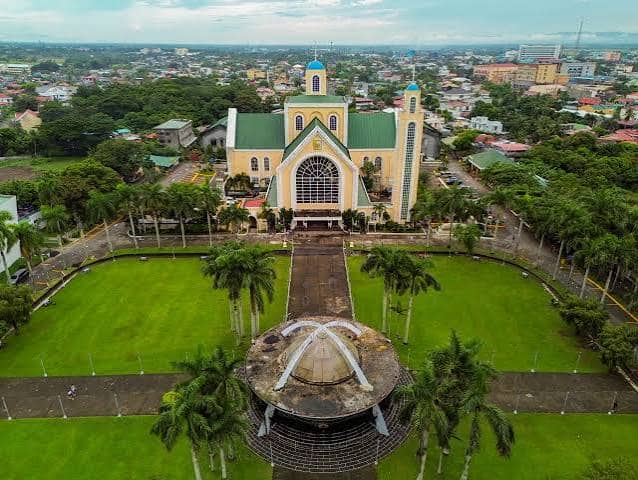
FOUNDED by the Spaniards in 1575 as Ciudad de Caceres (later Nueva Caceres), it is one of the oldest royal cities in the country.
Photographs courtesy of City Government of naga/fb
The numbers behind the upgrade matter to anyone reading this with a spreadsheet open. Naga’s population sits at roughly 210,545 as of the 2024 census and its annual income now surpasses P1 billion — the statutory threshold for HUC status.
HUC status means Naga is prioritized for national flagship projects and, eventually, its own congressional seat — the kind of institutional weight that tends to precede, not follow, a property boom.
The smart city part
This is where Naga separates itself from every other regional capital currently promising “growth.”
In January 2026, the city sealed a partnership with the national Department of Economy, Planning, and Development (DEPDev) to launch the Naga AI City Planner — the first project of its kind in the Philippines, using artificial intelligence to run people-centric transport and land-use planning, monitoring and evaluation.
The P6.7-million grant-funded system feeds maps, mobility data, and project information into a single platform so the city government can plan more like a logistics company and less like a bureaucracy. Robredo has framed it as one piece of a larger ambition: “An Open, Digital and Participatory Naga by 2028.”
Translation, for the property crowd: this is a local government actively engineering walkability, traffic flow and land-use efficiency before density arrives — not scrambling to retrofit it after.
Here’s what a spreadsheet can’t capture. Naga calls itself An Maogmang Lugar — the Happy Place — and it earns the nickname every September, when the Peñafrancia Festival, the largest Marian gathering in Asia, pulls in over 1.8 million devotees for the Traslacion and Fluvial processions along the Naga River. The 2026 edition runs 11 to 22 September, with the feast day on the 20th.
Locals say the whole city softens during festival week — businesses close early, streets fill with flowers and makeshift altars, and even the ferris wheels feel like part of the liturgy rather than a distraction from it.
Beyond the processions, the week folds in the Voyadores Street Dance Competition, the Tagboan Music, Arts and Gastronomy Fest and trade fairs where Bicolano chefs and artisans take over downtown.
The food alone justifies the address. Kinalas — a beef-and-noodle soup best eaten after a long walk — sits next to laing and pinangat, taro leaves simmered in coconut milk and chili, and toasted siopao, a Naga original best paired with coffee from one of the roadside cafés locals actually use, not the ones built for tourists.
Naga’s character, as one travel guide put it, shows itself in the steady, welcoming pace of church bells, roadside cafés and public plazas — the kind of texture that doesn’t show up in a floor plan.