
Habagat, cyclones leave P2.68-B infra damage, P733.84-M agri losses in Ilocos Region

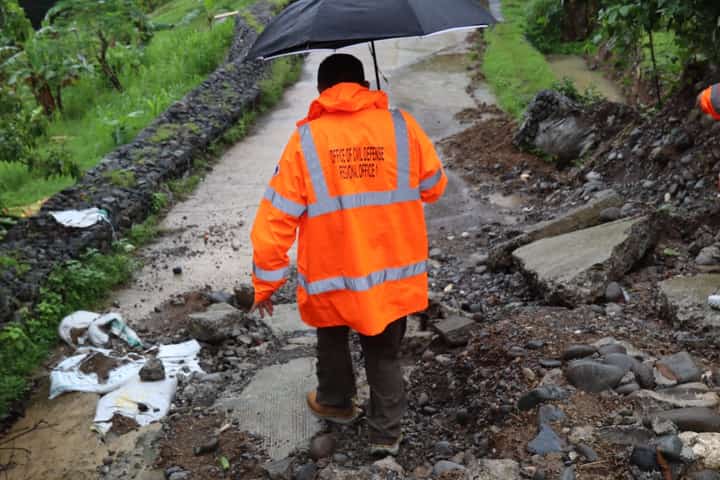
The combined effects of the enhanced southwest monsoon or Habagat and tropical cyclones Luis, Maymay, Neneng and Pilandok left more than P3.41 billion in reported infrastructure damage and agricultural losses across the Ilocos Region, according to the latest regional disaster report as of 4 September 2026.
The Regional Disaster Risk Reduction and Management Council (RDRRMC) Region 1, in its Situational Report No. 36 issued at noon on September 4, reported P2,678,456,012.54 in infrastructure damage and P733,841,428.52 in agricultural production losses and damage, for a combined P3,412,297,441.06.
The report said 630,654 families or 2,259,088 persons in 1,855 barangays across Ilocos Norte, Ilocos Sur, La Union, Pangasinan and Dagupan were affected by the weather disturbances.
Pangasinan recorded the largest affected population with 1,710,195 persons, followed by Dagupan with 266,556, La Union with 168,117, Ilocos Norte with 72,783, and Ilocos Sur with 41,437.
Of the affected population, 4,301 families or 14,026 persons were served inside 181 evacuation centers, while 1,987 families or 6,797 persons were served outside evacuation centers.
The weather disturbances covered several weeks, beginning with Tropical Depression Luis, which developed from a low-pressure area on August 1 and made landfall over Maconacon, Isabela, on August 3 before weakening into a low-pressure area.
On 4 August, a low-pressure area located 180 kilometers west of Bacnotan, La Union, developed into Tropical Depression Maymay. It intensified into a tropical storm before making landfall over Magsingal, Ilocos Sur, at 2 a.m. on August 6. Maymay weakened into a tropical depression later that morning and eventually into a low-pressure area on August 7.
Tropical Depression Neneng developed east of extreme Northern Luzon on August 18 before weakening into a low-pressure area on August 20.
Typhoon Saudel, meanwhile, entered the Philippine Area of Responsibility on August 24 and was assigned the local name Obet. It exited the PAR the same day but continued to enhance the southwest monsoon before weakening while moving away from the Philippine landmass.
Tropical Depression Pilandok developed on 30 August from a low-pressure area east of extreme Northern Luzon. It intensified into a tropical storm on 1 September but remained far from the Philippine landmass and exited the PAR on 3 September.
As of 4 September, Pilandok remained outside the PAR and was no longer directly affecting the Philippines.
The disaster council reported four confirmed deaths in the region, including three in Pangasinan and one in La Union. One injury in Ilocos Sur remained for validation, while no missing persons were reported.
Flooding, rain-induced landslides and fallen trees were also reported in Pangasinan, Dagupan, La Union and Ilocos Sur.
The regional tally included 26 flooded areas, 271 areas with subsiding floodwaters, 59 areas where flooding was receding, 30 rain-induced landslides and four fallen trees.
Pangasinan recorded 25 flooded areas, 172 areas with subsiding floodwaters, 32 areas where flooding was receding and 14 rain-induced landslides.
Dagupan reported five areas with subsiding flooding and 26 areas where floodwaters were receding. La Union recorded one flooded area, 35 areas with subsiding flooding, one receding area and six landslides. Ilocos Sur reported 59 areas with subsiding flooding, 10 landslides and four fallen trees.
Transportation infrastructure was also affected, with 298 road sections and 10 bridges reported affected.
Of these, 34 road sections and two bridges remained not passable, while 264 road sections and eight bridges previously reported as not passable or passable only through one lane were listed as passable.
Pangasinan had the highest number of still-not-passable road sections at 24, followed by La Union with five, Ilocos Sur with four and Dagupan with one. No road section or bridge in Ilocos Norte was listed as not passable.
Infrastructure damage was estimated at P2,678,456,012.54.
La Union accounted for the largest reported amount at P1,690,947,142.61, followed by Ilocos Sur with P481,921,040, Ilocos Norte with P320,767,829.93, and Pangasinan with P184,820,000.
The report also listed 876 damaged houses, consisting of 823 partially damaged and 53 totally damaged houses.
Ilocos Sur recorded 417 damaged houses, Pangasinan 372 and La Union 87.
Agriculture also sustained significant losses, with the Department of Agriculture reporting 21,620 farmers and fisherfolk affected and 13,565.56 hectares of agricultural areas affected.
Reported production losses reached 15,973.44 metric tons, while the estimated production loss and cost of damage totaled P733,841,428.52.
Pangasinan accounted for P599,528,727.56 of the agricultural losses, followed by La Union with P114,106,653.98, Ilocos Sur with P18,058,052.75, and Ilocos Norte with P2,147,994.23.
The National Irrigation Administration reported no damaged irrigation infrastructure in the regional tally.
Despite the widespread effects, power supply had been restored in all 30 cities and municipalities previously affected. Water supply was also restored in five affected areas, while communication lines were restored in five areas.
Two seaports were affected, with one listed as operational and trips resumed while another remained under the non-operational or cancelled-trips category in the latest data.
A total of 48 cities and municipalities were declared under a state of calamity, including 47 in Pangasinan and one in Dagupan.
Meanwhile, 897 families or 2,706 persons were preemptively evacuated. La Union accounted for 1,415 of those evacuees from 446 families, followed by Pangasinan with 808 persons from 276 families, Ilocos Sur with 293 persons from 110 families, and Dagupan with 190 persons from 65 families.
Classes were suspended in 125 cities and municipalities, including 47 in Pangasinan, 34 in Ilocos Sur, 23 in Ilocos Norte, 20 in La Union and one in Dagupan. Work suspensions were likewise reported in 125 areas.
The RDRRMC also reported that 499,935 families required assistance. Of these, 416,818 families had been assisted, representing 83.37 percent, with assistance amounting to P420,611,532.07.
Pangasinan had the highest number of families requiring assistance at 376,653, with 313,087 already assisted.
La Union posted the highest assistance rate among the provinces at 93.57 percent, with 33,707 of 36,023 families requiring assistance already served.
As of September 4, the RDRRMC reported no outstanding needs, with continuous monitoring to continue as the Ilocos Region recovers from the combined effects of the enhanced southwest monsoon and the tropical cyclones.