




Paraborgs: drug-delivering insects in the making
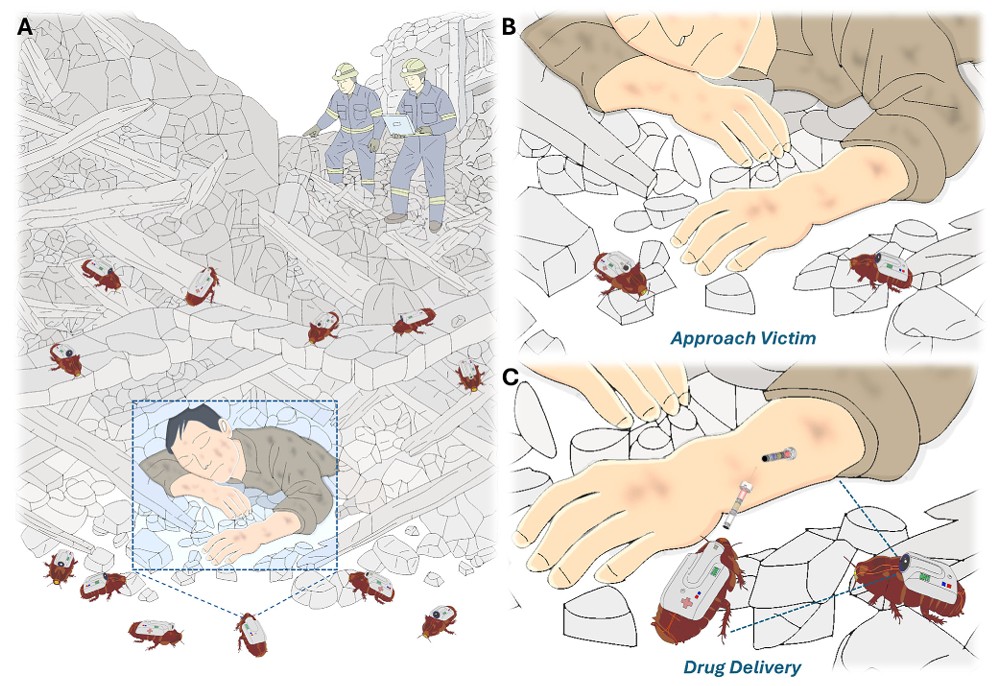
Tentative scenario for real-world deployment of Paraborgs.
Screenshot from Paraborg: Paramedic Cyborg Insects for In Situ Emergency Drug-Delivery
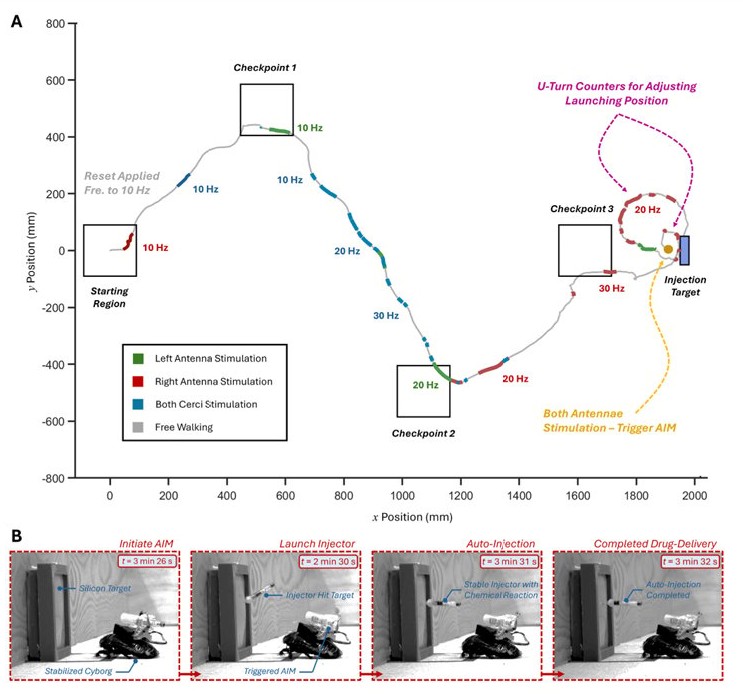
Representative trial of successful in situ drug-delivery by single paramedic cyborg cockroach.
Screenshot from Paraborg: Paramedic Cyborg Insects for In Situ Emergency Drug-Delivery
Scientists in Australia have engineered remote-controlled "cyborg" cockroaches designed to navigate disaster zones and administer emergency medication to trapped survivors.
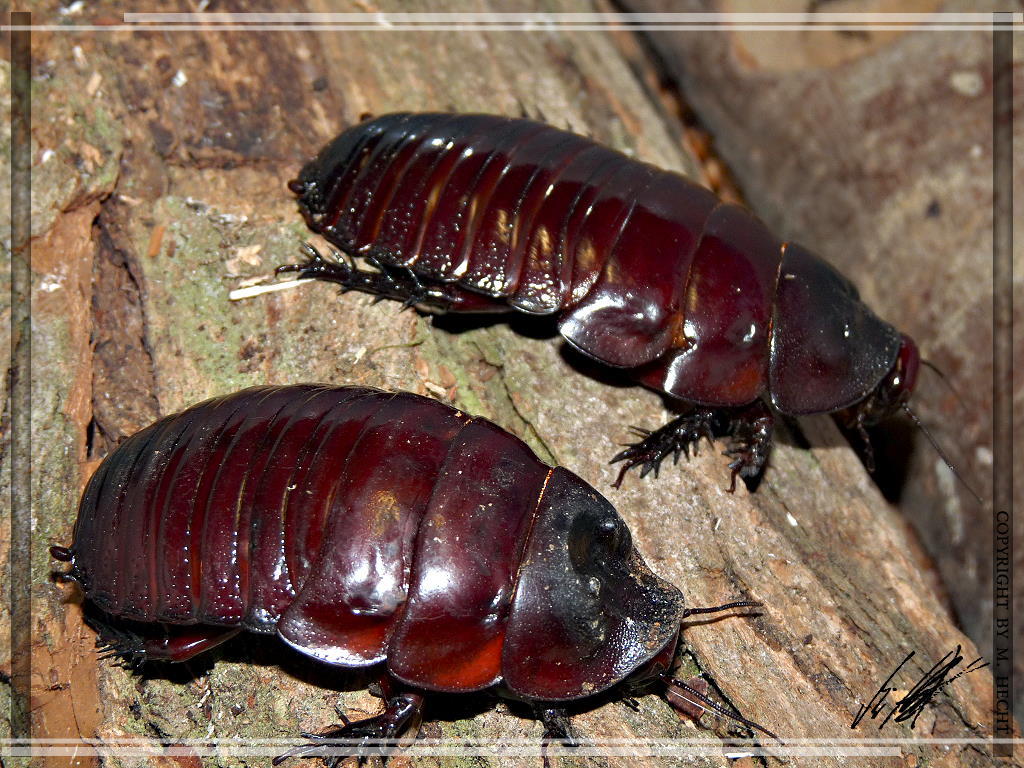
Named "Paraborgs" by researchers from the University of Queensland and the University of New South Wales, the biohybrid insects are built using North Queensland giant burrowing cockroaches or Macropanesthia rhinoceros.
Each insect is fitted with a removable electronic backpack and implanted electrodes, allowing human operators to steer them precisely through tight, confined spaces.
In a recent study titled “Paraborg: Paramedic Cyborg Insects for In Situ Emergency Drug-Delivery,” the team detailed a system featuring a human-supervised auto-injection mechanism (AIM) and an onboard camera. This setup enables needle-based liquid drug delivery managed by multiple teleoperated units working in tandem.
Laboratory trials demonstrated the system's viability across several key metrics such as manual control strategy and achieved a 100% success rate in reaching designated checkpoint, while operators achieved a 72% success rate in positioning the cyborg cockroaches for a targeted injection.
The compact auto-injection mechanism successfully launched and delivered liquid medication with a 90% overall success rate, jumping to 95% for close-range deployments within 150 millimeters of the target.
Three decades after the Marcopper mining disaster devastated Marinduque’s waterways, the province is again pressing the…
Housing is probably the biggest issue affecting people the world over.
Malacañang on Monday called for a more thorough investigation into the questioned flood control projects in Taguig…
The defense on Monday backed the move by senator-judges to exclude a prosecution witness who testified on the firearms…
The technology relies on specialized teamwork. In demonstrations, one cyborg cockroach equipped with a Wi-Fi camera scouted ahead to provide a live point-of-view feed, while a second unit carrying the miniature auto-injection mechanism delivered the payload via needle.
While the concept opens new possibilities for search-and-rescue operations, the technology remains in the experimental phase.
No medications have yet been delivered to human subjects, and extensive safety and field testing are required before medical deployment.
The research team envisions deploying coordinated swarms within the decade, where individual insects carry specialized roles such as environmental sensors, cameras, or emergency medical supplies.
