
TESDA, DA push urban agriculture
‘I have always believed that Filipinos have a special gift. Give us a small patch of land, a rooftop, a balcony or even a few recycled containers, and before long, someone has turned them into a thriving garden.’
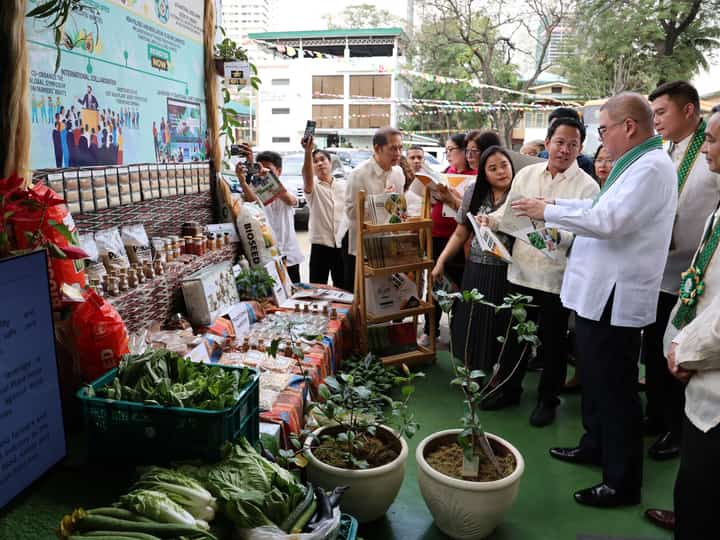
Agriculture Secretary Francisco P. Tiu Laurel Jr. (right) stated that skills development is ultimately about creating opportunities for people, noting that through their partnership with TESDA, the Department of Agriculture i giving Filipinos practical skills through urban farming that they can use to earn a living, start an enterprise, and contribute to food security in their own communities.
PHOTOGRAPH courtesy of DA
The Technical Education and Skills Development Authority (TESDA) and the Department of Agriculture (DA) have joined in a bid to provide opportunities to gain skills in urban agriculture and turn them into livelihood and enterprise opportunities to institutionalize urban and peri-urban agriculture (UPA) skills training nationwide.
TESDA Secretary Kiko Benitez and Agriculture Secretary Francisco Tiu Laurel Jr. recently sealed the partnership that will pave the way for the development of competency standards, training programs, and the Urban Agriculture Production National Certificate (NC II), giving Filipinos a nationally recognized qualification in urban agriculture.
The implementation of the initiative will be led by the TESDA Green Technology Center (GTC), in collaboration with the DA-BPI, particularly its NUPAP, to ensure that the training programs are grounded in appropriate, modern, and climate-smart urban agriculture technologies and practices.
For individuals seeking livelihood opportunities, the initiative can provide pathways to employment, entrepreneurship, and community-based food production.
For communities, it can help build local capacity to produce food using modern and climate-smart technologies, even in areas where conventional agricultural space is limited.
“Skills development is ultimately about creating opportunities for people. Through this partnership with DA, we are giving Filipinos practical skills that they can use to earn a living, start an enterprise, and contribute to food security in their own communities,” Sec. Kiko said.
“At TESDA, we believe that skills transform lives. This convergence ensures that learning goes beyond the classroom and translates into sustainable livelihoods, entrepreneurship, and stronger, more resilient communities,” he added.
For his part, Secretary Tiu Laurel said the initiative draws on a distinctly Filipino ingenuity that became particularly evident during the Covid-19 pandemic, when Filipinos transformed rooftops, vacant lots, and other unused spaces into productive vegetable gardens.
“I have always believed that Filipinos have a special gift. Give us a small patch of land, a rooftop, a balcony or even a few recycled containers, and before long, someone has turned them into a thriving garden. We are, by nature, nurturers. Today, our task is to match that instinct with knowledge, skills, and opportunity,” the Agriculture chief said.
To make these opportunities more accessible and relevant to communities, TESDA and DA will establish technology demonstration hubs and strengthen the capacity of trainers, assessors, and partner institutions nationwide. These facilities will showcase practical applications of urban agriculture that learners can adopt and replicate in their own homes, communities, or enterprises.
As part of the initiative, the TESDA Complex in Taguig will be developed as a flagship Urban Agriculture Technology Demonstration and Training Center, featuring modern and climate-smart farming technologies such as hydroponics, vertical farming, container gardening, composting, and other innovative production systems.
The demonstration center will serve as a learning and knowledge-sharing facility where trainers, learners, community members, and partner institutions can gain hands-on exposure to technologies suited for urban and peri-urban environments.
Through competency-based training and nationally recognized certification, TESDA and DA aim to build a pool of skilled and certified urban agriculture practitioners who can contribute to local food production while pursuing employment and entrepreneurship opportunities.
Beyond developing technical skills, the partnership seeks to bring practical solutions closer to Filipinos by enabling communities to make productive use of available spaces, adopt modern farming technologies, and develop sustainable sources of food and income.
The collaboration supports the government’s broader goals of strengthening food security, promoting climate-resilient and sustainable communities, and expanding inclusive economic opportunities through skills development.