
Where patience flowers
In his latest exhibition, Erikson Arcilla turns orchids, moss and weathered limestone into a meditation on endurance, belonging and the slow arrival of beauty.


Beauty does not always emerge from abundance. Sometimes, it takes root in the cracks of stone, gathers strength through years of waiting and flowers where the landscape appears least hospitable.
This quiet but persistent process lies at the heart of The Longest Wait Makes the Prettiest Flowers, the latest solo exhibition of Quezon City-based artist Erikson Arcilla at Art Underground Manila.
In the new body of work, Arcilla draws attention to an unlikely yet self-sustaining ecosystem: weathered limestone gradually covered by moss and, rising from this softened surface, the delicate bloom of an orchid. The paintings examine the intimate relationship among these three natural forms — one hardened by time, another slowly spreading across it, and the last waiting for the proper conditions in which to flower.
Rendered in oil with careful attention to surface and detail, Arcilla’s compositions bring out the chalky texture and fractures of limestone, the dense softness of moss and the near-translucent quality of orchid petals. These contrasts lend the works their visual tension. The durable and the delicate do not merely occupy the same space; they depend upon and transform one another.
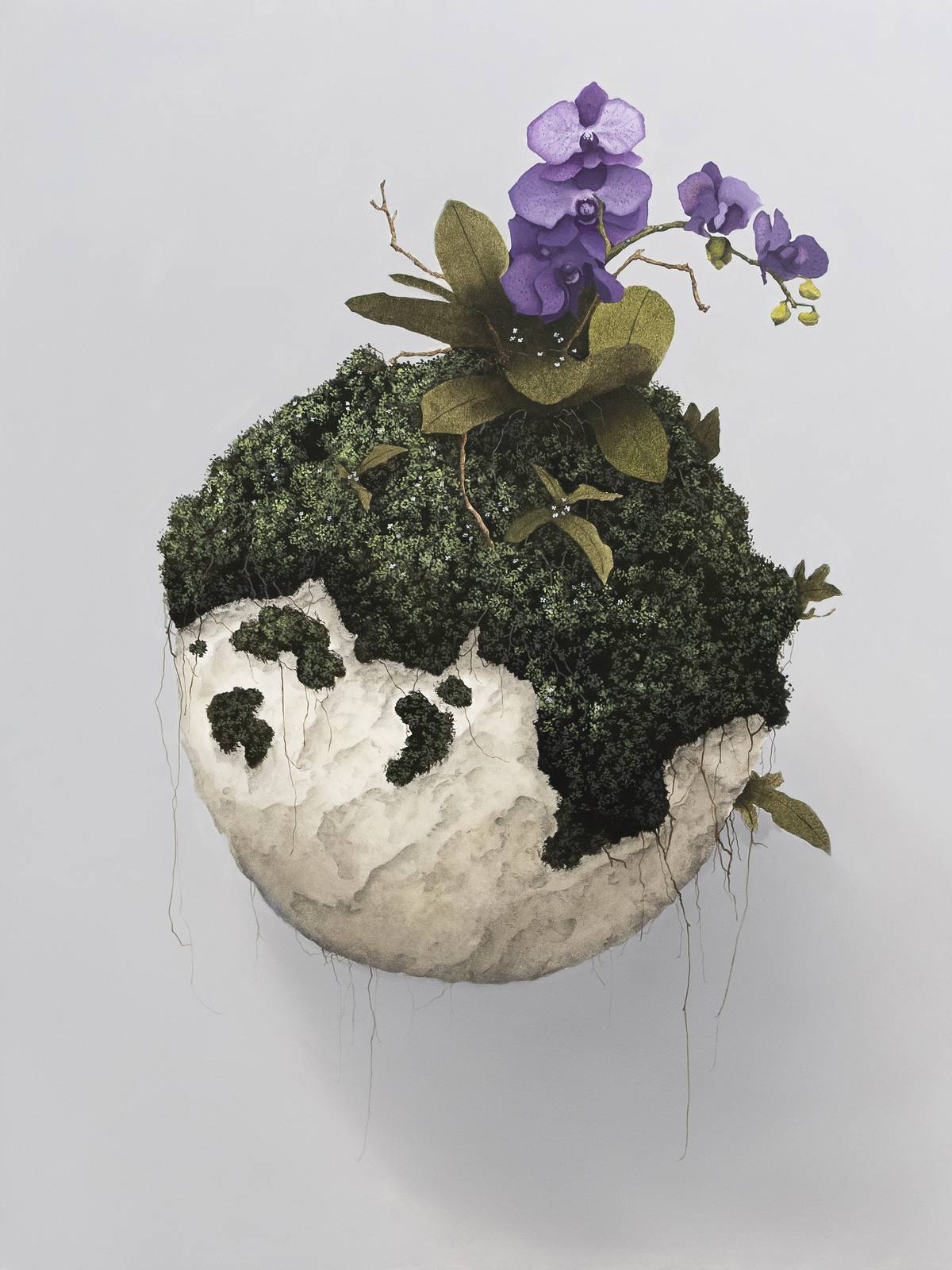
‘Quiet Violets,’ (48by36 inches, 2026).
The paintings unfold at an intentionally unhurried pace. Rather than presenting nature at its most dramatic, Arcilla focuses on gradual processes that often escape notice. The stone bears traces of the seasons it has endured. Moss slowly settles upon and softens its hard exterior. The orchid, after a long period of preparation, finally emerges.
In this sense, the exhibition is as much about time as it is about the natural world. Growth is portrayed not as a sudden miracle but as the result of persistence — the steady claiming of a surface that initially seems to offer little nourishment or welcome.
Arcilla’s orchids are neither ornamental additions nor fragile forms subordinated to the rocks supporting them. They possess a presence of their own, asserting their shape and character against an environment that might have prevented them from thriving. Rooted in the landscape and inevitably shaped by it, they nevertheless remain distinct.
Through this relationship, the artist considers the difference between belonging to something and becoming indistinguishable from it. The paintings suggest that integration need not require the loss of individuality. One may be shaped by a place, a community or an experience while retaining a sense of self.
The landscape consequently becomes a metaphor for human emotional life. Hardship, adaptation and renewal appear through natural forms rather than narrative scenes. What initially seems barren may, over time, become capable of sustaining life. Fragility, meanwhile, is not presented as weakness but as a form of resilience — an ability to survive long enough to bloom.
Born in 1992, Arcilla has built a practice centered on giving visual form to human emotions. Working primarily in oil, he creates images through which viewers may recognize aspects of their own experiences and emotional states. His practice received an unusual distinction through its inclusion in the Lunar Codex, a digital archive of creative works sent to the moon.
With The Longest Wait Makes the Prettiest Flowers, Arcilla offers no spectacle of instantaneous transformation. Instead, he turns to the older rhythms of the natural world, where change takes place through accumulation, weathering and patient growth.
The title’s “longest wait” is therefore not an empty interval or a postponement of life. It is itself part of becoming — the unseen and often difficult process preceding the moment when something is finally ready to reveal its fullest form.
The Longest Wait Makes the Prettiest Flowers runs from 21 July to 10 August at Art Underground Manila, second floor, Mabini180, 180 A. Mabini Street, Addition Hills, San Juan City.