
Phl files diplomatic protest vs Chinese-state-run media 'racist' post portraying Pinoys as monkeys
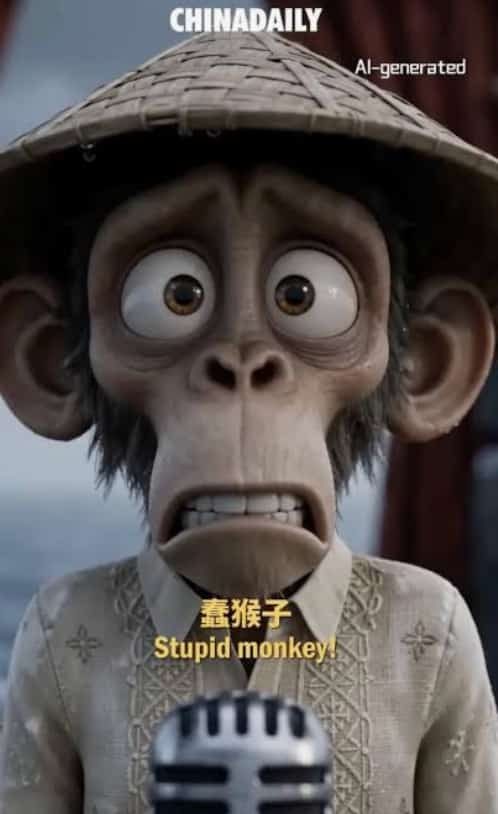
The Philippines has lodged a diplomatic protest against the barrage of “racist” and “offensive” editorial cartoons of the Beijing state-controlled media outlet China Daily, particularly an AI-generated video portraying the country as a monkey controlled by the United States and Japan, as part of its fresh effort to undermine the 2016 arbitral ruling.
The Department of Foreign Affairs (DFA) said Friday that the filing was the result of China’s blatant disregard for the Philippines’ request to immediately take down the materials, as it goes against the two nations' shared commitment to mutual respect despite their longstanding maritime row in the West Philippine Sea.
Chinese Ambassador to the Philippines Jing Quan was personally notified about the appeal on Thursday, according to the DFA, though no action was taken.
In rebuking China Daily’s editorial cartoons and videos, the DFA argued that the state-controlled media “went beyond legitimate political debate by resorting to demeaning, dehumanizing, and racist depictions of Filipinos.”
“The department remains committed to dialogue and diplomacy in its engagement with China, but will not hesitate to call out discriminatory and offensive rhetoric whatever happens,” the DFA stressed.
The department added that the Philippine-China disagreement over legal and political issues cannot be invoked as justification for such use of the imagery, drawing a firm line against discriminatory propaganda.
China Daily has a long history of editorial cartoons ridiculing Manila over its robust stance in the WPS, but what crossed the line was the AI-generated video depicting the Philippines as a monkey dressed in a Barong Tagalog and a salakot.
The minute-long video was posted on 10 July, two days before the 10th anniversary of the 2016 landmark ruling handed down by the Hague-based Permanent Court of Arbitration that ruled in favor of Manila and unanimously dismissed Beijing’s sweeping claims in the WPS as invalid and baseless.
A portion of the video showed the monkey was holding the South China Sea Arbitration Award before it was shoved by figures representing the US and Japan into the sea, and was blasted with a water cannon.
The video had not been taken down as of press time.
Senators joined the DFA in calling for the immediate take-down of the “racist stereotype” video, with Senator Kiko Pangilinan demanding that Beijing should order China Daily to come up with a public apology and hold to account those responsible for its release.
Senate President Win Gatchalian and Senator Robn Padilla are one in saying that freedom of expression is “not a license” or "excuse" for China Daily to dehumanize, mock, and humiliate Filipinos, adding that opposing stances between Manila and Beijing should be addressed through diplomacy and respect.
In the same vein, Senator Migz Zubiri lamented that “China has crossed the line, but we will take the high road and refuse to answer such provocation with the same contempt.”
Although the Philippines and China have kept their friendly ties, the two nations have also long been embroiled in a maritime row over Beijing’s expansive claims in almost the entire SCS, including areas that overlap with the WPS.
The 2016 arbitral ruling invalidated China’s nine-dash line claims over the vast majority of the SCS, asserting that it has no legal basis under international law.
China has never honored the decision, calling it “a worthless piece of paper that is illegal, null and void, and has no binding force” in Beijing.
As the Philippines marked a decade since the arbitral award on 12 July, 13 countries allied with Manila, including the US, Japan, Australia, Canada, and the United Kingdom, strongly urged China to abide by the ruling, which they affirmed as “final, legally binding and definitive” consistent with international law.