
Jesus’ real presence
As long as the rite is performed validly (correctly and with the correct intention), the grace is objectively offered.
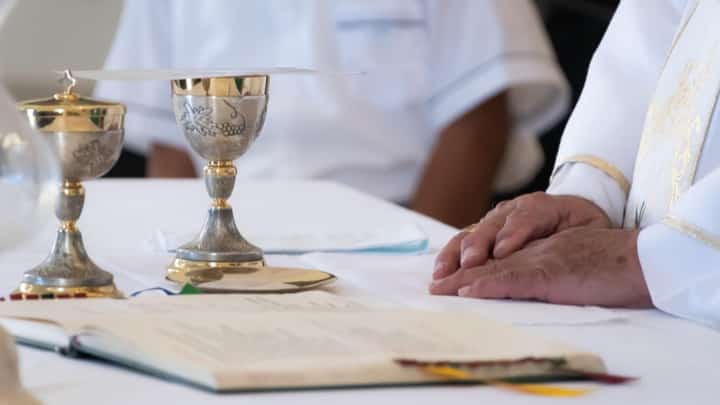
During one of our classes on Liturgy at the CICM Maryhill School of Theology, our professor Sr. Maria Cecilia Maulino Payawal, PDDM would always say “We bring Christ’s presence.”
Every time we celebrate the Eucharist, we experience the abiding presence of a loving God as Emmanuel — God with us — in order to give collective thanks to our Lord for his living with us in the Eucharist.
The feast of Corpus Christi gives us an occasion to learn more about the importance and value of the “Real Presence” of Jesus in the Eucharist so that we may appreciate the Infinite Value of the Sacrament by adoring and receiving Jesus in it. Jesus on Holy Thursday, gave the Holy Eucharist as our spiritual food.
Jesus instituted the Holy Eucharist during his Last Supper. He commanded his disciples to repeat it in his memory.
Here I can mention “transubstantiation” which means that the substance of the consecrated bread and wine is changed, by the action of the Holy Spirit at the Epiklesis through the words of the priest, “This is my body, this is my blood,” into the substance of the risen Jesus’s glorified Body and Blood, Soul and Divinity, while its accidents (color, shape, taste etc.) remain unchanged.
The Church, through the Holy Mass, makes present again the Sacramental Self-offering Jesus makes on Calvary.
Jesus instituted the Holy Eucharist both as a sacramental banquet and a sacrificial offering.
1) As a Sacrament:
a) The Eucharist is a visible sign that gives us God’s grace and His life and,
b) as a meal, it nourishes our souls.
2) As a sacrifice:
a) The Eucharistic celebration is a reenactment of Jesus’s sacrifice on Calvary, completed in His Resurrection.
b) We offer Jesus’s sacrifice to God the Father for the remission of our sins, using signs and symbols.
Allow me to tell you, my dear friends, that the grace we receive from the Sacraments does not depend on the minister — whether the presider or minister is sinful, living an immoral life, full of vices and more — it does not affect the graces we are to receive every time we attend Mass and receive Holy Communion, go to Confession and participate in other Sacraments like Baptism, Confirmation, Marriage and Ordinations.
“Ex opere operato” is a Latin theological phrase that translates to “by the very fact of the action’s being performed.” In Christian sacramental theology, it means the sacraments confer grace based on the inherent power of Christ’s sacrifice, independent of the personal holiness of the minister or recipient.
A sacrament remains valid and effective even if the priest or minister celebrating it lacks personal holiness or faith.
The sacraments derive their efficacy directly from God, not from human virtue. As long as the rite is performed validly (correctly and with the correct intention), the grace is objectively offered.
While grace is always available when a valid sacrament is performed, fully receiving its spiritual fruits still requires the recipient to have an open heart and the proper disposition.