
UN, gov’t agencies bare actions to Very Strong El Niño
PAGASA provides localized agrometeorological advisories to help farmers adopt climate-resilient agricultural practices.
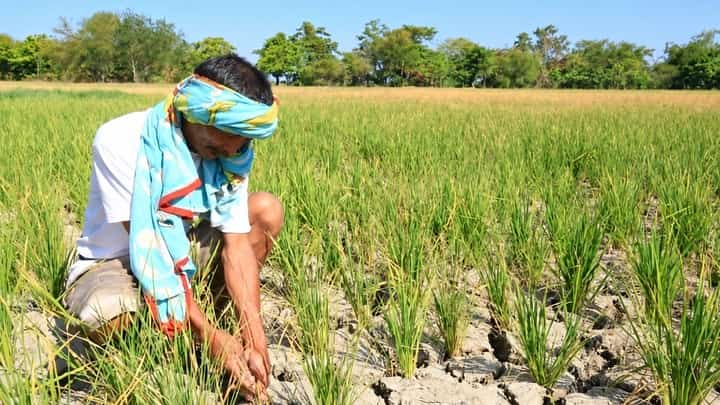
United Nations agencies in the Philippines are beefing up the government’s response to the Very Strong El Niño (VSEN) as drought already hit nine provinces while 109 areas have declared a state of calamity due to the weather phenomenon.
Speaking at the United Nations press briefing on El Niño and early action on climate shocks at the IOM office in Makati City last 22 October, Ana Liza S. Solis, chief of the Climate Monitoring and Prediction Section of the Climatology and Agrometeorology Division of the Philippine Atmospheric, Geophysical and Astronomical Services Administration (PAGASA) identified the nine provinces as Albay, Camarines Norte, Camarines Sur, Catanduanes, Leyte, Negros Oriental, Samar, Siquijor and Misamis Oriental.
Solis also mentioned 32 provinces under a dry spell and 14 provinces under dry condition, all identifiable in the PAGASA website’s El Niño monitoring page. Areas under a state of calamity are in all the mentioned provinces, she added.
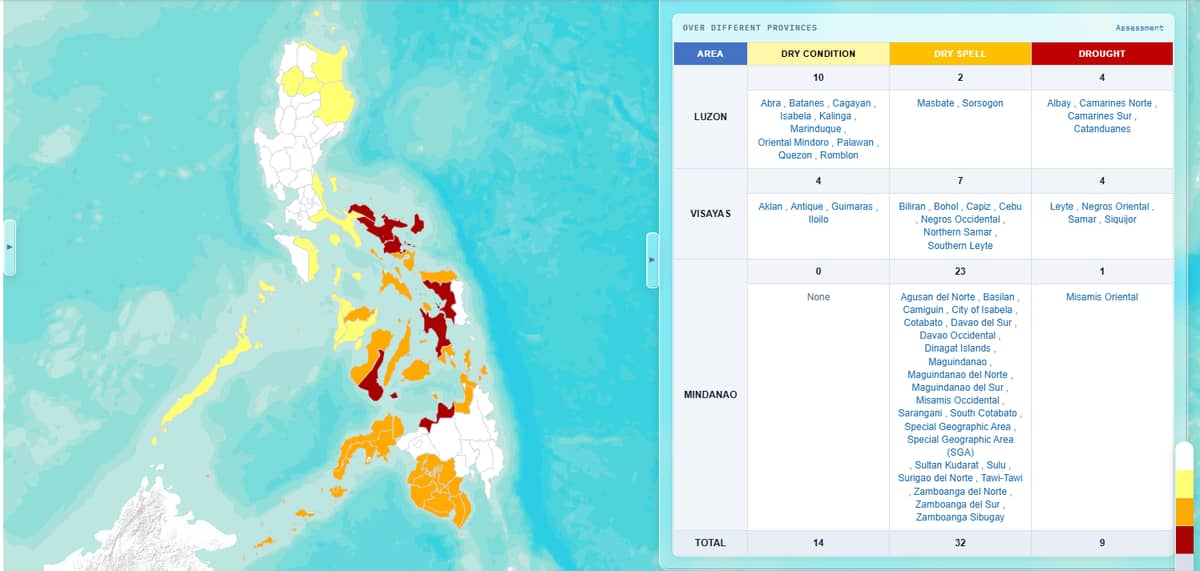
A PAGASA map of the Very Strong El Niño impact in the country shows affected areas in varying intensity.
MAP COURTESY OF PAGASA
VSEN, which is characterized by higher probability of below-normal rainfall and warmer temperatures in many parts of the country, started as early as June and PAGASA predicts it will last until May 2027, according to Solis. The weather condition could affect water availability, agriculture production, energy demand and workforce productivity, she warned.
Areas along the western section of the country were the first to experience a significant rainfall reduction and this region’s dry spell is expected to last until the first quarter of 2027, Solis explained.
“As the rainy season eases, the dry spell and drought in the western part of the country may ease, while parts of the Visayas and Mindanao could still experience dry conditions,” she said.
PAGASA’s role, Solis said, is to provide localized agrometeorological advisories to help farmers in 100 municipalities across 9 provinces and 5 regions adopt climate-resilient agricultural practices. The agency also provides climate services to the Bangsamoro Autonomous Region in Muslim Mindanao.
“Our goal here is to transform early warnings into early actions,” Solis told reporters. “Reliable climate information combined with effective risk management reduces losses and builds long-term resilience.”
Meanwhile, Solis revealed that PAGASA is still developing its impact-based forecasting and early warning system for drought or the anticipatory action framework for drought following the signing of the implementing rules and regulations for Republic Act 12287 or the Declaration of State of Imminent Disaster Act (DSIDA), which institutionalizes anticipatory action and allows a state of imminent disaster to be declared before a calamity occurs.
The agency is working with the Department of Agriculture, Bureau of Soils and Water Management, and the Philippine Space Agency to develop a national and government-led triggers and threshold for anticipatory action for drought.
Jose Barber, representing the Office of Civil Defense (OCD), which is the implementing arm of the National Disaster Risk Reduction and Management Council, said the agency’s preparedness goes beyond contingency plans and emergency supplies.”
The OIC for policy development and planning service of the OCD said the agency positions essential supplies, facilitates early evacuation where necessary, protects critical families, supports vulnerable households, and safeguards livelihoods and food supplies.
“The preparations are adequate, including bottled water, rice, water filtration and desalination systems, generators, family packs, kitchen kits, and so forth and so on. And we have also the pre-action plan easily available for those who have declared a state of calamity,” Barber said.
Both PAGASA and OCD work with other national agencies, local government units and the UN agencies, such as the Philippines offices of the Food and Agriculture Organization (FAOP), International Organization for Migration (IOMP), United Nations Development Program, United Nations Children’s Emergency Fund (UNICEFP), World Food Program (WFPP) and World Health Organization (WHOP).
Barber also gave an update on the implementation of the DSIDA. He said LGUs may complete the operational guidelines (OG) for the law’s IRR in the next three to four months. Pending the OGs, city and town leaders can still declare a state of calamity for the funding of disaster response.
Meanwhile, WFPP representative and country director Regis Chapman said they are working on providing technical assistance to government partners for evidence generation. He added that WFPP supports the Department of Social Welfare and Development’s (DSWD) Project LAWA and BINHI, which gives communities cash incentives for building or improving small farm reservoirs, rain-harvesting facilities, irrigation systems; rehabilitating waterways; and growing vegetables for food security during drought.
Dulce Carandang, assistant representative for program of FAOP, said her agency worked with the Department of Agriculture and DSWD in piloting drought anticipatory action in Echague, Isabela that involved cash transfers, tools, inputs and training for some 900 farming households.
Carandang added that FAOP will soon deploy six mobile solar irrigation pump system and one high-density polyethylene fish cage in Isabela and Cagayan to help some 10,000 farmers and fishers protect their livelihood.
IOMP chief of mission Tristan Burnett said it is working with the government in identifying recipients of the Climate Mobility Investment Plan, which helps barangay or municipality in a flood-prone hotspot fund locally identified adaptation measures, rather than relying solely on post-disaster rehabilitation funds.